Home › Territories & Regions › Macau
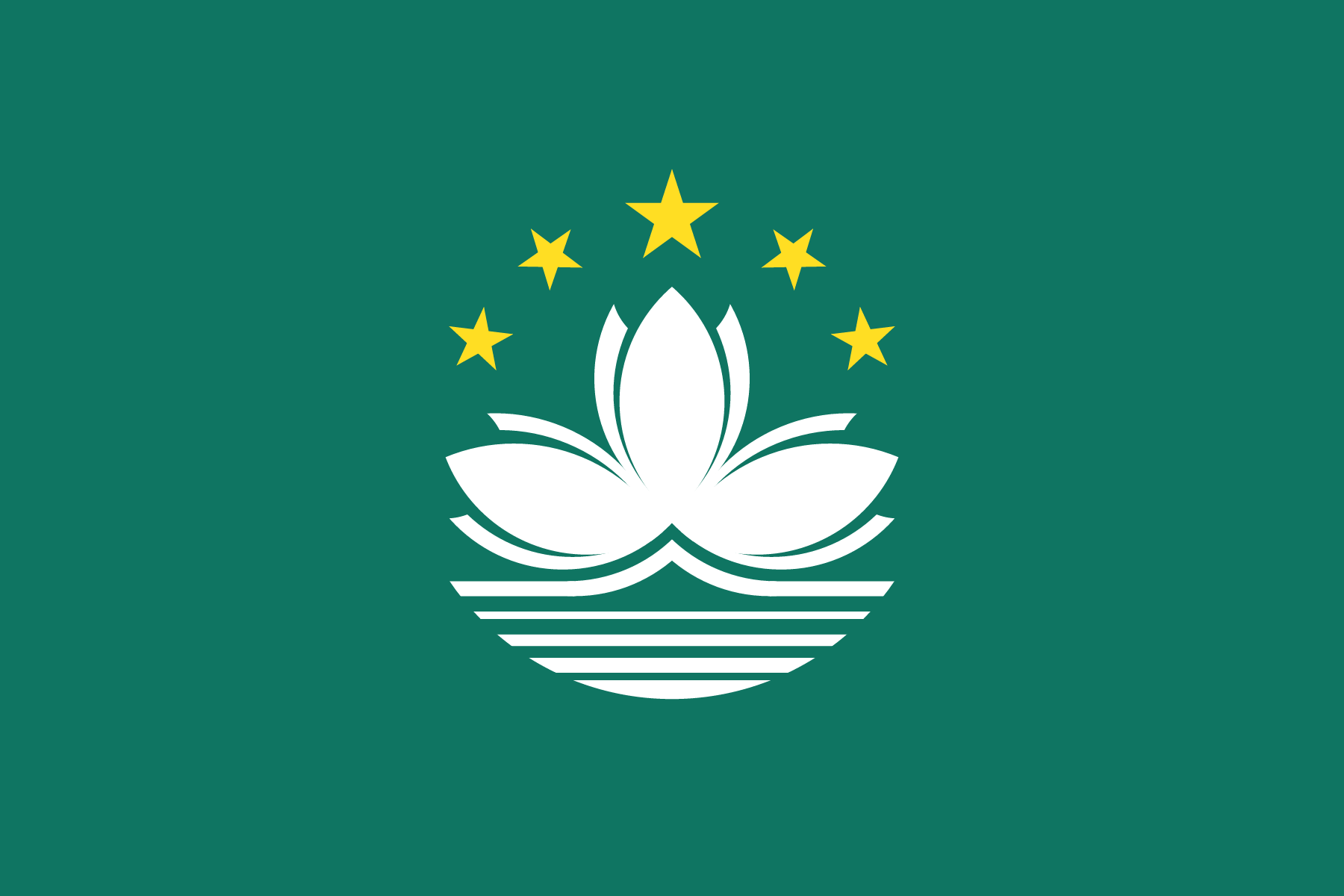
Flag of Macau
A green field with a white lotus over a bridge, beneath five stars.
The flag of Macau has a green field with a white lotus flower in the centre, sitting above a stylised bridge and water, beneath an arc of five yellow stars. Macau is a Special Administrative Region of the People's Republic of China, on the southern coast of China, governed under the principle of “one country, two systems”.
About the Macau flag
The design was adopted in 1993 and first flown on 20 December 1999, when sovereignty over Macau passed from Portugal to China after more than four centuries of Portuguese presence. The white lotus is Macau's floral emblem, and its three petals stand for Macau's three parts — the peninsula and the islands of Taipa and Coloane. Beneath it, a stylised bridge and water represent the sea around Macau and the bridges that connect it. The five stars echo those on the national flag of China, and the green field is a colour long associated with the territory.
Macau flag colours
The Macau flag uses three colours. These are the approximate shades if you're recreating it:
Macau flag facts
Frequently asked questions
What does the flag look like?
A green field with a white lotus over a bridge and water, beneath an arc of five yellow stars.
What do the lotus and bridge mean?
The lotus is Macau's emblem — its three petals = Macau's three parts (peninsula, Taipa, Coloane); the bridge and water = the sea and the bridges linking them.
Is Macau part of China?
Yes — a Special Administrative Region of China under "one country, two systems", with its own flag. A former Portuguese territory, it returned to China in 1999. Not a separate UN country, so it sits here under Territories & Regions.
When was the flag first used?
Adopted in 1993 and first flown on 20 December 1999, at the handover from Portugal to China.