Caribbean
Puerto Rico Flag
Explore Puerto Rico's flag history, symbolism, geography and facts — the five red and white stripes, the blue triangle with its lone white star, and the flag's close link to the Cuban flag.
Capital
San Juan
Region
Caribbean
Population
3.2 million
Status & key facts
Political status
US territory
Unincorporated, organized
Currency
US Dollar
USD ($)
Sovereign state
United States
Territory since 1898
🌡️ Climate: Tropical — warm and humid, with a hurricane season from June to November
Flag symbolism
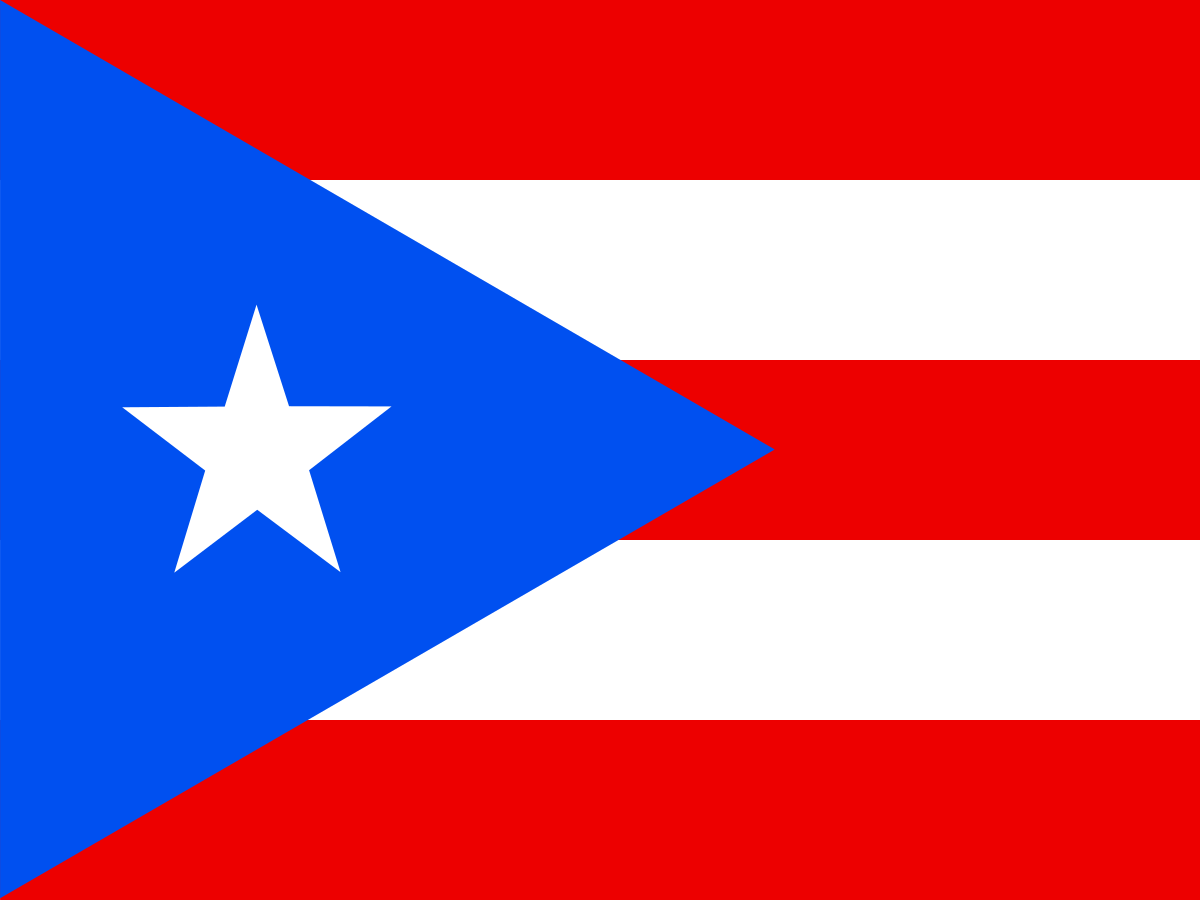
Five stripes — three red and two white — with a blue triangle at the hoist bearing a single white five-pointed star. The star is generally taken to represent the island itself, and the three sides of the triangle the three branches of government.
lone startrianglestripes
Did you know?
The Puerto Rican flag is a near-mirror of the Cuban flag: the two were designed as a pair, with the red and blue swapped between them, as a symbol of solidarity between the islands' nineteenth-century independence movements.
Test your knowledge
Think you know your world flags? Try the FlagAtlas daily challenge, speed quiz, or explore all the territory flags.
📚 Revising for GCSE Geography? Visit our free revision page →
About Puerto Rico
Puerto Rico is a Caribbean island and an unincorporated territory of the United States, lying in the north-eastern Caribbean Sea within the Greater Antilles. It sits east of the Dominican Republic and west of the U.S. and British Virgin Islands, with the Atlantic Ocean to the north and the Caribbean Sea to the south.
San Juan is the capital and largest city. Puerto Ricans have been United States citizens since 1917, and the island has its own constitution and elected governor while remaining under overall U.S. sovereignty. Spanish and English are both official languages.
CapitalSan Juan
RegionCaribbean / Greater Antilles
PopulationAbout 3.2m
Area9,104 km²
CurrencyUS Dollar (USD)
LanguageSpanish & English
The flag of Puerto Rico
Puerto Rico's flag has five horizontal stripes — three red and two white — with an equilateral blue triangle at the hoist carrying a single white five-pointed star. It is one of the world's best-known "lone star" flags.
What the parts stand for.
The white star is usually said to represent the island (or commonwealth); the three sides of the triangle, the three branches of republican government. The red stripes are commonly linked to the blood and courage of the people, and the white stripes to liberty and the rights of the individual. As with many flags, these readings are traditional rather than fixed in law.
The shade of blue in the triangle has changed over time. Early versions used a pale sky blue; the blue was later darkened, and since 1995 the official flag has used a dark navy blue similar to that of the United States flag.
The Puerto Rican and Cuban flags
The flag was designed in 1895 in New York by members of the Puerto Rican section of the Cuban Revolutionary Party, who were campaigning for independence from Spain. It was deliberately based on the Cuban flag, with the red and blue swapped: where Cuba's flag has a blue triangle and red stripes, Puerto Rico's has a red-and-white stripe pattern and a blue triangle.
The two designs were meant to express solidarity between the independence movements of the two islands — often described as "two wings of the same bird." The flag was closely associated with the independence cause for decades before becoming an official government symbol.
A short history of Puerto Rico
Before European contact the island was home to the Taíno people, who called it Borikén. Christopher Columbus reached the island in 1493, and it became a Spanish colony that remained under Spanish rule for roughly four centuries, with San Juan growing into a heavily fortified port.
Following the Spanish–American War, Spain ceded Puerto Rico to the United States in 1898 under the Treaty of Paris. Puerto Ricans were granted U.S. citizenship in 1917 through the Jones–Shafroth Act.
In 1952 Puerto Rico adopted its own constitution and became a U.S. commonwealth (in Spanish, Estado Libre Asociado), and the flag was made an official government symbol that same year. Its political status — and the questions of statehood, independence or the current arrangement — remains the subject of ongoing debate, with several referendums held in recent decades.
Puerto Rico's flag history
The flag moved from an independence-movement banner to the island's official symbol over the course of the twentieth century.
Before 1493 — BorikénThe island was inhabited by the Taíno, who knew it as Borikén.
1493 — Spanish colonisationColumbus reached the island; Spain ruled Puerto Rico for around 400 years.
1895 — the flag is designedDesigned in New York alongside the Cuban flag as a symbol of the independence movement.
1898 — ceded to the United StatesSpain ceded Puerto Rico to the U.S. under the Treaty of Paris.
1952 — official adoptionPuerto Rico became a U.S. commonwealth and the flag became an official symbol.
TodayThe flag flies across the island; the darker navy blue has been standard since 1995.
Geography of Puerto Rico
Puerto Rico consists of one main island together with several smaller islands, including Vieques and Culebra to the east. The main island has a mountainous interior — the Cordillera Central — fringed by coastal plains and beaches, with a tropical rainforest, El Yunque, in the north-east.
Puerto Rico's neighbours
Across the Mona Passage to the west lies the Dominican Republic, while the U.S. and British Virgin Islands lie to the east. The Atlantic Ocean borders the island to the north and the Caribbean Sea to the south.
People, language and culture
Spanish and English are both official languages, with Spanish the everyday language of most Puerto Ricans. The island's culture blends Taíno, Spanish and African influences, seen in its music — such as salsa, bomba and plena — its cuisine and its festivals.
Puerto Ricans are U.S. citizens and move freely between the island and the mainland, and there is a large Puerto Rican community across the United States, particularly in the north-east.
Puerto Rico today
Puerto Rico is a self-governing U.S. territory with its own constitution, legislature and elected governor. As a territory rather than a state, it has no voting representation in Congress and its residents do not vote in the general presidential election.
The island's future status is a long-running political question, with support divided between statehood, continued commonwealth status and independence. Several non-binding referendums have been held, but the matter remains unresolved.
Explore Puerto Rico on FlagAtlas
Continue exploring Puerto Rico and the world's flags with these FlagAtlas resources.
Sources & further reading
This page combines the information already present on the FlagAtlas Puerto Rico page with additional territorial and historical context. Statistics such as population and area are dated because they can change over time.
Encyclopaedia Britannica — Puerto Rico