Europe
Albania Flag
Explore Albania's flag history, symbolism, geography and country facts, including the double-headed eagle associated with Skanderbeg.
Capital
Tirana
Continent
Europe
Population
2.8 million
Development indicators
GDP per capita
$7,400
USD per year (approx. 2023)
Human Development Index
0.789
High development
World Bank income classification
Upper-Middle Income (UMIC)
UMIC
🌡️ Climate: Mediterranean / Mountainous
Flag symbolism
Explore Albania's flag history, symbolism, geography and country facts, including the double-headed eagle associated with Skanderbeg.
eagle
Did you know?
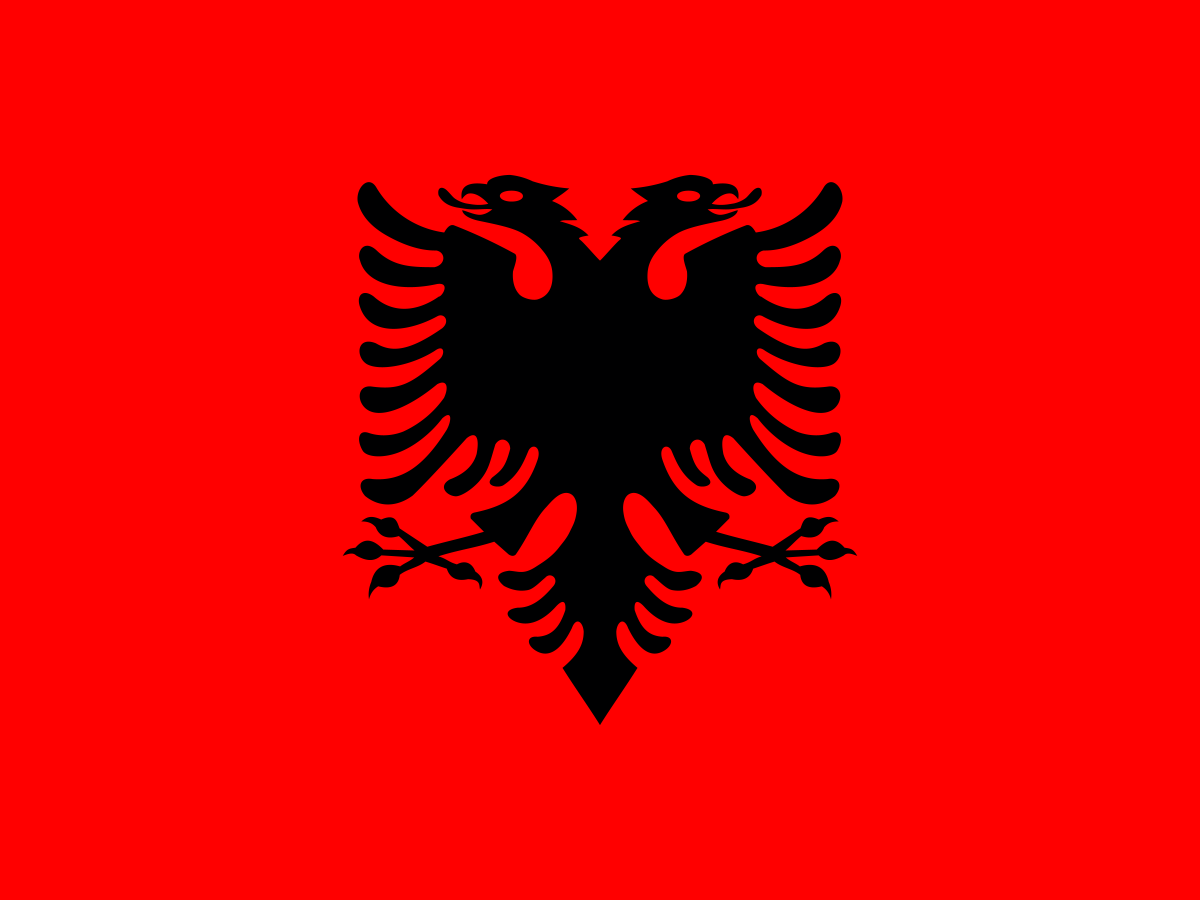
Albania has one of Europe’s most distinctive flags: unlike most European national flags, its design is dominated by a large black double-headed eagle rather than a cross, tricolour or coat of arms.
Test your knowledge
Think you know your world flags? Try the FlagAtlas daily challenge, speed quiz, or explore all Europe flags.
📚 Revising for GCSE Geography? Visit our free revision page →
About Albania
Albania is a country in south-eastern Europe on the western side of the Balkan Peninsula. It has a coastline on both the Adriatic and Ionian seas and is separated from Italy by the Strait of Otranto.
The country is known for its mountainous landscape, long coastline and distinctive cultural history. Tirana is the capital and largest city. Albania became a member of NATO in 2009 and is a candidate country for European Union membership.
CapitalTirana
RegionBalkans / Europe
PopulationAbout 2.8m
Area28,748 km²
CurrencyAlbanian lek (ALL)
LanguageAlbanian
The flag of Albania
Albania's national flag consists of a red field bearing a black double-headed eagle. The eagle is a heraldic symbol with a long history in the region and is strongly associated with the Albanian national identity.
The eagle is the key symbol.
The two-headed eagle is traditionally linked with Albanian history and the figure of Skanderbeg. It appears prominently on the national flag rather than being placed inside a small central shield.
The red background is also deeply established in Albanian national symbolism. The exact historical meanings attributed to the colours and eagle have varied, so it is better to understand the flag through its history rather than rely on a simple modern colour-code explanation.
Skanderbeg and the double-headed eagle
Gjergj Kastrioti, better known as Skanderbeg, was a fifteenth-century Albanian military leader who led resistance against the Ottoman Empire. His banner and heraldic tradition are closely associated with the double-headed eagle that later became a central symbol of Albanian identity.
Skanderbeg is an important figure in Albanian national history, and the eagle became especially powerful as a symbol of independence and national unity. Albania's modern national identity drew heavily on this historical tradition.
A short history of Albania
The lands of modern Albania have been influenced by Illyrian, Greek, Roman, Byzantine, Venetian and Ottoman traditions. The region's position on the Adriatic made it an important meeting point between the Balkans and the Mediterranean.
Much of the territory was incorporated into the Ottoman Empire for centuries. Albanian resistance became particularly associated with Skanderbeg in the fifteenth century, while a modern Albanian national movement developed strongly during the nineteenth century.
Albania declared independence from the Ottoman Empire in 1912. The country later experienced monarchy, occupation during the Second World War and a highly isolated communist dictatorship under Enver Hoxha.
Communist rule ended in the early 1990s. Albania subsequently moved towards a multi-party political system, a market economy and closer integration with European and Euro-Atlantic institutions.
Albania's flag history
The Albanian flag has its roots in medieval heraldic traditions, but the national design has passed through several forms as the country's political system changed.
15th century — SkanderbegThe double-headed eagle became strongly associated with Skanderbeg and Albanian resistance to Ottoman rule.
1912 — independenceAlbania declared independence and adopted the red flag with the black double-headed eagle as a central national symbol.
Communist periodThe flag was modified during communist rule, including the addition of a red star above the eagle for much of the period.
1992 — post-communist flagThe communist star was removed as Albania became a democratic republic.
TodayThe modern flag is the red field with the black double-headed eagle, without the communist star.
Geography of Albania
Albania has a varied landscape despite its relatively small size. Mountains cover much of the interior, while lower plains lie around the western coast. The Albanian Alps occupy the north and include some of the country's most dramatic scenery.
Albania's neighbours
Albania shares land borders with Montenegro to the north-west, Kosovo to the north-east, North Macedonia to the east and Greece to the south. Across the Adriatic Sea lies Italy.
The country's coastline stretches along the Adriatic and Ionian seas, giving Albania an important Mediterranean connection.
People, language and culture
Albanian is the country's official language and belongs to its own distinct branch of the Indo-European language family. Albanian has two major traditional dialect groups, Gheg in the north and Tosk in the south.
Albania has a diverse religious history, with Muslim, Catholic, Orthodox and Bektashi traditions all forming part of the country's cultural landscape. Albania is also notable for its long history of coexistence between different religious communities.
Albania today
Albania is a parliamentary republic with an economy based on services, tourism, manufacturing, agriculture and energy. Tourism has become increasingly important, particularly along the Adriatic and Ionian coasts and in the country's mountain regions.
Albania joined NATO in 2009 and remains closely connected with European institutions. It formally became an EU candidate country in 2014 and accession negotiations have since progressed.
Explore Albania on FlagAtlas
Continue exploring Albania and the world's flags with these FlagAtlas resources.
Sources & further reading
This page combines the information already present on the FlagAtlas Albania page with additional country and historical context. Statistics such as population, area and development indicators are dated because they can change over time.
Encyclopaedia Britannica — Albania · World Bank — Albania data