Africa
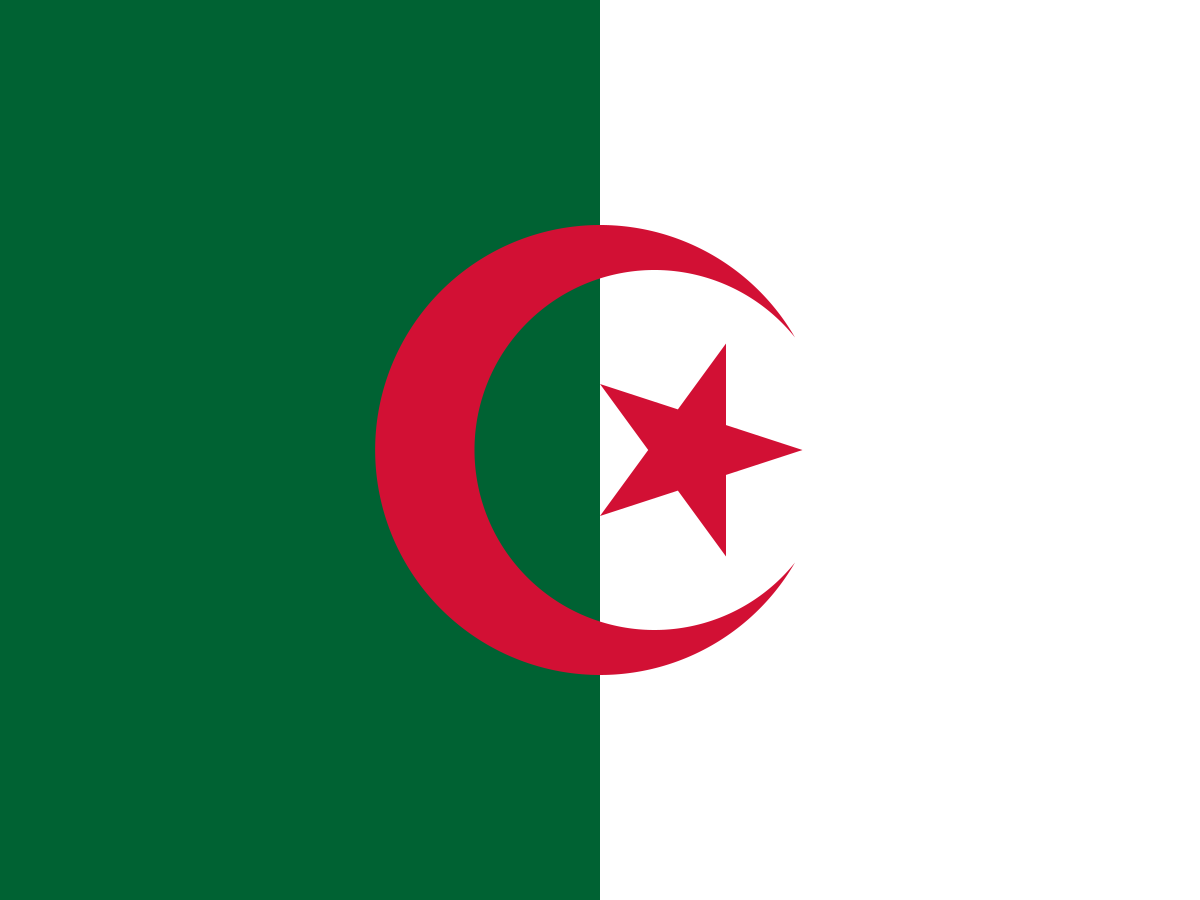
Algeria Flag
Explore Algeria's flag history, symbolism, geography and country facts, including the green and white field and red crescent and star.
Capital
Algiers
Continent
Africa
Population
44.0 million
Development indicators
GDP per capita
$5,320
USD per year (approx. 2023)
Human Development Index
0.745
High development
World Bank income classification
Upper-Middle Income (UMIC)
UMIC
🌡️ Climate: Mediterranean / Hot desert
Flag symbolism
Explore Algeria's flag history, symbolism, geography and country facts, including the green and white field and red crescent and star.
crescentstar
Did you know?
Algeria is the largest country in Africa by area and the tenth-largest country in the world. Most of its territory lies within the Sahara.
Test your knowledge
Think you know your world flags? Try the FlagAtlas daily challenge, speed quiz, or explore all Africa flags.
📚 Revising for GCSE Geography? Visit our free revision page →
About Algeria
Algeria is the largest country in Africa and occupies a huge area of North Africa. The Mediterranean coastline forms the northern edge of the country, while the vast majority of Algeria's territory extends southwards into the Sahara Desert.
Algiers is the capital and largest city. Algeria's history has been shaped by Amazigh, Phoenician, Roman, Arab, Ottoman and French influences, followed by a long and costly struggle for independence from France.
CapitalAlgiers
RegionNorth Africa
PopulationAbout 46m
Area2,381,741 km²
CurrencyAlgerian dinar
LanguagesArabic & Tamazight
The flag of Algeria
Algeria's flag is divided vertically into green and white. A red crescent and five-pointed star are placed at the centre, crossing the boundary between the two fields.
A flag closely linked with independence.
The modern Algerian flag emerged from the country's nationalist movement and was adopted when Algeria became independent from France in 1962.
The crescent and star are widely recognised Islamic symbols. Green is also strongly associated with Islam, while the white field is commonly connected with peace and purity.
Why does Algeria have a crescent and star?
The crescent and star have a long history across the Islamic world and appear on the flags of several countries. They are particularly prominent on the Algerian flag because of the country's Islamic cultural heritage and the history of the nationalist movement.
The symbols have older and more varied histories than Islam alone. On Algeria's flag, however, they are clearly connected with the country's Islamic identity.
A short history of Algeria
The region of modern Algeria has a long history stretching from ancient Amazigh kingdoms and Phoenician settlements through Roman rule and later Arab and Islamic dynasties. The Roman city of Timgad is one of the country's best-known archaeological sites.
Algeria later became part of the Ottoman world. In 1830 France invaded and began a period of colonial rule that lasted more than a century.
The Algerian War of Independence began in 1954 when the National Liberation Front (FLN) launched an armed struggle against French rule. The conflict ended with the Évian Accords in 1962, and Algeria became independent on 5 July 1962.
Independence remains central to modern Algerian national identity, and the flag is one of the most visible symbols of that history.
Algeria's flag history
The green-and-white design with a red crescent and star developed from Algerian nationalist symbolism. The modern national flag became established with independence.
19th century — French conquestAlgeria was incorporated into the French colonial system after the French invasion beginning in 1830.
1920s–1950s — nationalist symbolismAlgerian nationalist organisations increasingly used green, white and the crescent and star as symbols of Algerian identity.
1954 — war of independenceThe FLN launched the armed struggle that eventually led to independence.
1962 — independenceAlgeria became independent from France and the national flag was established as a central symbol of the new state.
TodayThe green, white and red flag remains one of the strongest symbols of Algerian sovereignty and independence.
Geography of Algeria
Algeria is enormous, but its population is concentrated mainly in the north. The northern part contains the Mediterranean coast, the fertile Tell region and the Atlas mountain ranges. Farther south, the landscape becomes increasingly arid and eventually merges into the Sahara.
Algeria's neighbours
Algeria shares borders with Tunisia and Libya to the east, Niger and Mali to the south, Mauritania and Western Sahara to the south-west, and Morocco to the west. Its northern coastline faces the Mediterranean Sea.
The Sahara covers most of Algeria's land area, making the country an excellent example of how population distribution can be very different from the distribution of territory.
People, language and culture
Algerian society includes Arab and Amazigh communities with diverse regional identities. Arabic and Tamazight are official languages, while French remains widely used in education, business and everyday communication.
Algerian culture includes strong traditions in music, food, literature, crafts and architecture. Mediterranean, Arab, Amazigh, African and Ottoman influences can all be seen in different parts of its cultural heritage.
Algeria's economy
Algeria has major reserves of oil and natural gas, and energy exports have played a central role in the country's economy for decades. Agriculture, manufacturing, construction and services also contribute.
The enormous size of Algeria means that economic activity varies considerably between the densely populated north and the sparsely populated Saharan interior.
Algeria today
Algeria is a republic with its political and economic life strongly shaped by the legacy of the independence struggle. It is one of Africa's largest countries by territory and population and plays an important role in North African and Mediterranean affairs.
Its location gives Algeria links to the Mediterranean, the Sahel and the wider Arab world, while its enormous Saharan territory gives it a distinctive geographical position within Africa.
Explore Algeria on FlagAtlas