Europe
Andorra Flag
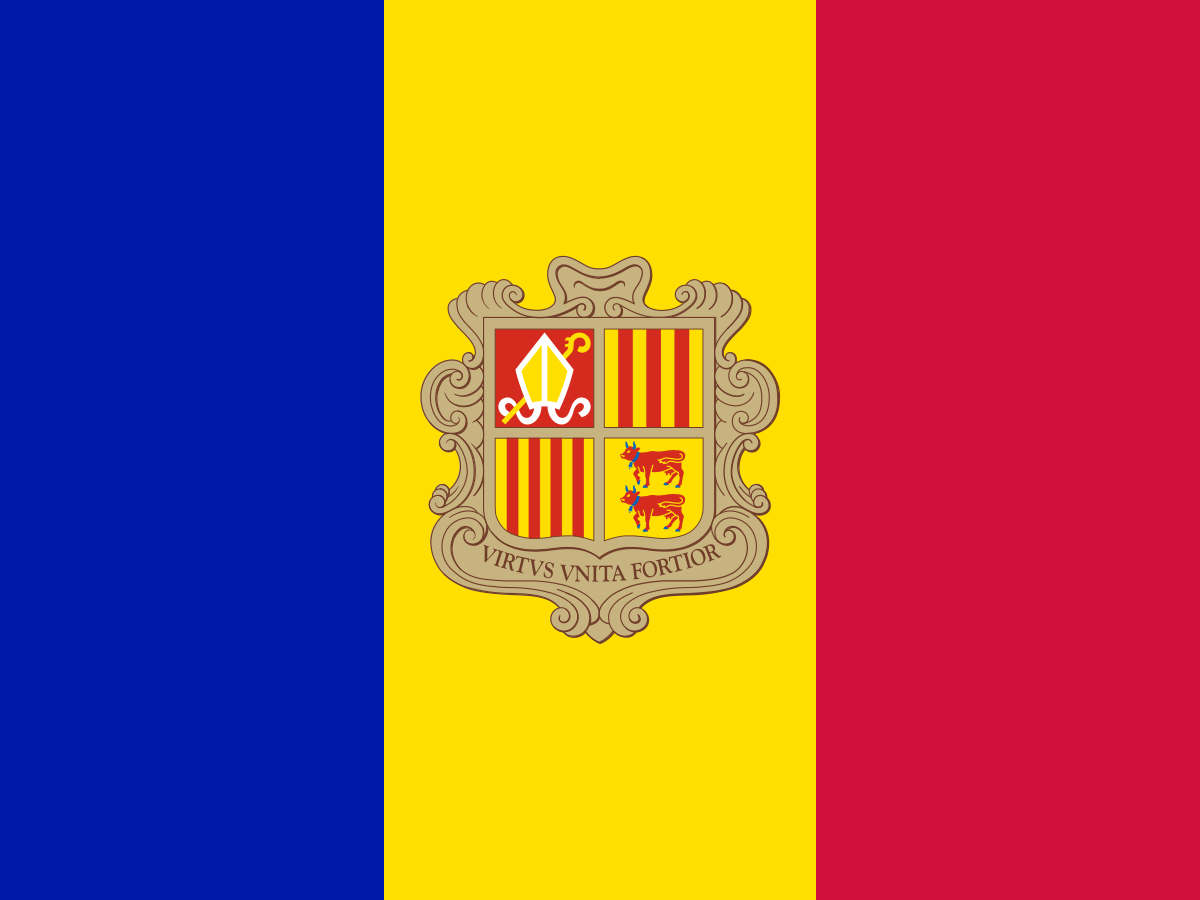
Andorra is a tiny landlocked country in the Pyrenees between France and Spain. Its blue, yellow and red flag carries the national coat of arms, reflecting the country's long history and close connections with both neighbouring states.
Capital
Andorra la Vella
Continent
Europe
Population
77 thousand
Development indicators
GDP per capita
$43,000
USD per year (approx. 2023)
Human Development Index
0.906
Very High development
World Bank income classification
High Income (HIC)
HIC
🌡️ Climate: Alpine / Mediterranean
Flag symbolism
Blue and red come from France, yellow and red from Spain — reflecting Andorra's position between the two countries.
coat of arms
Did you know?
Andorra is one of the world's smallest countries. It is famous for its mountain scenery, ski resorts and unusual system of government as a co-principality.
Test your knowledge
Think you know your world flags? Try the FlagAtlas daily challenge, speed quiz, or explore all Europe flags.
📚 Revising for GCSE Geography? Visit our free revision page →
About Andorra
Andorra is a small, landlocked country in south-western Europe, high in the Pyrenees between France and Spain. Although its territory is tiny, its mountainous landscape has made it a distinctive destination for skiing, hiking and tourism.
Andorra la Vella is the capital and largest settlement. The country has developed a prosperous service-based economy, with tourism, retail and finance playing important roles.
CapitalAndorra la Vella
RegionPyrenees / Europe
PopulationAbout 80,000
Area468 km²
CurrencyEuro (€)
Official languageCatalan
The flag of Andorra
Andorra's flag consists of three vertical bands of blue, yellow and red, with the national coat of arms positioned in the centre of the yellow band. The central coat of arms makes the flag more detailed than a simple tricolour.
Why does the flag look a little like Romania or Moldova?
Andorra's blue-yellow-red tricolour belongs to the same broad family of European tricolour designs. The central coat of arms is what makes the Andorran flag immediately distinctive.
The colours are traditionally associated with Andorra's historical relationships with France and Spain. The exact origins of the modern colour arrangement are more complicated than the simple explanation that each colour represents one neighbouring country.
What is on the Andorra coat of arms?
The shield contains four quarters representing important parts of Andorra's historical heritage. The design incorporates symbols associated with the Bishop of Urgell, the Counts of Foix and the Catalan connection.
At the bottom of the shield is the national motto “Virtus Unita Fortior”, meaning roughly “United virtue is stronger.” The motto reflects the country's history and the idea of strength through unity.
Andorra's unusual system of government
Andorra is a parliamentary co-principality. Its two co-princes are the President of France and the Bishop of Urgell in neighbouring Catalonia. This arrangement is a surviving example of a medieval political tradition adapted to a modern constitutional system.
The co-princes are heads of state, while day-to-day government is carried out through Andorra's elected institutions. The country's constitution, approved in 1993, established the modern parliamentary system.
A short history of Andorra
Andorra's history is closely connected with the valleys and mountain communities of the eastern Pyrenees. Medieval agreements gradually established a system of shared authority involving the Bishop of Urgell and the Count of Foix.
The historical relationship between these rulers eventually developed into the co-principality that still exists today. Unlike many European states, Andorra avoided becoming absorbed into either of its much larger neighbours.
For centuries Andorra remained a small and relatively isolated mountain society. During the twentieth century, improved roads, tourism and economic development transformed the country.
In 1993 Andorra adopted its first modern constitution, formally becoming a parliamentary co-principality and strengthening democratic institutions.
Andorra's flag history
The modern blue, yellow and red flag emerged during the period when Andorra was becoming a modern state. Its colours are closely related to the political history of the Pyrenean principality and its links with France and Spain.
Medieval period — the co-principality developsAgreements between the Bishop of Urgell and the Count of Foix established the unusual shared sovereignty that lies behind modern Andorra.
19th century — national symbols developAs European ideas of national identity became stronger, Andorra increasingly used distinctive national colours and symbols.
20th century — modern tricolourThe blue, yellow and red design became established as the national flag, with the coat of arms distinguishing it from similar tricolours.
1993 — constitutional eraAndorra adopted its constitution and became a modern parliamentary co-principality.
TodayThe tricolour with the central coat of arms remains the national flag of Andorra.
Geography of Andorra
Andorra is almost entirely mountainous. The country lies in the Pyrenees and contains narrow valleys, steep slopes, forests and high peaks. There is no coastline because the country is completely surrounded by France and Spain.
Andorra's neighbours
Andorra has just two land neighbours: France to the north and Spain to the south. Its location between these two countries has had a major influence on its history, language and culture.
The highest point is Coma Pedrosa, at around 2,942 metres above sea level.
People, language and culture
Catalan is the official language of Andorra, making the country an important part of the Catalan-speaking world. Spanish and French are also widely spoken, reflecting Andorra's location between its two larger neighbours.
Andorran culture combines Pyrenean traditions with strong Catalan influences. Romanesque churches, mountain villages and traditional festivals form an important part of the country's cultural heritage.
Tourism and the Andorran economy
Tourism is one of the most important parts of Andorra's economy. The country's ski resorts attract visitors during winter, while hiking, cycling and mountain activities bring tourists during warmer months.
Retail is also important, with visitors traditionally attracted by Andorra's shopping centres and duty-free reputation. Financial and other service industries contribute to the modern economy as well.
Why is Andorra not part of France or Spain?
Andorra's survival as an independent state is largely connected to its medieval political arrangements. Its shared sovereignty with the Bishop of Urgell and the Count of Foix gave the territory a constitutional relationship that differed from ordinary neighbouring feudal lands.
Over time the French side of this arrangement passed to the French head of state. Today the President of France and the Bishop of Urgell continue as Andorra's two co-princes.
Andorra today
Modern Andorra is a peaceful European microstate with a high standard of living and a strong tourism sector. Its small size, mountain environment and unusual political system make it one of Europe's most distinctive countries.
Although Andorra is not a member of the European Union, it uses the euro and maintains close economic and cultural links with both France and Spain.
Explore Andorra on FlagAtlas
Continue exploring Andorra and the world's flags with these FlagAtlas resources.