Americas
Argentina Flag
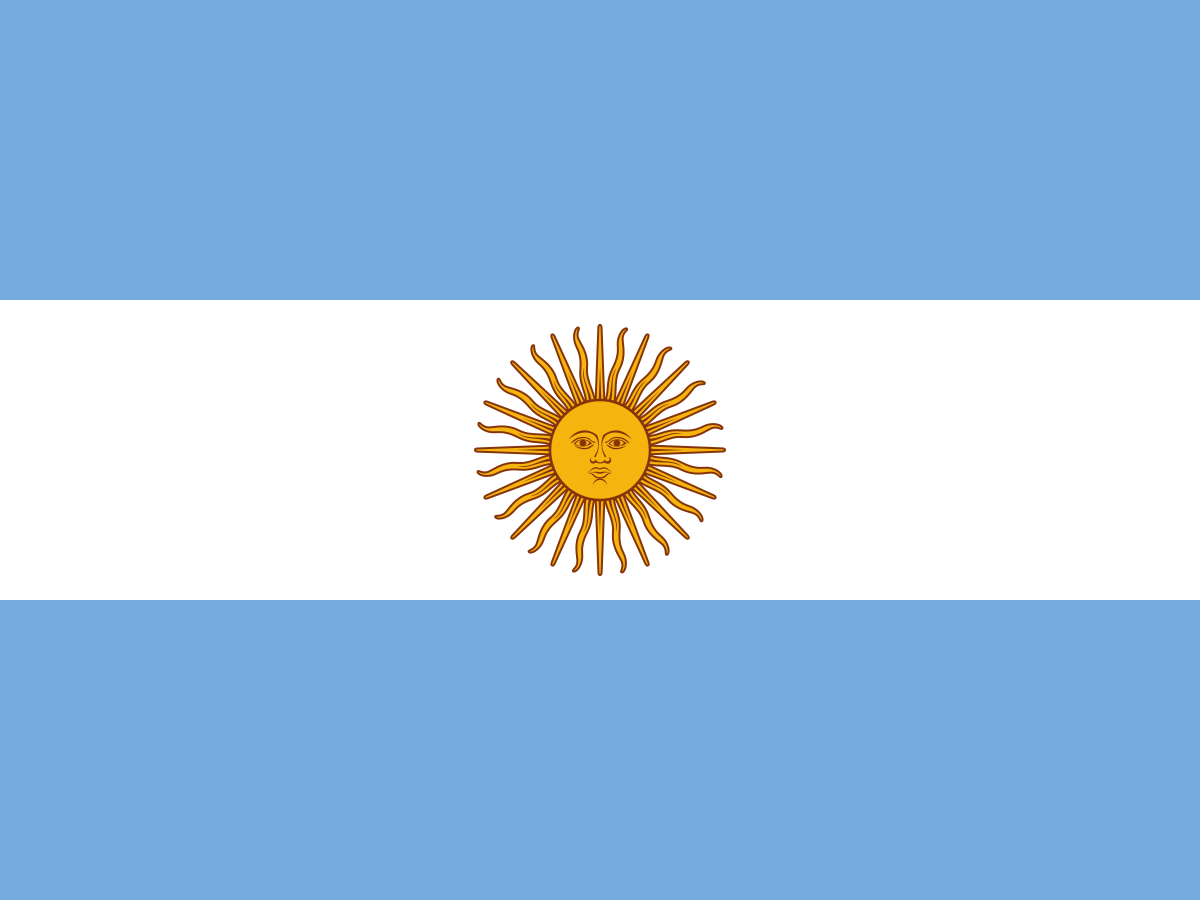
Argentina is the second-largest country in South America. Its famous light-blue and white flag carries the golden Sun of May, a symbol closely connected with independence and the May Revolution of 1810.
Capital
Buenos Aires
Continent
Americas
Population
46.0 million
Development indicators
GDP per capita
$10,900
USD per year (approx. 2023)
Human Development Index
0.849
Very High development
World Bank income classification
Upper-Middle Income (UMIC)
UMIC
🌡️ Climate: Temperate / Arid
Flag symbolism
Light blue and white are Argentina's traditional colours. The Sun of May represents the Inca sun god Inti and also commemorates the May Revolution of 1810.
sun
Did you know?
Argentina is famous for tango, the Andes, the vast Pampas grasslands, football and its distinctive cuisine. It is also home to Aconcagua, the highest mountain in both the Western and Southern Hemispheres.
Test your knowledge
Think you know your world flags? Try the FlagAtlas daily challenge, speed quiz, or explore all Americas flags.
📚 Revising for GCSE Geography? Visit our free revision page →
About Argentina
Argentina is a large country in the southern part of South America. It stretches from the subtropical north to the cold landscapes of Patagonia in the south and includes a long Atlantic coastline.
Buenos Aires is the capital and largest city. Argentina has one of the largest economies in Latin America and is known for agriculture, energy, manufacturing, tourism and rich cultural traditions.
CapitalBuenos Aires
RegionSouth America
PopulationAbout 46m
Area2,780,400 km²
CurrencyArgentine peso
Official languageSpanish
The flag of Argentina
Argentina's flag has three horizontal bands: light blue, white and light blue. The central white band contains the golden Sun of May.
The Sun of May is the flag's most recognisable feature.
The sun has a human face and alternating straight and wavy rays. It is associated with the May Revolution of 1810 and Argentina's emergence as an independent nation.
The light-blue and white colours became closely associated with the Argentine national movement during the early nineteenth century. The flag was designed by Manuel Belgrano and first raised on 27 February 1812.
Why does Argentina's flag have a sun with a face?
The central emblem is known as the Sun of May. It is a traditional representation of the sun used in Argentine and wider South American symbolism around the time of independence.
The face is not simply decoration. The emblem connects the flag with the events of the May Revolution and with the idea of a new nation emerging into the light of independence.
The sun has 32 alternating straight and wavy rays. The combination of the face and rays makes Argentina's flag easy to distinguish from other light-blue and white designs.
A short history of Argentina
The territory of modern Argentina was home to many Indigenous peoples before European colonisation. Spanish settlement expanded from the sixteenth century, and the region eventually became part of the Spanish Empire.
The May Revolution of 1810 began the process that eventually led to independence from Spain. Argentina formally declared independence on 9 July 1816 at the Congress of Tucumán.
The nineteenth century was marked by political conflict, civil wars and the gradual consolidation of the Argentine state. Large-scale immigration from Europe later transformed the country's population and culture.
During the twentieth century Argentina experienced alternating periods of civilian government and military rule. Democracy was restored in 1983 and has continued since then.
Argentina's flag history
Argentina's national colours emerged during the struggle against Spanish rule. Manuel Belgrano, a leading figure in the independence movement, created the original light-blue and white flag.
1810 — May RevolutionThe revolution in Buenos Aires began the political process that eventually led to independence from Spain.
1812 — first raising of the flagManuel Belgrano first raised the light-blue and white flag at Rosario on 27 February.
1816 — independenceThe Congress of Tucumán declared independence from Spain on 9 July.
1818 — Sun of May addedThe golden sun became part of the national war flag and later became the defining emblem of the national flag.
TodayThe light-blue, white and golden-sun design remains one of South America's most recognisable national flags.
Geography of Argentina
Argentina has an extraordinary range of landscapes. The Andes form the western boundary, while the Pampas provide vast fertile plains around the centre-east. Patagonia covers much of the south, with deserts, mountains, glaciers and open steppe.
Argentina's neighbours
Argentina shares borders with Chile, Bolivia, Paraguay, Brazil and Uruguay. Its western border with Chile follows much of the Andes and is one of the world's longest international land borders.
Aconcagua, near the Chilean border, rises to about 6,961 metres and is the highest mountain outside Asia.
People, language and culture
Spanish is the dominant language of Argentina, with regional accents and vocabulary that make Argentine Spanish distinctive. Indigenous languages are also spoken by parts of the population.
Argentina's culture has been influenced by Indigenous traditions, Spanish colonial history and large waves of European immigration. Tango, football, literature, cinema and food are major parts of its cultural identity.
Argentine cuisine is particularly associated with beef, empanadas, mate and asado. Buenos Aires is internationally known for its architecture, cafés and tango culture.
Argentina's economy
Argentina has a diversified economy with important agricultural, industrial and service sectors. The fertile Pampas support large-scale production of soybeans, wheat, maize and beef.
The country also has significant energy and mineral resources, including natural gas and lithium. Tourism is another important sector, with visitors attracted by Buenos Aires, Patagonia, the Andes and wine regions.
Argentina and football
Football is deeply embedded in Argentine culture. The country has won the FIFA World Cup multiple times, including the 1978, 1986 and 2022 tournaments.
The national team's blue-and-white colours are closely connected with national identity, meaning the flag appears frequently at football matches and celebrations.
Why are Argentina's colours light blue and white?
The exact origin of the colours has been debated, but light blue and white were already being used as symbols of the emerging Argentine nation during the early independence period.
They became strongly associated with the May Revolution and with Belgrano's flag. Over time the colours came to represent Argentina itself rather than a particular political movement.
Argentina today
Argentina is a federal presidential republic and one of South America's largest countries by population and territory. Buenos Aires remains the country's political, financial and cultural centre.
Its enormous geographical range gives Argentina a remarkably varied environment, from subtropical forests and wetlands in the north to the glaciers and mountains of Patagonia in the south.
Explore Argentina on FlagAtlas