Asia
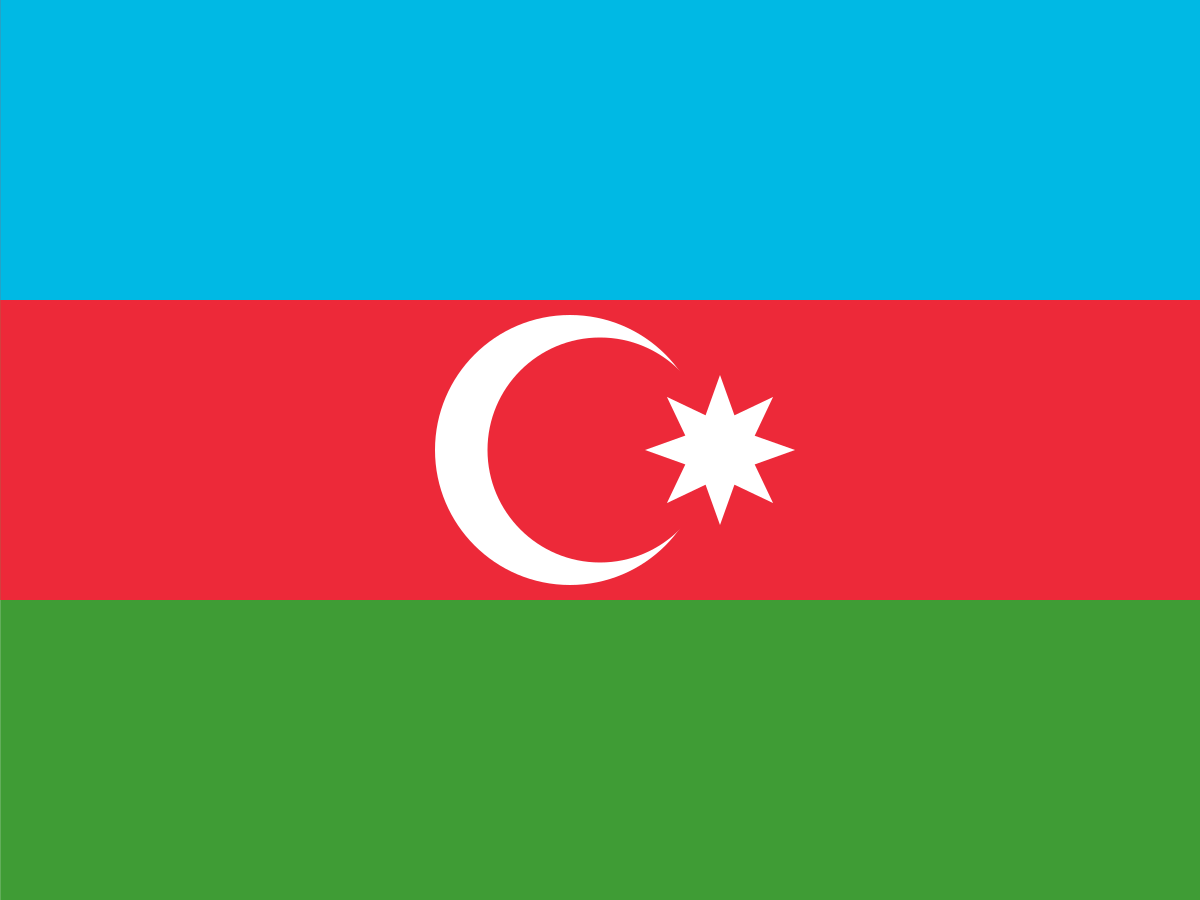
Azerbaijan Flag
Azerbaijan is a country on the western shore of the Caspian Sea, at the crossroads of the Caucasus and Central Asia. Its striking blue, red and green flag carries a white crescent and eight-pointed star.
Capital
Baku
Continent
Asia
Population
10.0 million
Development indicators
GDP per capita
$7,200
USD per year (approx. 2023)
Human Development Index
0.765
High development
World Bank income classification
Upper-Middle Income (UMIC)
UMIC
🌡️ Climate: Semi-arid / Subtropical
Flag symbolism
Blue represents the Turkic heritage, red stands for progress, and green symbolises Islam. The crescent and eight-pointed star represent the eight letters of 'Azerbaijan' in Arabic script.
crescentstar
Did you know?
Azerbaijan is sometimes called the 'Land of Fire', a name associated with natural gas flames and the country's long history of fire-related traditions.
Test your knowledge
Think you know your world flags? Try the FlagAtlas daily challenge, speed quiz, or explore all Asia flags.
📚 Revising for GCSE Geography? Visit our free revision page →
About Azerbaijan
Azerbaijan is a country in the South Caucasus on the western shore of the Caspian Sea. It borders Russia, Georgia, Armenia and Iran and has a small land border with Turkey through the Nakhchivan exclave.
Baku is the capital and largest city. Azerbaijan's position between Europe, the Caucasus and Central Asia has made it an important crossroads for trade, culture and energy.
CapitalBaku
RegionSouth Caucasus
PopulationAbout 10m
Area86,600 km²
CurrencyAzerbaijani manat
Official languageAzerbaijani
The flag of Azerbaijan
Azerbaijan's national flag is a horizontal tricolour of blue, red and green. A white crescent and an eight-pointed star are placed in the centre of the red band.
The three colours reflect major elements of Azerbaijani national identity.
Blue is associated with Turkic heritage, red with modernisation and progress, and green with Islamic cultural heritage. The symbols in the centre add another layer of national symbolism.
The current design was adopted as the national flag after Azerbaijan restored its independence from the Soviet Union in 1991. The same basic tricolour had also been used by the Azerbaijan Democratic Republic between 1918 and 1920.
What do the colours on Azerbaijan's flag mean?
Blue is traditionally associated with the Turkic identity of the Azerbaijani people. Red represents modernisation, progress and the development of a modern society. Green is associated with Islam and Azerbaijan's broader Islamic cultural heritage.
The combination creates a flag that connects ethnic and linguistic heritage with modern national development and religious tradition.
What do the crescent and eight-pointed star mean?
The white crescent is a familiar symbol in the Islamic world and is used on Azerbaijan's flag alongside the star.
The eight-pointed star has several traditional interpretations. It has often been connected with the historic Turkic peoples and with the traditional rendering of the word Azerbaijan in Arabic script. The eight points are also commonly associated with eight branches or groups within the wider Turkic world.
The precise symbolism has been interpreted in different ways, so it is better to treat these explanations as traditional interpretations rather than a single universally agreed meaning.
A short history of Azerbaijan
The territory of modern Azerbaijan has been inhabited for thousands of years and has been influenced by Persian, Caucasian, Turkic and Islamic cultures. Ancient and medieval states in the region included Caucasian Albania and later various Persian and Turkic-ruled polities.
From the early nineteenth century, much of the area became part of the Russian Empire following conflicts between Russia and Persia. Baku later became one of the world's most important early oil-producing centres.
Following the Russian Revolution, the Azerbaijan Democratic Republic was established in 1918. It was incorporated into the Soviet Union in 1920 and remained a Soviet republic until 1991.
Azerbaijan restored its independence in 1991 as the Soviet Union collapsed.
Azerbaijan's flag history
The modern tricolour has its roots in Azerbaijan's independence movement of the early twentieth century.
1918 — Azerbaijan Democratic RepublicA blue, red and green tricolour was adopted as the flag of the newly independent republic.
1918 — central symbols introducedThe crescent and eight-pointed star were incorporated into the red band.
1920 — Soviet period beginsAzerbaijan became part of the Soviet Union and used Soviet-era flag designs.
1990–1991 — tricolour returnsThe historic tricolour was restored during the movement towards independence.
1991 — independenceAzerbaijan became independent and the tricolour became the national flag.
TodayThe blue, red and green flag is one of the strongest symbols of modern Azerbaijan.
Geography of Azerbaijan
Azerbaijan has a varied landscape ranging from the Caspian Sea coast to the Greater Caucasus mountains. The country's climate varies considerably because of its geography and elevation.
Azerbaijan's neighbours
Azerbaijan borders Russia to the north, Georgia to the north-west, Armenia to the west and Iran to the south. Its Nakhchivan exclave borders Armenia, Iran and Turkey.
The Greater Caucasus includes some of Azerbaijan's highest mountains, while the lowlands around the Kura and Aras river systems contain important agricultural areas.
The Caspian Sea
Azerbaijan has a long coastline on the Caspian Sea, the world's largest inland body of water. The sea has been central to Azerbaijan's economy, transport and energy industries.
Baku developed into a major port and oil centre on the Caspian coast. Offshore oil and gas production remains economically important.
Baku and the oil industry
Baku has been associated with oil production for centuries. By the late nineteenth century it had become one of the world's major oil-producing centres, attracting investment, workers and businesses from across the Russian Empire and beyond.
The city's architecture reflects this history, combining historic buildings, Soviet-era structures and striking modern developments. The Flame Towers are among its best-known contemporary landmarks.
People, language and culture
Azerbaijani is the official language and belongs to the Oghuz branch of the Turkic language family. Russian is also understood and used by parts of the population because of Azerbaijan's Soviet history.
Azerbaijani culture combines Turkic, Persian, Caucasian and Islamic influences. Music, carpets, poetry, cuisine and traditional crafts are important parts of the country's cultural heritage.
Religion in Azerbaijan
Azerbaijan has a predominantly Muslim population, with both Shia and Sunni traditions represented. The country is constitutionally secular, meaning the state is separate from religious institutions.
Islam has nevertheless played an important role in the country's historical and cultural development, which is reflected symbolically by the green band and crescent on the national flag.
Azerbaijan's economy
Azerbaijan's economy has historically been strongly influenced by oil and natural gas. Hydrocarbon exports remain important, while the country has also sought to expand agriculture, transport, tourism, logistics and other sectors.
Azerbaijan's location between the Caspian region and European markets gives it strategic importance for energy and transport routes.
Azerbaijan today
Modern Azerbaijan is a presidential republic and an independent state in the South Caucasus. Baku is the country's political, economic and cultural centre.
The country combines a strong national identity with influences from its Turkic heritage, Caucasian surroundings, Persian history, Islamic culture and Soviet past.
Why is Azerbaijan sometimes called the "Land of Fire"?
The nickname is associated with natural gas and oil resources that can produce persistent flames. The region has long had traditions and stories connected with natural fire.
Fire also has a deeper historical association with the Caucasus and the wider Iranian cultural world, making the nickname particularly fitting for a country whose modern economy was transformed by oil.
Explore Azerbaijan on FlagAtlas
Continue exploring Azerbaijan and the world's flags with these FlagAtlas resources.