Europe
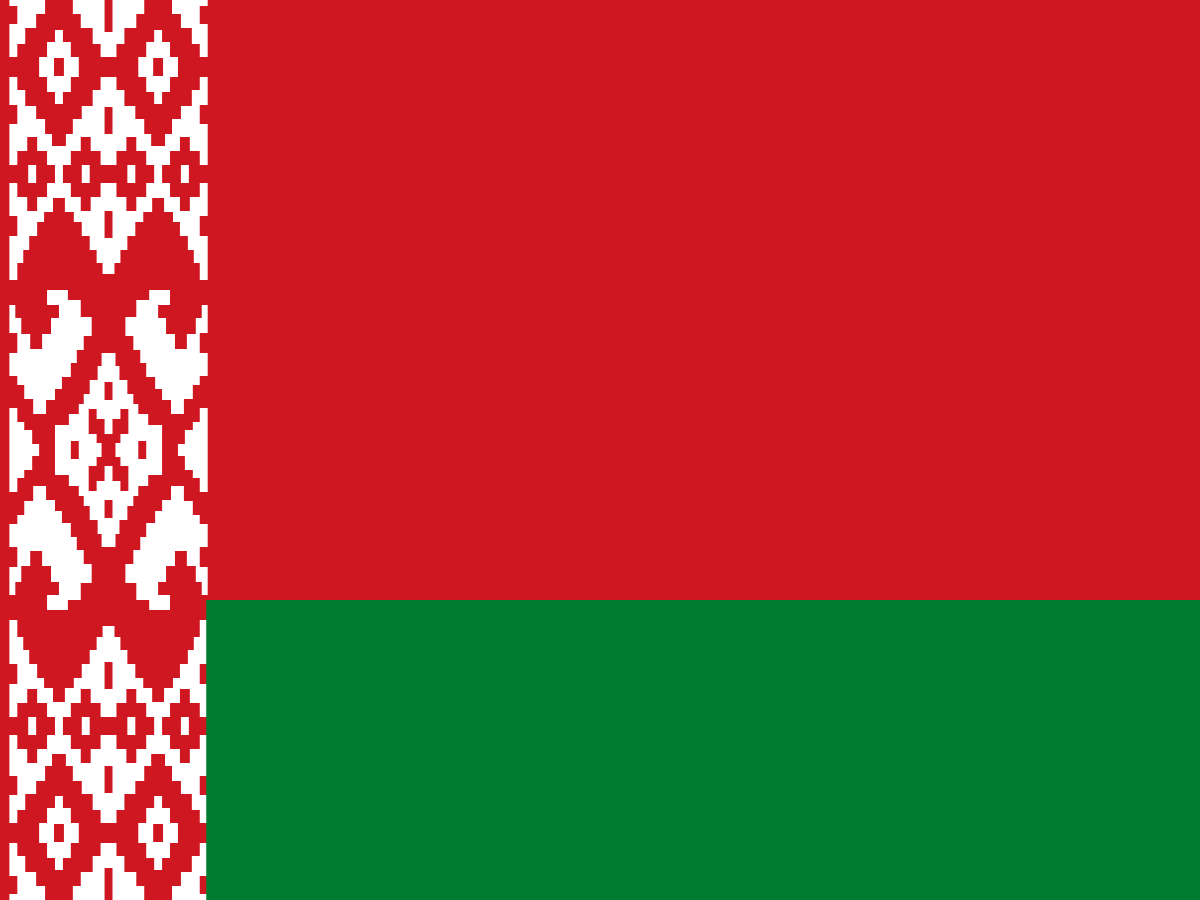
Belarus Flag
Belarus is a landlocked country in Eastern Europe, known for its extensive forests, wetlands and lakes. Its red-and-green flag combines traditional national colours with a distinctive geometric ornament inspired by Belarusian folk textiles.
Capital
Minsk
Continent
Europe
Population
9.4 million
Development indicators
GDP per capita
$7,600
USD per year (approx. 2023)
Human Development Index
0.801
Very High development
World Bank income classification
Upper-Middle Income (UMIC)
UMIC
🌡️ Climate: Temperate continental
Flag symbolism
Red and green are traditional Belarusian colours. The decorative pattern on the left side is a traditional folk design called rushnik.
pattern
Did you know?
Belarus is one of the few countries in Europe still largely covered by ancient primeval forest.
Test your knowledge
Think you know your world flags? Try the FlagAtlas daily challenge, speed quiz, or explore all Europe flags.
📚 Revising for GCSE Geography? Visit our free revision page →
About Belarus
Belarus is a landlocked country in Eastern Europe, bordered by Russia, Ukraine, Poland, Lithuania and Latvia. Minsk is the capital and largest city and is the centre of the country's political, economic and cultural life.
Belarus has extensive forests, wetlands and lakes. Its location between Russia and the European Union has also made it an important country in the history and politics of Eastern Europe.
CapitalMinsk
RegionEastern Europe
PopulationAbout 9m
Area207,600 km²
CurrencyBelarusian ruble
Official languagesBelarusian & Russian
The flag of Belarus
The current Belarusian flag has a red upper section, a green lower section and a vertical ornamental pattern at the hoist. The ornament is based on traditional Belarusian textile designs.
The patterned strip is part of the national identity.
The decorative design is inspired by traditional Belarusian embroidery and woven textiles. Its geometric forms are an important visual link between the modern flag and Belarusian folk culture.
The present flag was adopted in 1995 following a referendum. It is closely related to the Soviet-era Belarusian flag, while adding and retaining elements associated with Belarusian national tradition.
What do the colours on Belarus' flag mean?
Red has long been associated with Belarusian history, including military traditions and the country's historical political movements. Green is strongly associated with Belarus' forests, fields and natural landscape.
The colours therefore combine historical identity with the country's environment. Interpretations can vary, but red and green have a long-established place in Belarusian symbolism.
What is the pattern on the Belarus flag?
The vertical ornament along the hoist is based on a traditional Belarusian textile pattern. It is inspired by embroidery and woven designs used in folk clothing and household textiles.
The pattern contains repeated geometric shapes, including diamonds and other forms that have appeared in Belarusian folk art. It makes the flag distinctive and connects the modern state with traditional culture.
A short history of Belarus
The lands of modern Belarus have been home to Slavic peoples for many centuries and became part of larger medieval political states, including the Grand Duchy of Lithuania and later the Polish-Lithuanian Commonwealth.
Following the partitions of the Polish-Lithuanian Commonwealth in the late eighteenth century, most of the territory became part of the Russian Empire.
After the Russian Revolution, Belarus became a Soviet republic. The Belarusian Soviet Socialist Republic existed as part of the Soviet Union until 1991.
Belarus declared independence in 1991 as the Soviet Union dissolved. The country has since developed its own independent state institutions while retaining close historical, economic and political ties with Russia.
Belarus' flag history
The history of Belarus' flags reflects the country's changing political status during the twentieth century.
1918 — Belarusian Democratic RepublicA white-red-white flag became associated with the short-lived Belarusian national government.
1919–1991 — Soviet periodBelarus used Soviet flag designs, including red fields with Belarusian national and decorative elements.
1951 — BSSR flagA Soviet Belarusian design introduced a green band and a decorative national ornament.
1991 — independenceBelarus adopted the historic white-red-white flag after becoming independent.
1995 — current designA referendum led to the adoption of the red-and-green design based closely on the earlier Soviet-era Belarusian flag.
TodayThe current flag is the official state flag, while the white-red-white design remains associated with Belarusian opposition and historical national movements.
Geography of Belarus
Belarus is predominantly flat, with broad plains, forests, marshes and numerous lakes. The country has no coastline and depends on river systems and neighbouring countries for access to wider trade routes.
Belarus' neighbours
Belarus borders Russia to the east and north-east, Ukraine to the south, Poland to the west, and Lithuania and Latvia to the north-west.
The country's central position gives it a significant geographical role between Eastern Europe and Russia.
Belarus' forests and wildlife
Forests cover a large part of Belarus and are one of its most important natural features. The country contains extensive areas of mixed woodland, wetlands and protected landscapes.
Belarus is particularly famous for the Białowieża Forest, shared with Poland. The forest is one of Europe's last major areas of primeval lowland woodland and is home to European bison and many other species.
The Belarusian language
Belarusian is an East Slavic language closely related to Russian and Ukrainian. Russian is also widely spoken and is an official language alongside Belarusian.
Belarusian literature and poetry form an important part of the country's cultural heritage. The language experienced periods of suppression and revival during the nineteenth and twentieth centuries.
People and culture
Belarusian culture includes a strong tradition of folk embroidery, textiles, music, dance and seasonal customs. The geometric ornament on the national flag is one of the clearest visual examples of this heritage.
Traditional Belarusian foods include dishes based on potatoes, grains, mushrooms and other locally available ingredients. Potatoes are particularly prominent in the country's cuisine.
Minsk
Minsk is Belarus' capital and largest city. It has been rebuilt and redeveloped several times, particularly after the extensive destruction of the Second World War.
The city combines broad Soviet-era avenues and monumental architecture with older churches, modern buildings, museums and cultural institutions.
Belarus and the Second World War
Belarus suffered enormous destruction and loss of life during the Second World War. The country was occupied by Nazi Germany and became the scene of major fighting and resistance activity.
The war remains a major part of Belarusian historical memory. Many monuments, museums and memorials across the country commemorate the dead and the destruction caused by the conflict.
Belarus' economy
Belarus has a diversified industrial economy with important manufacturing, machinery, chemical, agricultural and food-processing sectors. The country also has a significant state-owned enterprise sector.
Its geographical position gives it strong trade connections with neighbouring countries, particularly Russia and other states in the region.
Belarus today
Belarus is a presidential republic. Minsk is the political centre, while the country maintains close economic and political ties with Russia.
Belarus' modern identity is shaped by its Belarusian language and cultural traditions, its Soviet history, its geographical position in Eastern Europe and the memory of the enormous losses suffered during the Second World War.
Why is the Belarus flag unusual?
The flag is distinctive because it combines a very simple red-and-green field with a detailed vertical folk ornament. That makes it different from many European flags that rely on stripes, crosses, stars or coats of arms.
The ornament is particularly valuable from a cultural perspective because it directly connects a national flag with traditional textile art.
Explore Belarus on FlagAtlas
Continue exploring Belarus and the world's flags with these FlagAtlas resources.