Americas
Belize Flag
Belize is a small country on the Caribbean coast of Central America, famous for its English-speaking heritage, Maya sites, tropical forests and spectacular barrier reef. Its flag is unusually detailed, with a coat of arms at the centre.
Capital
Belmopan
Continent
Americas
Population
400 thousand
Development indicators
GDP per capita
$6,400
USD per year (approx. 2023)
Human Development Index
0.683
Medium development
World Bank income classification
Upper-Middle Income (UMIC)
UMIC
🌡️ Climate: Tropical
Flag symbolism
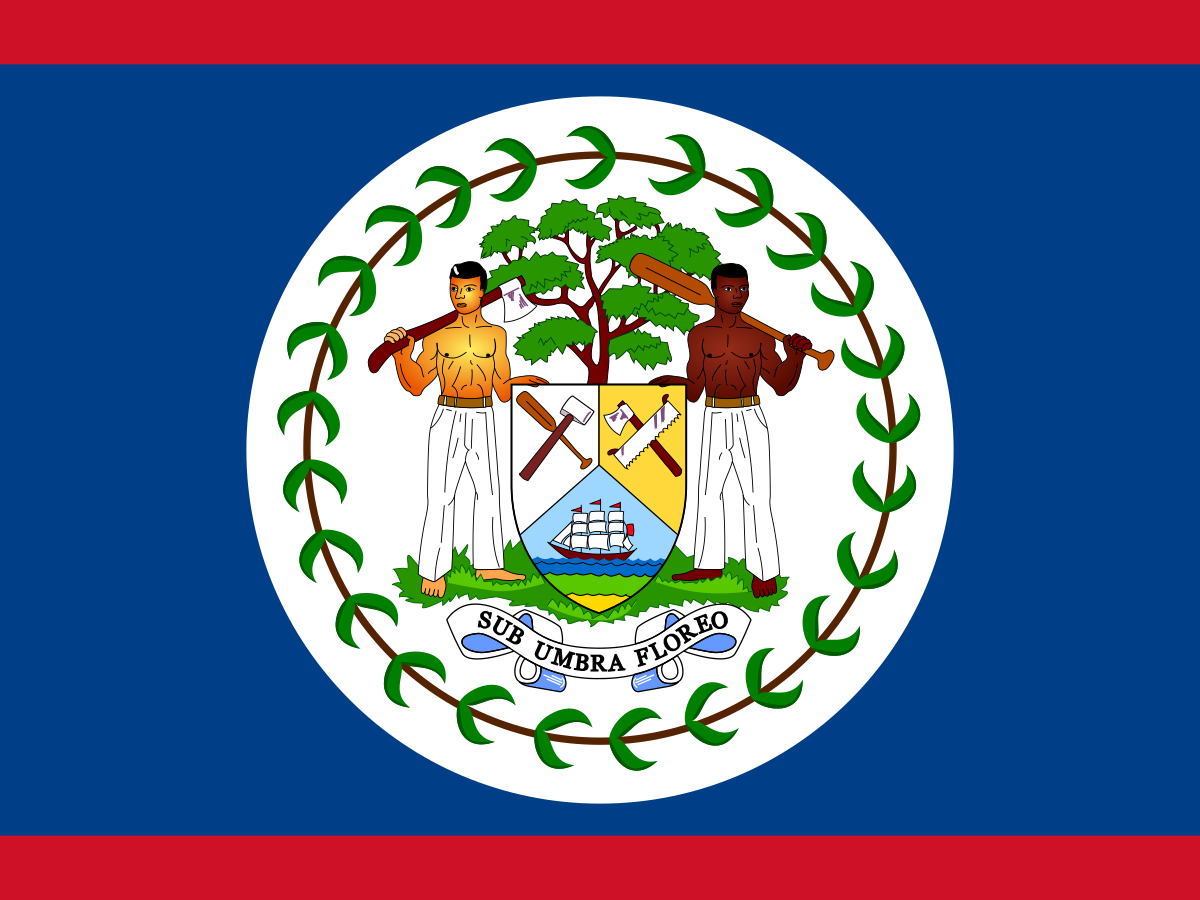
Belize uses a royal-blue field bordered by narrow red stripes, with a large white disc containing the national coat of arms. The design reflects political history as well as the former logging industry.
coat of armscircle
Did you know?
Belize has the second-largest barrier reef in the world — the Mesoamerican Barrier Reef.
Test your knowledge
Think you know your world flags? Try the FlagAtlas daily challenge, speed quiz, or explore all Americas flags.
📚 Revising for GCSE Geography? Visit our free revision page →
About Belize
Belize is a small country on the Caribbean coast of Central America. It borders Mexico to the north and Guatemala to the west and south, while the Caribbean Sea lies to the east.
Belmopan is the capital, while Belize City is the country's largest urban centre and an important historical port. Belize is notable for being the only country in Central America where English is the official language.
CapitalBelmopan
RegionCentral America
PopulationAbout 400,000
Area22,966 km²
CurrencyBelize dollar
Official languageEnglish
The flag of Belize
The Belizean flag has a royal-blue field with narrow red stripes along the top and bottom. At the centre is a large white disc containing the country's coat of arms.
Belize has one of the world's most detailed national flags.
The coat of arms contains a mahogany tree, two woodcutters, tools, a ship and the national motto. These elements reflect the importance of forestry and timber to Belize's history.
The current flag was adopted on 21 September 1981, the day Belize became independent from Britain.
What do the colours on Belize's flag mean?
The blue field has historical links to the People's United Party, while the red stripes were added to create a more inclusive national design and were associated with the opposition United Democratic Party.
The colours therefore have an unusually direct connection to Belize's political history. The white disc provides the background for the national coat of arms.
What is shown on the Belize coat of arms?
The centre of the flag contains a detailed coat of arms. It shows a mahogany tree, two woodcutters, tools used in the timber industry and a ship.
The motto “Sub Umbra Floreo” means “Under the shade I flourish”. Together, the imagery recalls the logging and timber industries that played a major role in the development of the country.
A short history of Belize
Long before European settlement, the region was home to Maya communities and formed part of the wider Maya civilisation. Numerous archaeological sites survive in Belize today.
British settlers and loggers established a strong presence from the seventeenth century. The territory became known as British Honduras and developed around the extraction and export of timber, particularly mahogany.
British Honduras became a self-governing colony and gradually developed a distinct national identity. The name was officially changed to Belize in 1973.
Belize achieved independence on 21 September 1981 while remaining a member of the Commonwealth.
Belize's flag history
The flag developed from Belize's colonial and political history and was significantly revised at independence.
Ancient Maya periodThe region formed part of the wider Maya world, with important cities and ceremonial centres.
17th century — British settlementBritish loggers established settlements and began exploiting the region's valuable timber.
1862 — British HondurasThe territory became a British colony known as British Honduras.
1973 — name changedBritish Honduras officially became Belize.
1981 — independenceBelize became independent and adopted its current flag.
TodayThe flag's coat of arms remains a visual reminder of Belize's timber heritage and political history.
The Maya heritage of Belize
Belize contains some of the most important Maya archaeological sites in Central America. Ancient Maya cities and ceremonial centres developed across the region over many centuries.
Sites such as Xunantunich, Caracol and Lamanai provide evidence of sophisticated architecture, trade, writing and political organisation. Maya communities remain part of Belize's population and cultural life today.
Belize's barrier reef
The Belize Barrier Reef is part of the larger Mesoamerican Barrier Reef System and is one of the country's most famous natural features.
Coral reefs, mangroves and offshore islands support a huge variety of marine life. The reef is important for tourism, fishing and coastal protection and is recognised as a UNESCO World Heritage Site.
Forests and wildlife
Belize contains extensive tropical forests and protected areas. Jaguars, tapirs, monkeys, crocodiles and many bird species are among the wildlife found in the country.
The forest is also central to the story told by the national flag, where the mahogany tree and timber tools recall an industry that once dominated the economy.
Belize's languages and culture
English is the official language, but Belize is highly multilingual. Spanish, Belizean Creole, Garifuna and several Maya languages are also spoken.
This mixture reflects Belize's location between the Caribbean and Central America and its diverse population, including Creole, Mestizo, Maya, Garifuna, East Indian, Mennonite and other communities.
The Garifuna culture
Garifuna culture is an important part of Belizean identity, particularly along the southern Caribbean coast. Garifuna communities maintain distinctive music, dance, language, food and traditions.
Garifuna Settlement Day, celebrated on 19 November, commemorates the arrival of the Garifuna in Belize and is an important national cultural celebration.
Belize City and Belmopan
Belize City is the country's largest city and was historically the main colonial and commercial centre. Its location on the coast has also made it vulnerable to hurricanes and flooding.
Belmopan became the capital in 1970 after the government moved inland following the devastating effects of Hurricane Hattie in 1961. It is one of the world's smaller national capitals.
Tourism and the economy
Tourism is a major part of Belize's economy, supported by the barrier reef, beaches, Maya archaeological sites, rainforests and wildlife.
Agriculture, fisheries, manufacturing and services also contribute to the economy. Citrus, sugar and bananas are among important agricultural products, while the offshore reef supports fishing and tourism.
Belize and hurricanes
Belize's Caribbean coastline makes it vulnerable to tropical storms and hurricanes. Hurricane Hattie in 1961 was particularly destructive and helped lead to the decision to move the national capital inland to Belmopan.
Coastal communities continue to face risks from storm surges, flooding and changing climate conditions.
Belize today
Belize is a parliamentary constitutional monarchy and a member of the Commonwealth. The British monarch is head of state, represented locally by a Governor-General, while an elected government manages the country.
Its English-speaking heritage, Caribbean identity, Central American location and diverse Maya and Garifuna cultures make Belize particularly distinctive within the region.
Why is Belize's flag so unusual?
Most national flags use simple symbols that can be recognised from a distance. Belize goes in the opposite direction by placing a highly detailed coat of arms in a large central disc.
The design is therefore especially useful as an educational example of how a flag can act almost like a miniature historical illustration, telling a story about politics, industry and national identity.
Explore Belize on FlagAtlas
Continue exploring Belize and the world's flags with these FlagAtlas resources.
Sources & further reading
Statistics and country indicators are dated because they can change over time. Historical and geographical information is presented as concise educational background for this FlagAtlas reference page.
Encyclopaedia Britannica — Belize · World Bank — Belize data