Asia
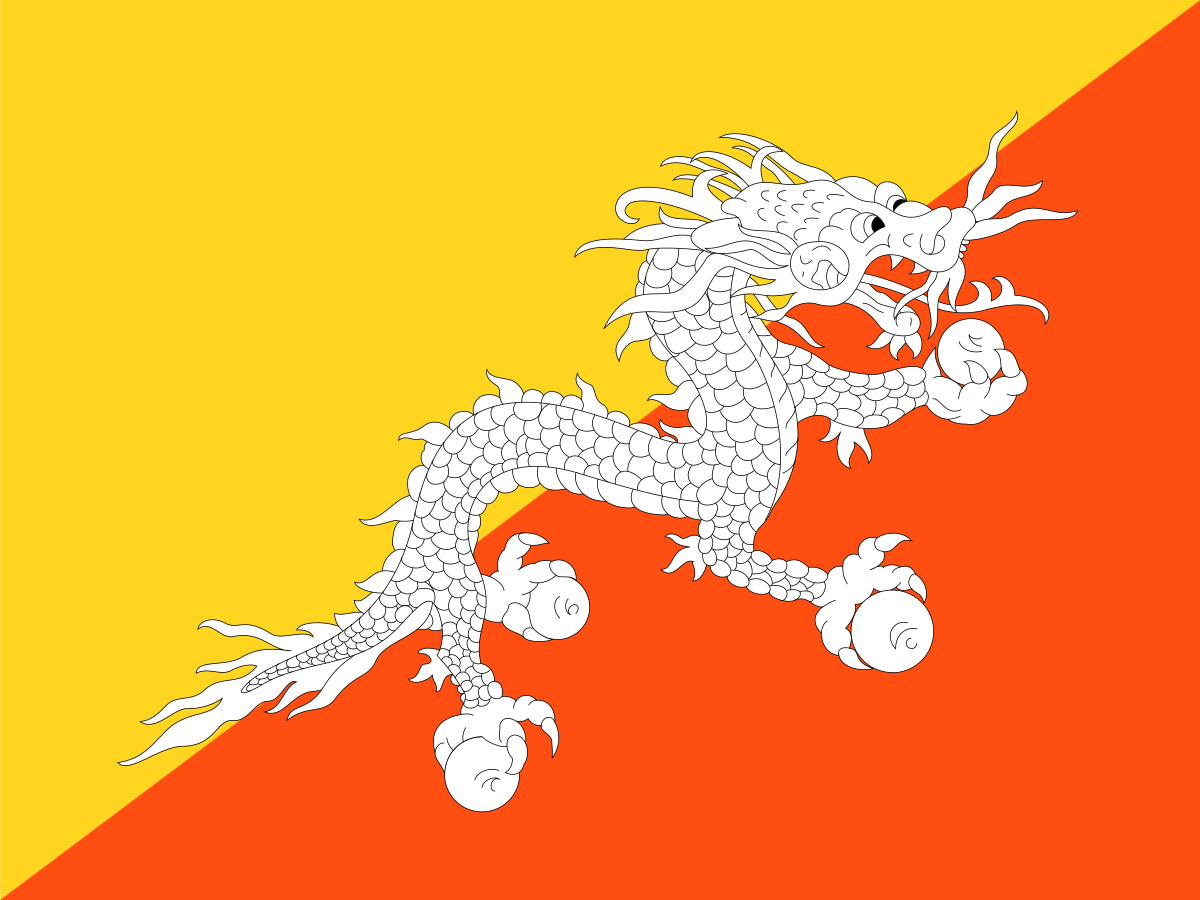
Bhutan Flag
Bhutan is a Himalayan kingdom famous for its dramatic mountains, Buddhist heritage and distinctive national identity. Its flag features a white dragon, known as the Druk, making it one of the world's most recognisable national flags.
Capital
Thimphu
Continent
Asia
Population
780 thousand
Development indicators
GDP per capita
$3,670
USD per year (approx. 2023)
Human Development Index
0.681
Medium development
World Bank income classification
Lower-Middle Income (LMIC)
LMIC
🌡️ Climate: Alpine / Subtropical
Flag symbolism
Orange represents Bhutan's Buddhist spiritual tradition, while saffron-yellow represents the country's secular authority and the monarchy. The white dragon represents the Druk, the thunder dragon of Bhutan, and holds jewels representing prosperity and security.
dragon
Did you know?
Bhutan is the only country in the world that measures its success using 'Gross National Happiness' instead of GDP.
Test your knowledge
Think you know your world flags? Try the FlagAtlas daily challenge, speed quiz, or explore all Asia flags.
📚 Revising for GCSE Geography? Visit our free revision page →
About Bhutan
Bhutan is a landlocked Himalayan kingdom between India and China. The country is known for its high mountains, Buddhist monasteries, traditional architecture and distinctive approach to preserving its culture and environment.
Thimphu is the capital and largest city. Bhutan remained relatively isolated from the outside world for much of its history, helping preserve traditions that are still central to national life.
CapitalThimphu
RegionSouth Asia
PopulationAbout 780,000
Area38,394 km²
CurrencyNgultrum
Official languageDzongkha
The flag of Bhutan
Bhutan's flag is divided diagonally into a yellow upper half and an orange lower half. A large white dragon crosses the boundary between the two colours.
The dragon is the Druk — the Thunder Dragon.
Bhutan is often called Druk Yul, meaning “Land of the Thunder Dragon”. The dragon is a central symbol of Bhutanese identity and appears in the country's national symbolism.
The present form of the flag developed from earlier Bhutanese designs and was formalised during the twentieth century.
What do the colours on Bhutan's flag mean?
The yellow half represents the secular authority of the monarchy, while the orange half represents the country's Buddhist spiritual tradition.
The combination reflects Bhutan's traditional relationship between spiritual and temporal authority. The diagonal division also gives the flag a distinctive appearance unlike most national flags.
What does the dragon on Bhutan's flag mean?
The white dragon is the Druk, the thunder dragon associated with Bhutan. Its white colour represents purity and the dragon is shown holding jewels in its claws.
The jewels symbolise wealth and prosperity. The dragon's snarling expression is traditionally associated with the strength and protection of the country.
A short history of Bhutan
Bhutan's history is closely connected with the development of Himalayan Buddhism. Buddhist teachers and religious institutions played an important role in shaping the country's political and cultural identity.
In the seventeenth century, Zhabdrung Ngawang Namgyal helped unify much of Bhutan and established a system of government combining religious and secular authority.
The Wangchuck dynasty was established in 1907 when Ugyen Wangchuck became the first hereditary King of Bhutan. The monarchy remains central to the country's identity.
Bhutan gradually opened to the outside world during the twentieth century. Television and the internet were introduced comparatively late, and the country continues to place strong emphasis on cultural preservation.
Bhutan's flag history
The national flag evolved from older Bhutanese designs and became more standardised as Bhutan developed its modern state institutions.
17th century — unificationZhabdrung Ngawang Namgyal unified much of Bhutan and established a dual system of spiritual and secular government.
1907 — hereditary monarchyUgyen Wangchuck became the first hereditary King of Bhutan.
20th century — modern flagThe yellow and orange diagonal design with the Druk was progressively standardised.
1970s–1990s — gradual openingBhutan increased contact with the wider world while continuing to protect traditional culture.
2008 — constitutional monarchyBhutan held its first democratic parliamentary elections and adopted a written constitution.
TodayThe Druk flag remains one of the strongest symbols of Bhutanese national identity.
Gross National Happiness
Bhutan is famous for the idea of Gross National Happiness, or GNH. Rather than judging national progress only through economic output, the framework considers wider aspects of wellbeing and development.
GNH is associated with areas including good governance, sustainable development, cultural preservation and environmental conservation. It has become one of Bhutan's best-known contributions to international discussions about how countries measure progress.
Buddhism and Bhutanese culture
Vajrayana Buddhism has a major influence on Bhutanese culture, architecture, festivals and daily life. Monasteries and dzongs are prominent features of the landscape.
Traditional festivals known as tshechus often include masked dances, music and religious ceremonies. They are important occasions for communities to gather and celebrate their heritage.
Dzongs — Bhutan's fortress monasteries
Dzongs are among Bhutan's most distinctive buildings. These large structures traditionally combined religious, administrative and defensive functions.
Many dzongs occupy dramatic positions beside rivers or on hillsides. Their architecture, whitewashed walls and timber details form an important part of Bhutan's visual identity.
Bhutan's mountains and geography
Bhutan is dominated by the Himalayas. Elevation rises sharply from the southern foothills towards some of the world's highest mountain ranges in the north.
The country has deep valleys, fast-flowing rivers and extensive forests. Its geography has historically made travel difficult and helped communities develop distinctive local traditions.
Forests and the environment
Bhutan has a strong reputation for environmental conservation and maintains extensive forest cover. Forests provide habitat for species including takin, red panda, Himalayan black bear and many birds.
Environmental protection is closely linked with Bhutan's development philosophy. The country has also promoted hydropower as an important source of electricity and export revenue.
Thimphu — the capital
Thimphu is Bhutan's capital and political centre. Unlike many world capitals, it has traditionally avoided traffic lights and retains a relatively low-rise character.
The city contains government buildings, monasteries, markets, museums and traditional Bhutanese architecture. It is also the main gateway to understanding modern Bhutan.
Bhutanese architecture and traditional dress
Bhutan places strong emphasis on preserving traditional visual culture. Traditional buildings commonly feature painted wooden windows, decorative motifs and sloping roofs.
Traditional clothing is also important. Men commonly wear the gho, while women traditionally wear the kira. These customs remain visible in schools, government offices and formal occasions.
Bhutan and the outside world
Bhutan followed a cautious approach to international tourism and modern communications for much of the twentieth century. Television was introduced only in 1999.
The country now has modern communications and a growing tourism industry, but the government continues to emphasise cultural preservation and controlled tourism.
Bhutan today
Bhutan is a constitutional monarchy. King Jigme Khesar Namgyel Wangchuck is the head of state, while elected institutions and the government manage day-to-day political affairs.
Bhutan's identity continues to combine monarchy, Buddhism, environmental protection, cultural traditions and gradual modernisation.
Why is Bhutan's flag unusual?
Bhutan's flag is unusual because the dragon is not a small emblem placed in a corner or shield. It dominates the design and stretches across the diagonal boundary between the two colours.
It is therefore a particularly good example of a flag where the central symbol carries much of the country's identity and history.
Explore Bhutan on FlagAtlas
Continue exploring Bhutan and the world's flags with these FlagAtlas resources.
Sources & further reading
Statistics and country indicators are dated because they can change over time. Historical and geographical information is presented as concise educational background for this FlagAtlas reference page.
Encyclopaedia Britannica — Bhutan · World Bank — Bhutan data