Americas
Brazil Flag
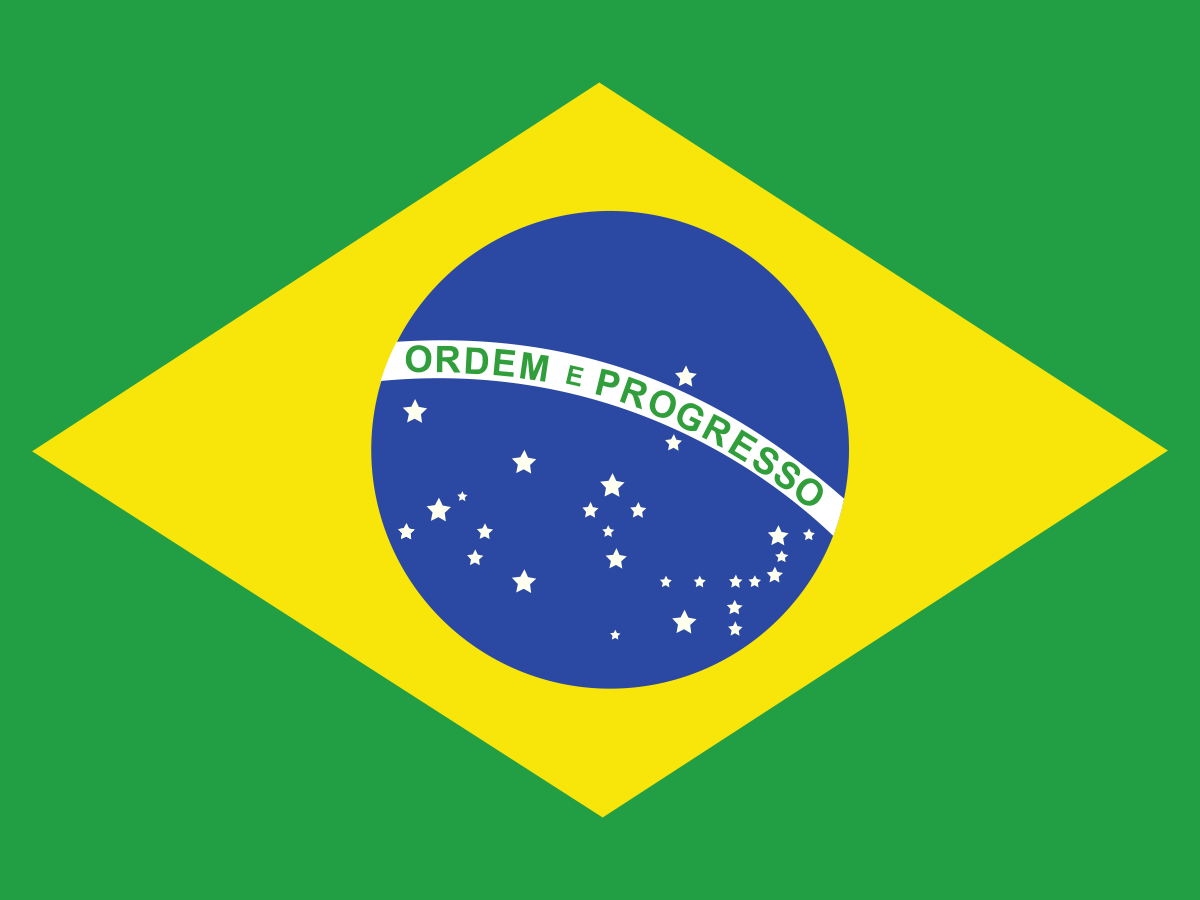
Brazil is the largest country in South America and one of the most geographically diverse countries on Earth. Its famous green, yellow and blue flag contains a star-filled globe and the Portuguese motto “Ordem e Progresso” — Order and Progress.
Capital
Brasília
Continent
Americas
Population
215.0 million
Development indicators
GDP per capita
$9,670
USD per year (approx. 2023)
Human Development Index
0.760
High development
World Bank income classification
Upper-Middle Income (UMIC)
UMIC
🌡️ Climate: Tropical rainforest / Savanna
Flag symbolism
The green and yellow colours have historical associations with Brazil's imperial period, while the blue globe and stars represent the sky over Rio de Janeiro at the time of the republic's proclamation. The white band carries the motto “Ordem e Progresso”.
starsglobetext
Did you know?
Brazil is the only country in South America where Portuguese is the official language.
Test your knowledge
Think you know your world flags? Try the FlagAtlas daily challenge, speed quiz, or explore all Americas flags.
📚 Revising for GCSE Geography? Visit our free revision page →
About Brazil
Brazil is the largest country in South America and the fifth-largest country in the world by area. It borders every South American country except Chile and Ecuador and has a vast Atlantic coastline.
Brasília is the capital, while São Paulo is the country's largest city. Brazil is famous for the Amazon rainforest, football, Carnival, Portuguese language and enormous cultural and geographic diversity.
CapitalBrasília
RegionSouth America
PopulationAbout 215 million
Area8,515,767 km²
CurrencyBrazilian real
Official languagePortuguese
The flag of Brazil
Brazil's flag consists of a green field, a large yellow diamond and a blue celestial globe crossed by a white band. The globe contains 27 white stars representing Brazil's federal units.
The stars are not random.
They depict the appearance of the sky over Rio de Janeiro at the moment the republic was proclaimed on 15 November 1889.
The white band carries the motto “Ordem e Progresso”, meaning “Order and Progress”.
What do the colours on Brazil's flag mean?
The green and yellow colours were inherited from Brazil's imperial flag and are traditionally associated with the royal houses connected with the country's monarchy. In popular explanations, green is also linked with Brazil's forests and yellow with its mineral wealth.
The blue globe represents the sky, while the white band carries the national motto. The combination creates one of the world's most distinctive national flags.
What do the stars on Brazil's flag mean?
There are 27 stars on the current flag: one for each of Brazil's 26 states and one for the Federal District.
The stars are arranged as constellations rather than simply scattered across the blue circle. The Southern Cross is particularly prominent. The arrangement represents a view of the night sky from Rio de Janeiro on the date the republic was proclaimed.
What does “Ordem e Progresso” mean?
The motto means “Order and Progress”. It was inspired by the ideas of French philosopher Auguste Comte and reflects the positivist thinking that influenced some of the republic's founders.
The motto is written across the white band in green lettering and is one of the most recognisable textual elements on any national flag.
A short history of Brazil
Brazil was home to many Indigenous peoples long before European arrival. Portuguese explorer Pedro Álvares Cabral reached the Brazilian coast in 1500, after which Portugal established a colonial presence.
Brazil became a major centre of the Portuguese Empire, with its economy shaped by sugar, gold, coffee and later other agricultural and mineral resources. The Atlantic slave trade brought millions of enslaved Africans to Brazil.
Brazil declared independence from Portugal in 1822. It became an empire under Pedro I and remained a monarchy until 1889, when the republic was proclaimed.
The twentieth century included periods of democracy and dictatorship before Brazil returned to civilian democratic government in 1985. A new constitution followed in 1988.
Brazil's flag history
The current flag developed from Brazil's earlier imperial and republican symbols. Its colours have historical roots, while the stars and motto were introduced to represent the new republic.
1500 — Portuguese arrivalPedro Álvares Cabral reached the Brazilian coast and Portugal established a colony.
1822 — independenceBrazil declared independence from Portugal under Pedro I.
1889 — republicThe monarchy was overthrown and Brazil became a republic.
1889 — republican flagThe first republican flag was introduced, soon replaced by the familiar green, yellow and blue design.
1960 — BrasíliaBrazil's capital moved from Rio de Janeiro to the newly built Brasília.
TodayThe flag remains unchanged in its essential design, with stars updated as federal units change.
The Amazon rainforest
Brazil contains the largest share of the Amazon rainforest, the world's largest tropical rainforest. The Amazon basin contains an extraordinary range of plants, animals and Indigenous cultures.
The forest plays an important role in regional climate, biodiversity and the global carbon cycle. Protecting it is one of Brazil's major environmental challenges.
The Amazon River
The Amazon is one of the world's great rivers and carries an enormous volume of water into the Atlantic Ocean. Its network of tributaries reaches deep into the interior of South America.
River transport is vital to many communities in the Amazon region, where roads can be limited and distances are enormous.
Brasília — Brazil's planned capital
Brasília became Brazil's capital in 1960, replacing Rio de Janeiro. The city was planned by urban planner Lúcio Costa and became famous for the modernist architecture of Oscar Niemeyer.
The city's distinctive layout and buildings were designed to symbolise a modern future for Brazil. Brasília is now a UNESCO World Heritage Site.
Rio de Janeiro
Rio de Janeiro is one of Brazil's best-known cities. It is famous for Sugarloaf Mountain, Christ the Redeemer, Copacabana Beach and its spectacular coastal setting.
Rio was Brazil's capital until 1960 and remains an important cultural and tourist centre. It is also central to Brazil's famous Carnival celebrations.
Brazilian Carnival
Brazil's Carnival is one of the world's most famous festivals. Celebrations combine music, dance, elaborate costumes and huge public parades.
The samba schools of Rio de Janeiro are particularly well known for their spectacular performances. Carnival traditions vary considerably across Brazil, reflecting the country's regional diversity.
Football and Brazilian culture
Football is deeply embedded in Brazilian popular culture. Brazil has won the men's FIFA World Cup more times than any other country, with five titles.
Players such as Pelé helped turn Brazilian football into a major part of the country's international image. Football is played throughout the country, from large stadiums to local streets and pitches.
Brazil's Indigenous peoples
Brazil is home to hundreds of Indigenous peoples and many Indigenous languages. Communities live in environments ranging from the Amazon rainforest to the cerrado and other regions.
Indigenous knowledge is especially important in discussions about biodiversity, forests and sustainable use of natural resources. Indigenous rights and land protection remain important national issues.
Brazil's wildlife
Brazil has extraordinary biodiversity. Its ecosystems include the Amazon rainforest, Atlantic Forest, Cerrado savanna, Pantanal wetlands and Caatinga drylands.
Wildlife includes jaguars, giant river otters, capybaras, toucans, macaws, anacondas and countless other species. The Pantanal is particularly important for wetland wildlife.
Brazil's economy
Brazil has one of the largest economies in the world and is a major producer of agricultural products, minerals, manufactured goods and energy.
Important exports include soybeans, coffee, sugar, meat, iron ore and aircraft. Brazil also has major offshore oil resources and a large renewable-energy sector.
Portuguese in Brazil
Brazil is the only country in the Americas where Portuguese is the national official language. Brazilian Portuguese developed from the language brought by Portuguese colonists and was influenced by Indigenous and African languages.
The result is a distinctive form of Portuguese with its own accents, vocabulary and regional variations.
Brazil today
Brazil is a federal presidential republic made up of 26 states and the Federal District. The country has a bicameral National Congress and a president who serves as both head of state and head of government.
Brazil continues to balance economic growth, social inequality, environmental protection and the development of its huge natural-resource base.
Why is Brazil's flag interesting?
Brazil's flag is unusual because its stars form an actual astronomical arrangement rather than a decorative pattern. It is also one of the few national flags to display a motto directly on the design.
Its combination of history, astronomy, geography and politics makes it an excellent example of how a national flag can tell a much larger story.
Explore Brazil on FlagAtlas
Continue exploring Brazil and the world's flags with these FlagAtlas resources.
Sources & further reading
Statistics and country indicators are dated because they can change over time. Historical and geographical information is presented as concise educational background for this FlagAtlas reference page.
Encyclopaedia Britannica — Brazil · World Bank — Brazil data