Asia
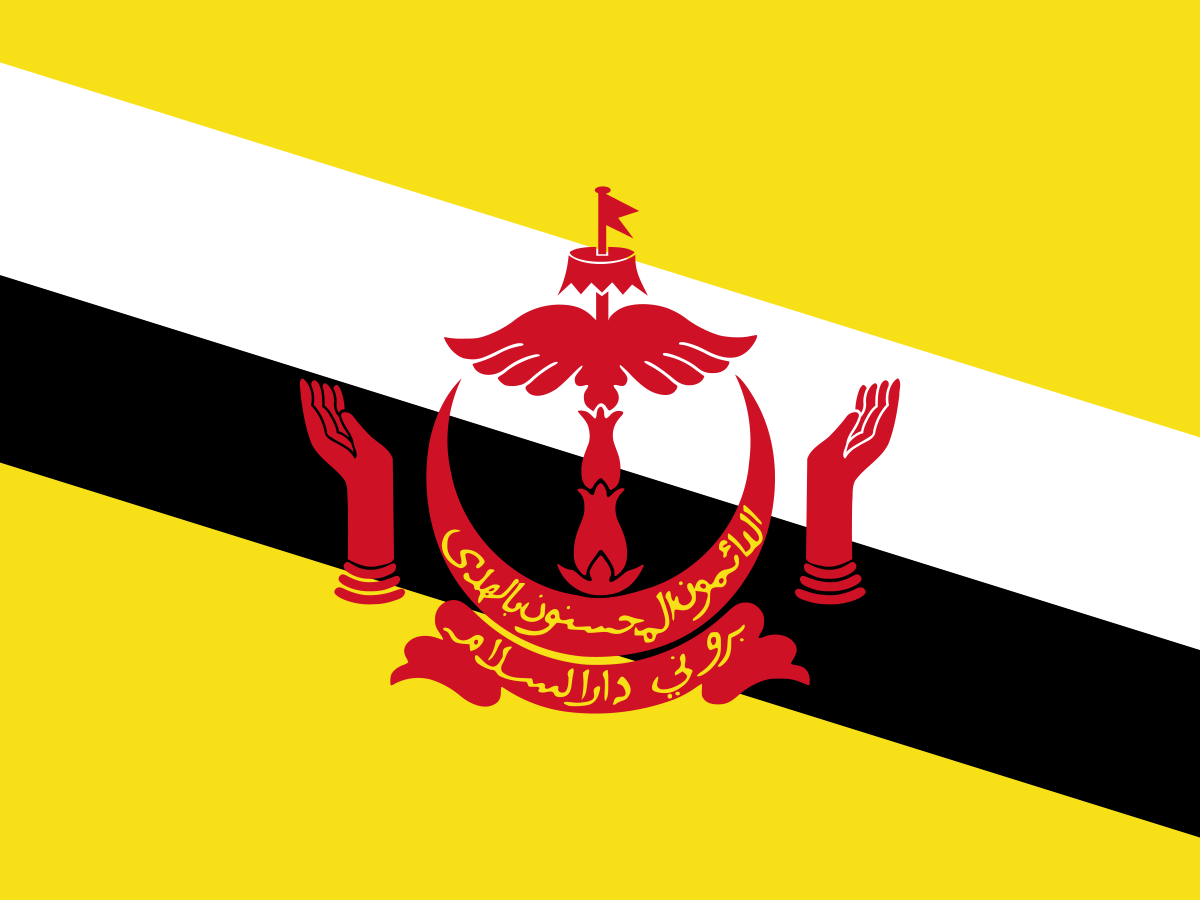
Brunei Flag
Brunei is a small, oil-rich sultanate on the island of Borneo in Southeast Asia. Its distinctive yellow flag, crossed by black and white bands and dominated by a red national emblem, reflects the country's monarchy, Islamic heritage and long political history.
Capital
Bandar Seri Begawan
Continent
Asia
Population
437 thousand
Development indicators
GDP per capita
$32,900
USD per year (approx. 2023)
Human Development Index
0.823
Very High development
World Bank income classification
High Income (HIC)
HIC
🌡️ Climate: Tropical rainforest
Flag symbolism
The yellow field represents the Sultan, while the black and white stripes are traditionally associated with Brunei's two chief ministers. The red emblem contains several symbols of the monarchy, Islam, government and national motto.
crescentcoat of arms
Did you know?
Brunei is one of the few absolute monarchies in the world and has free healthcare and education for all citizens.
Test your knowledge
Think you know your world flags? Try the FlagAtlas daily challenge, speed quiz, or explore all Asia flags.
📚 Revising for GCSE Geography? Visit our free revision page →
About Brunei
Brunei Darussalam is a small country on the north coast of the island of Borneo in Southeast Asia. It is surrounded by the Malaysian state of Sarawak and has a coastline on the South China Sea.
Bandar Seri Begawan is the capital and main urban centre. Brunei is one of the world's smaller countries by population but has considerable wealth from oil and natural gas.
CapitalBandar Seri Begawan
RegionSoutheast Asia
PopulationAbout 450,000
Area5,765 km²
CurrencyBrunei dollar
Official languageMalay
The flag of Brunei
Brunei's flag has a yellow field crossed diagonally by black and white stripes. At the centre is a red national emblem containing a parasol, crescent, hands, flags and the country's motto.
Yellow has a royal connection.
Yellow is traditionally associated with Brunei's Sultan. The colour is also strongly connected with the Malay royal tradition.
The current flag was adopted in 1959 and has remained in use through Brunei's transition to full independence in 1984.
What do the colours on Brunei's flag mean?
Yellow represents the Sultan. The black and white diagonal stripes are traditionally associated with Brunei's two chief ministers, known by their traditional titles.
The colours and emblem therefore connect the flag closely with Brunei's system of monarchy and government rather than simply representing the landscape.
What does the red emblem mean?
The central red emblem is packed with symbols. The crescent represents Islam, Brunei's official religion, while the parasol represents royalty.
Two hands appear below the crescent and represent the government's duty to protect and serve the people. The emblem also includes flags, a mast-like staff and other royal and governmental symbols.
Brunei's national motto
The crescent on the emblem contains Brunei's national motto in Arabic script. The motto is commonly translated as “Always in service with God's guidance”.
The wording reflects the close relationship between Islam, the monarchy and the state's identity.
A short history of Brunei
Brunei has a long history on the island of Borneo. It became a powerful regional sultanate during the fifteenth and sixteenth centuries, with influence extending across parts of northern Borneo and nearby islands.
European powers increasingly became involved in Borneo during the nineteenth century. Brunei's territory gradually contracted, and in 1888 it became a British protectorate.
The country gained internal self-government in stages and became fully independent on 1 January 1984. Sultan Hassanal Bolkiah became the country's second Sultan in 1967 and remains the head of state.
Brunei's flag history
The flag has its roots in Brunei's nineteenth- and twentieth-century political development and was modified as the modern state took shape.
15th–16th centuries — Brunei SultanateBrunei became a major regional power with influence around northern Borneo.
1888 — British protectorateBrunei became a British protected state while retaining its Sultanate.
1906 — British ResidentBritish administrative influence increased while the Sultan remained the traditional ruler.
1959 — modern constitutionBrunei gained internal self-government and the modern flag and national symbols were established in their current form.
1984 — independenceBrunei became fully independent from Britain on 1 January.
TodayThe flag remains a central symbol of the Sultanate, Islam and Brunei's national identity.
The Brunei Sultanate
The Sultanate has been the central institution of Brunei's political identity for centuries. The modern monarchy traces its history through a long succession of Sultans.
Brunei's political system is unusual in the modern world because the Sultan combines the roles of monarch, head of state and head of government.
Oil and natural gas
Brunei's modern prosperity is closely connected with petroleum. Oil was discovered at Seria in 1929, and commercial production transformed the country's economy.
Natural gas is also extremely important. Revenue from energy exports has helped fund public services and produced a high standard of living compared with many countries in the region.
Bandar Seri Begawan
Bandar Seri Begawan is Brunei's capital and the centre of government, commerce and national culture. The city is famous for the magnificent Sultan Omar Ali Saifuddien Mosque.
The city also contains water villages known as Kampong Ayer, where homes and other buildings stand above the Brunei River.
Kampong Ayer — the water village
Kampong Ayer is one of Brunei's most distinctive settlements. Communities have lived along the Brunei River for centuries, with homes connected by wooden and modern walkways.
It has often been described as a “water village” and remains an important part of Brunei's cultural heritage despite the growth of modern urban areas on land.
Islam and Brunei
Islam is central to Brunei's national identity and is the country's official religion. The Sultan is also closely connected with the religious life of the state.
Brunei follows a legal system that combines common-law traditions with Islamic law. In 2014, the country began introducing the Syariah Penal Code in stages.
Rainforest and wildlife
Brunei retains extensive areas of tropical rainforest, including protected forest reserves. The country's forests are part of the wider biodiversity-rich environment of Borneo.
Wildlife includes proboscis monkeys, hornbills, clouded leopards and many other species. Brunei's forests also form part of one of the world's important tropical ecosystems.
Ulu Temburong National Park
Ulu Temburong National Park protects a large area of pristine rainforest in eastern Brunei. It is often called the “Green Jewel of Brunei”.
The park is known for forest trails, rivers and a canopy walkway that provides views over the rainforest. Access is deliberately limited to help protect the environment.
Brunei's culture
Bruneian culture is strongly influenced by Malay traditions and Islam. Traditional clothing, ceremonies, food and architecture remain important parts of national life.
Malay is the official language, while English is widely used in education, business and international communication. Brunei's population also includes Chinese and other communities.
Brunei's economy
Oil and natural gas have historically dominated Brunei's economy. The government has also encouraged diversification into areas such as tourism, finance, food production and other services.
Brunei's small population and substantial energy revenues have allowed the state to provide extensive public services, although dependence on hydrocarbons remains an important economic challenge.
Brunei today
Brunei is an absolute monarchy under Sultan Hassanal Bolkiah. The Sultan serves as head of state and head of government and holds extensive executive authority.
The country is a member of ASEAN, the United Nations and the Commonwealth. Its political system and close relationship between monarchy and Islam make it distinctive within Southeast Asia.
Why is Brunei's flag interesting?
Brunei's flag is unusual because almost every major element has a direct connection with the country's political and religious system. The yellow field points towards the monarchy, the diagonal stripes recall the traditional government structure and the red emblem combines royal and Islamic symbolism.
It is therefore an excellent example of a national flag that functions almost like a compact diagram of a country's constitutional and cultural identity.
Explore Brunei on FlagAtlas
Continue exploring Brunei and the world's flags with these FlagAtlas resources.