About Comoros
Comoros is a small island country in the western Indian Ocean, between Madagascar and the coast of East Africa. The country is made up of volcanic islands with tropical forests, beaches and dramatic mountainous landscapes.
Moroni, on Grande Comore, is the capital. Comoros is culturally influenced by Africa, the Arab world, Madagascar and centuries of Indian Ocean trade.
CapitalMoroni
RegionIndian Ocean / Africa
PopulationAbout 900,000
Area1,861 km²
CurrencyComorian franc
LanguagesComorian, French & Arabic
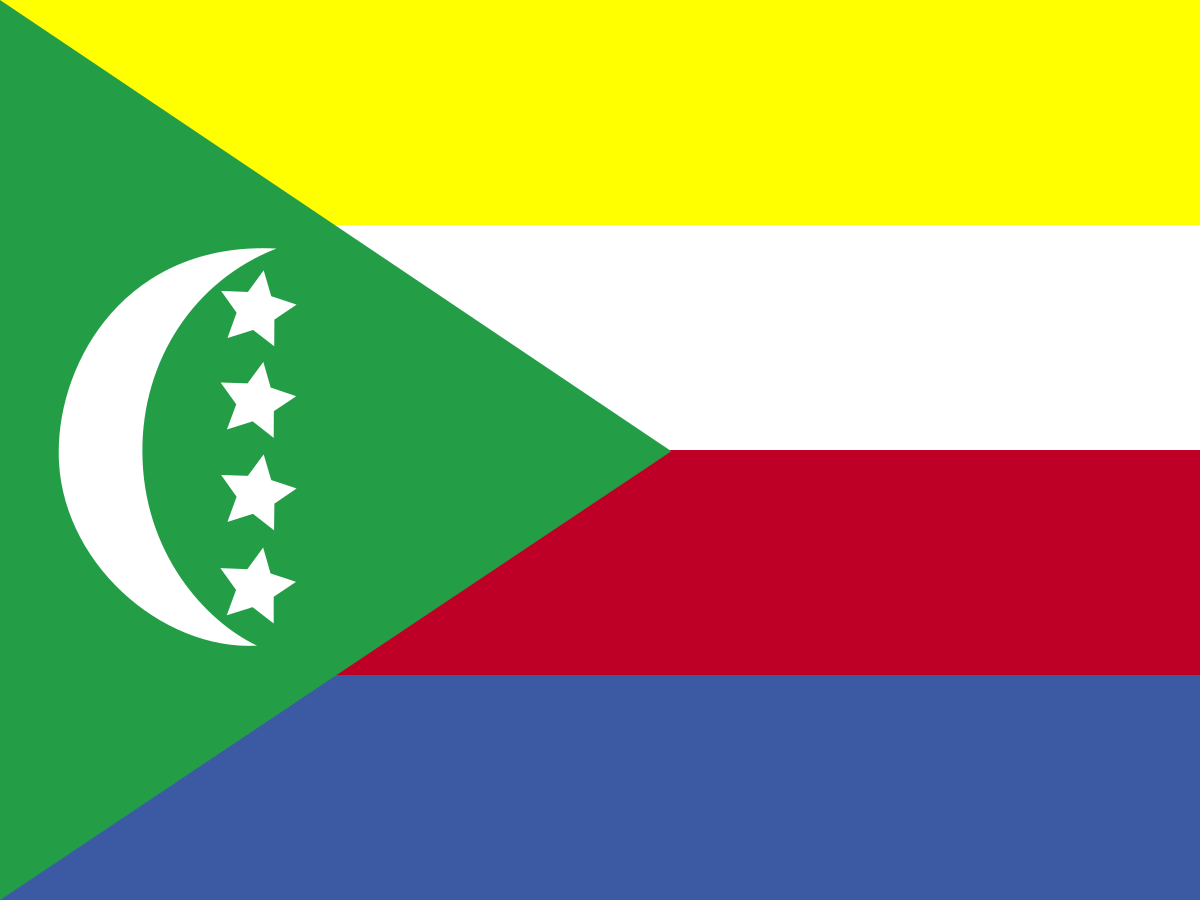
The flag of Comoros
The Comoros flag is unusually rich in symbolism. It has four horizontal bands of yellow, white, red and blue, a green triangle at the hoist, and a white crescent containing four stars.
The four stars and four coloured bands represent the four main islands of the Comoros archipelago.
The green colour, crescent and stars also reflect the country's strong Islamic heritage.
The current flag was adopted in 2001, after several earlier versions were used following independence.
What do the colours mean?
Green is associated with Islam, while the white crescent and stars also reflect the country's Muslim identity. The four colours are linked to the four principal islands and have also been given individual symbolic interpretations.
The flag's design is therefore both geographical and cultural: the four colours represent the islands, while the Islamic symbols identify a major part of Comorian history and identity.
Why are there four stars?
The four stars represent the four main islands traditionally associated with the Comoros archipelago: Grande Comore, Mohéli, Anjouan and Mayotte.
Mayotte is geographically part of the Comoros island group but is administered by France today. The inclusion of all four islands in the flag reflects the historical concept of the Comoros archipelago as a whole.
Why does the flag have a crescent?
The crescent is an Islamic symbol and reflects the fact that Islam is central to Comorian history and culture. The four stars sit within the crescent, reinforcing the connection between the country's islands and its religious heritage.
Comoros is one of the world's countries where Islam has a particularly strong influence on everyday life, traditions and national identity.
Mayotte and the Comoros flag
Mayotte is one of the four main islands of the Comoros group, but its political status is unusual. France administers Mayotte as an overseas department and region.
The Comorian government continues to regard Mayotte as part of the country's territory. This makes the four-star design of the national flag especially significant when explaining the country's geography and history.
A short history of Comoros
The islands have been connected to Indian Ocean trade for centuries. Arab and Persian merchants helped establish Islam and trading settlements, while African, Malagasy and other influences also shaped the population.
European powers became increasingly involved in the islands during the nineteenth century. France established colonial control over the Comoros, while Mayotte came under French control earlier than the other islands.
The Comoros became independent from France in 1975. Mayotte remained under French administration, creating a territorial dispute that continues today.
Flag history timeline
Before European ruleThe islands developed through Indian Ocean trade and a mixture of African, Arab, Persian and Malagasy influences.
1800s — French influenceFrance expanded its control over the islands, with Mayotte becoming a particularly important French possession.
1960s–1970s — autonomyThe Comoros moved towards self-government as French colonial rule weakened.
1975 — independenceGrande Comore, Mohéli and Anjouan became independent as the Comoros. Mayotte remained with France.
1990s–2000s — flag changesSeveral national flags were used as the country experimented with different political and Islamic symbolism.
2001 — current flagThe present four-colour, four-star and crescent design was adopted.
The islands of Comoros
The three islands administered by the independent Comoros are Grande Comore, Mohéli and Anjouan. Together with Mayotte, they form the main islands of the Comoros archipelago.
Each island has its own landscape and character. Grande Comore is dominated by the massive volcanic Mount Karthala, while Anjouan is famous for steep mountains and lush vegetation. Mohéli is smaller and particularly important for marine conservation.
Grande Comore and Mount Karthala
Grande Comore is the largest of the islands and home to Moroni. The island is dominated by Mount Karthala, one of the world's most active volcanoes.
Karthala's eruptions have repeatedly changed the landscape. The volcanic nature of the island also explains why much of the ground is dark, rocky and relatively young compared with older continental landscapes.
Anjouan
Anjouan is known for its steep volcanic terrain, forests and waterfalls. The island has a relatively high population density and a long history of farming and trade.
Its mountainous interior creates a striking landscape despite the island's small size.
Mohéli
Mohéli is the smallest of the three independent Comorian islands. Its waters and coastal ecosystems are particularly important for marine conservation.
The Mohéli Marine Park was established to protect coral reefs, sea turtles and other marine life. The island is also known for its relatively unspoilt natural environment.
Moroni — the capital
Moroni is located on the western coast of Grande Comore. It is the political and commercial centre of the country and contains the country's main port.
The old city includes narrow streets, traditional buildings and mosques reflecting the islands' long connections with the Islamic world and Indian Ocean trade.
Indian Ocean trade
Comoros sits on an important historic route between East Africa, Madagascar, the Arabian Peninsula and the wider Indian Ocean. Traders brought goods, ideas, languages and religions to the islands.
This history helps explain why Comorian culture contains a distinctive mixture of African, Arab, Persian, Malagasy and French influences.
Islam and Comorian culture
Islam is the dominant religion in Comoros and has influenced architecture, education, festivals, family life and national identity for centuries.
Most Comorians are Sunni Muslims. Mosques are prominent features of towns and villages, and religious celebrations are an important part of community life.
Languages
Comoros has three official languages: Comorian, French and Arabic. Comorian is a group of closely related Bantu languages with strong Swahili and Arabic influences.
French is important in administration and education, while Arabic has an important religious and cultural role.
Vanilla, ylang-ylang and perfume
Comoros is famous for producing ylang-ylang, a fragrant flower used in perfumes and cosmetics. The islands also produce vanilla, cloves and other agricultural products.
The tropical climate and volcanic soils support these crops, while the perfume industry gives Comoros an unusual place in global fragrance supply chains.
Marine life and conservation
The waters around Comoros contain coral reefs, sea turtles, dolphins and other marine life. The islands are part of the wider biodiversity-rich western Indian Ocean.
Conservation projects focus on protecting reefs, forests and nesting beaches while supporting local communities that depend on fishing and tourism.
Climate and geography
Comoros has a tropical maritime climate, with warm temperatures throughout the year and a wetter season influenced by the southwest Indian Ocean monsoon.
The islands are volcanic and mountainous, with limited flat land. Heavy rainfall, cyclones and volcanic activity can all affect communities.
Comoros today
Comoros is a small lower-middle-income island country whose economy depends heavily on agriculture, fishing, remittances and services.
Its geography creates challenges including limited land, high transport costs and exposure to climate and natural hazards. At the same time, its biodiversity, volcanic scenery and distinctive culture provide opportunities for sustainable tourism.
Why is the Comoros flag interesting?
The Comoros flag manages to tell a surprisingly detailed story in a small amount of space. The four colours and four stars connect it to the four main islands, while the crescent and green colour reflect Islam.
The flag also opens the door to one of the most interesting territorial stories in the Indian Ocean: the relationship between independent Comoros and French-administered Mayotte.
Explore Comoros on FlagAtlas
Continue exploring Comoros and the world's flags with these FlagAtlas resources.