About Costa Rica
Costa Rica is a small country in Central America between Nicaragua and Panama, with coastlines on both the Pacific Ocean and Caribbean Sea. Despite its size, it contains an extraordinary variety of landscapes and ecosystems.
San José is the capital and largest urban centre. Costa Rica is particularly well known for tropical forests, volcanoes, wildlife, coffee, beaches and its long-running emphasis on peace and environmental conservation.
CapitalSan José
RegionCentral America
PopulationAbout 5.1 million
Area51,100 km²
CurrencyCosta Rican colón
Official languageSpanish
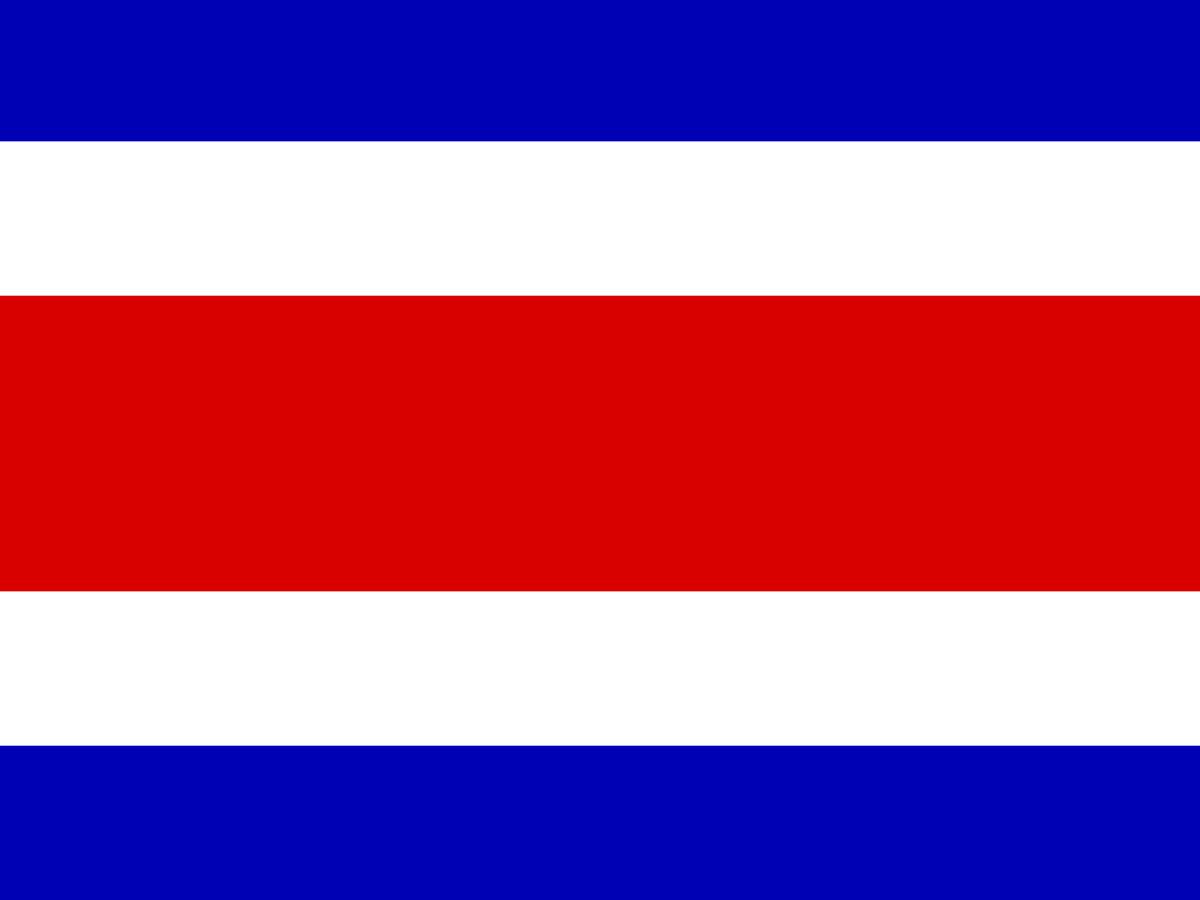
The flag of Costa Rica
Costa Rica's flag has five horizontal stripes of blue, white, red, white and blue. The central red stripe is twice the height of each blue or white stripe.
The flag has two official forms.
The version with the national coat of arms is used by the government and on official buildings, while the plain blue-white-red flag is widely used by the public.
The colours are closely connected with the ideals associated with Costa Rica's independence and national identity.
What do the colours mean?
Blue is traditionally associated with the sky, opportunity and the two oceans surrounding Costa Rica. White represents peace, wisdom and the purity of the country's ideals. Red represents the warmth of the people and the blood shed in the struggle for independence.
The three colours were inspired by the ideals associated with the French Revolution and were adopted in Costa Rica during the nineteenth century.
Why does Costa Rica have two flag versions?
Costa Rica has a distinction between its state flag and its simpler civil flag. The state flag includes the national coat of arms, while the plain tricolour is commonly flown by citizens.
This makes Costa Rica a useful example of the difference between a national symbol used by government and a version used more widely by the public.
The coat of arms
The coat of arms shows three volcanoes and two oceans, representing Costa Rica's location between the Pacific and Caribbean. Three stars above the volcanoes represent the country's provinces.
Ships on the oceans represent Costa Rica's maritime connections, while the rising sun represents a new era. The words República de Costa Rica identify the country.
A short history of Costa Rica
Before European arrival, the territory was home to several Indigenous peoples, including the Chorotega and Bribri. Spanish colonisation began in the sixteenth century, although Costa Rica remained relatively poor and isolated compared with some other parts of the Spanish Empire.
Central America became independent from Spain in 1821. Costa Rica was initially part of the Federal Republic of Central America before becoming fully independent as a separate state.
During the nineteenth and twentieth centuries, coffee became an important export and helped finance infrastructure and the development of San José and other settlements.
San José — the capital
San José lies in the Central Valley and is the political, economic and cultural centre of Costa Rica. The surrounding highlands have a relatively mild climate compared with the tropical lowlands.
The city contains museums, theatres, historic buildings, markets and universities. It also acts as the main gateway for much of the country's transport network.
Volcanoes of Costa Rica
Costa Rica lies along the Pacific Ring of Fire and has a chain of volcanoes running through the country. Some are active, while others are dormant or extinct.
Arenal is one of the country's most famous volcanoes, while Poás and Irazú are also well-known. Volcanic activity has helped create fertile soils that support agriculture.
Rainforests and biodiversity
Costa Rica contains a remarkable proportion of the world's biodiversity for such a small country. Tropical forests, cloud forests, mangroves and dry forests provide habitats for thousands of species.
Wildlife includes sloths, monkeys, toucans, frogs, jaguars and sea turtles. Conservation areas and national parks protect a large share of the country's land.
National parks
National parks are a major part of Costa Rica's identity and tourism industry. Protected areas include Corcovado National Park, Manuel Antonio National Park, Tortuguero and Arenal Volcano National Park.
These parks protect forests, wetlands, mountains, beaches and marine environments while allowing carefully managed tourism and research.
Costa Rica and conservation
Costa Rica is widely known for its environmental policies and protected areas. The country has restored significant areas of forest after decades of deforestation.
Its approach combines national parks, private reserves, ecotourism, reforestation and renewable electricity. This has made Costa Rica an important case study in conservation and sustainable development.
Coffee and agriculture
Costa Rican coffee is famous for its quality. Coffee grows particularly well in the country's highlands, where volcanic soils, altitude and climate provide favourable conditions.
Other important agricultural products include bananas, pineapples, sugar and ornamental plants. Agriculture remains important even though services and tourism now make up much of the modern economy.
Beaches and two coastlines
Costa Rica has very different coastlines on its two sides. The Pacific coast has numerous beaches, bays and surf destinations, while the Caribbean coast is known for coral reefs, rainforest and a distinctive Afro-Caribbean cultural influence.
This geography means visitors can experience very different landscapes within a relatively short distance.
Why did Costa Rica abolish its army?
After a brief civil war in 1948, Costa Rica made the historic decision to abolish its standing army. The decision became a major part of the country's national identity.
Resources that might otherwise have been devoted to a military were redirected towards areas such as education and social programmes. Costa Rica still maintains police and security forces, but it does not have a conventional standing army.
Education and quality of life
Costa Rica has long placed significant emphasis on education and public services. Literacy is high by regional standards and the country has developed a strong healthcare system.
Its relatively stable democratic institutions and long period without a conventional military have helped distinguish Costa Rica from many of its neighbours.
Renewable energy
Costa Rica generates a very high proportion of its electricity from renewable sources. Hydroelectric power provides much of the supply, with geothermal, wind and solar also contributing.
Geothermal energy is particularly useful because Costa Rica's volcanic geology provides a natural source of underground heat.
Culture and traditions
Costa Rican culture combines Indigenous, Spanish, African and Caribbean influences. Music, food, football and local festivals are important parts of everyday life.
The phrase “Pura Vida” is closely associated with Costa Rica. Literally meaning “pure life”, it is commonly used as a friendly expression and has become an important part of the country's international image.
Football in Costa Rica
Football is Costa Rica's most popular sport. The national team is known as La Sele and has represented the country at multiple FIFA World Cups.
Costa Rica produced one of the biggest surprises of the 2014 World Cup, reaching the quarter-finals after finishing above England, Italy and Uruguay in a difficult group.
Costa Rica today
Costa Rica is a democratic republic with an economy based on services, tourism, manufacturing, agriculture and technology. It has developed a growing high-tech and medical-device manufacturing sector alongside its traditional exports.
Tourism remains particularly important because visitors are attracted by wildlife, beaches, volcanoes, forests and the country's reputation for ecotourism.
Why is Costa Rica's flag interesting?
Costa Rica's flag is more than a simple blue, white and red tricolour. Its unusual stripe proportions, two official versions and detailed coat of arms give it several layers of meaning.
It also provides a fascinating link between flags, national identity and the country's unusual political history — particularly its decision to abolish its army and invest heavily in civilian institutions.
Flag history timeline
Before the 1500sDifferent Indigenous cultures developed across the region before European colonisation.
1500s — Spanish ruleSpain established colonial control over the territory that became Costa Rica.
1821 — independenceCosta Rica became independent from Spain as part of the wider Central American independence movement.
1848 — Republic of Costa RicaCosta Rica became a sovereign republic and developed the foundations of its modern national symbols.
1964 — coat of arms updatedThe modern form of the coat of arms was established after changes to the number of provinces represented.
TodayThe blue, white and red flag remains one of Costa Rica's most recognisable national symbols.
Explore Costa Rica on FlagAtlas
Continue exploring Costa Rica and the world's flags with these FlagAtlas resources.