About Croatia
Croatia is a country in southeastern Europe on the Adriatic Sea. It shares land borders with Slovenia, Hungary, Serbia, Bosnia and Herzegovina and Montenegro. Its long coastline and hundreds of islands have made the country especially well known for tourism and maritime history.
Zagreb is the capital and largest city. Croatia is a member of the European Union and uses the euro. Its geography ranges from the flat Pannonian plain in the north and east to mountains, forests, islands and a long Mediterranean coastline.
CapitalZagreb
RegionSoutheastern Europe
PopulationAbout 3.9 million
CurrencyEuro (€)
Official languageCroatian
CoastlineAdriatic Sea
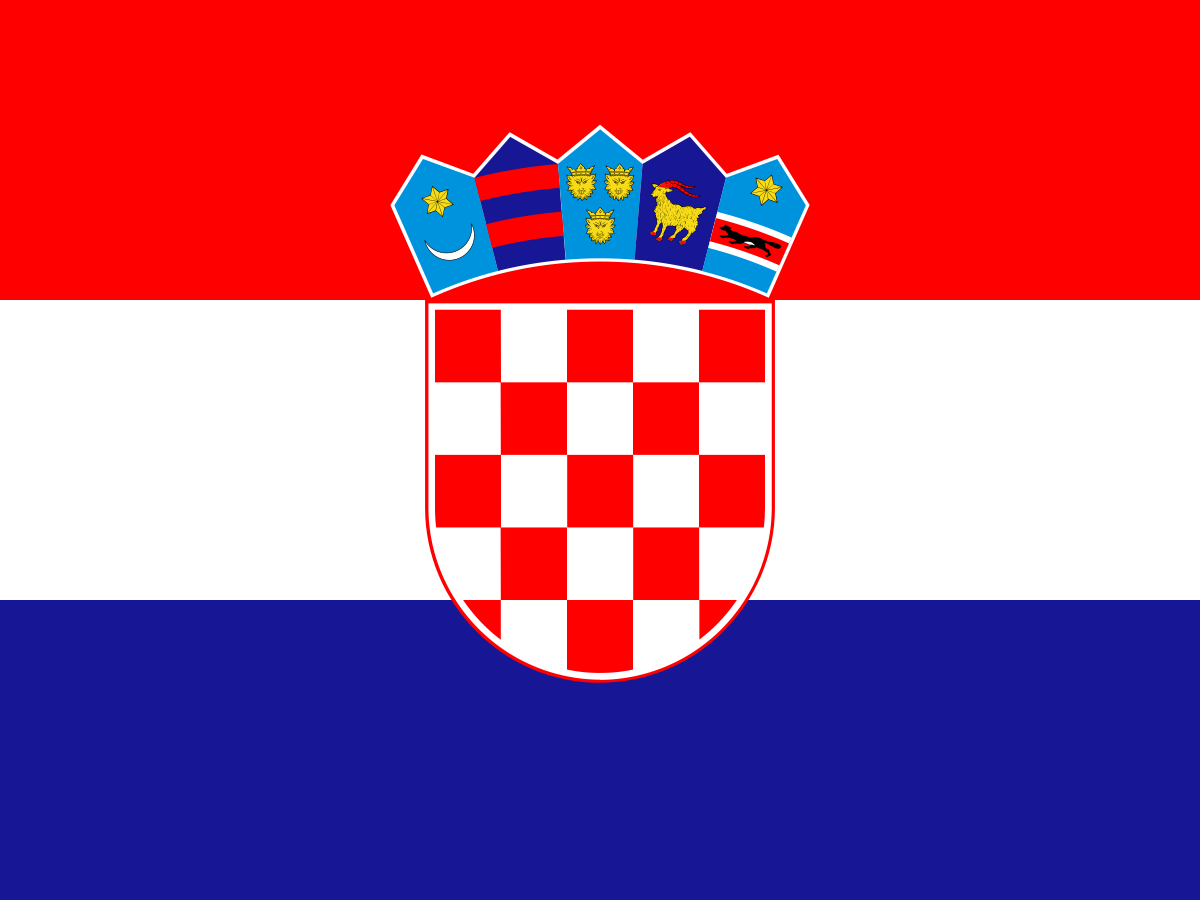
The flag of Croatia
Croatia's national flag consists of three horizontal stripes: red, white and blue. At the centre is the Croatian coat of arms, topped by a distinctive crown made up of five smaller historic shields.
The coat of arms is the feature that makes Croatia's flag particularly distinctive.
The five smaller shields represent historic lands associated with Croatian identity, while the main chequered shield is one of the country's oldest national symbols.
The red, white and blue colours are commonly associated with the wider Pan-Slavic tradition and became important to Croatian national identity during the nineteenth century.
What do the colours mean?
Red, white and blue are traditional Croatian national colours and are also found in the flags of several other Slavic countries. Rather than each colour having one simple official meaning, the combination developed through Croatian history and national movements.
The colours are closely associated with Croatian identity and appear in many historic Croatian flags, coats of arms and political symbols.
The Croatian coat of arms
The central shield has a distinctive red-and-white chequered pattern known as the šahovnica. Above it are five smaller shields arranged in a crown.
The five shields represent historic Croatian regions or lands: the oldest known Croatian coat of arms, Dubrovnik, Dalmatia, Istria and Slavonia. Together they create one of the most recognisable coats of arms in Europe.
What do the five crowns represent?
The five smaller shields above the main Croatian shield are not simply decorative. They represent important historic regions associated with Croatian identity.
Old Croatia is represented by a historic star and crescent design. Dubrovnik is represented by two red stripes on a blue field. Dalmatia has three crowned leopard heads. Istria has a golden goat. Slavonia has a marten, a star and a red-edged field.
A short history of Croatia
Croatia's history stretches back through Roman, medieval and early modern periods. The medieval Croatian kingdom emerged in the early Middle Ages and developed connections with neighbouring European powers.
From the nineteenth century, Croatian national movements promoted greater political and cultural autonomy. After the First World War, Croatia became part of the Kingdom of Serbs, Croats and Slovenes, later known as Yugoslavia.
Following the breakup of Yugoslavia, Croatia declared independence in 1991. The Croatian War of Independence followed, and Croatia eventually established itself as an independent European state.
Zagreb — the capital
Zagreb lies in northern Croatia near the southern slopes of Medvednica mountain. It is the country's political, economic, educational and cultural centre.
The city combines a medieval Upper Town with nineteenth- and twentieth-century districts, museums, galleries, theatres and universities. Zagreb also plays an important role in Croatia's transport network.
The Adriatic coast
Croatia has one of Europe's most famous Adriatic coastlines. The shore is highly indented, with bays, peninsulas and a large number of islands and islets.
The coast has a Mediterranean climate in many areas, with hot, dry summers and milder, wetter winters. Historic port towns and beaches make the Adriatic a major part of Croatia's tourism industry.
Croatia's islands
Croatia has more than a thousand islands, islets and reefs, although only a portion are permanently inhabited. Among the best known are Krk, Cres, Brač, Hvar, Korčula and Pag.
The islands vary considerably. Some are covered with Mediterranean vegetation, while others contain vineyards, olive groves, historic villages and popular resorts.
Dubrovnik — the Pearl of the Adriatic
Dubrovnik is one of Croatia's best-known historic cities. Its old city is enclosed by massive stone walls overlooking the Adriatic and is recognised as a UNESCO World Heritage Site.
For centuries Dubrovnik was the centre of the independent Republic of Ragusa, a maritime trading state. Its historic importance is also why Dubrovnik appears as one of the five shields in Croatia's coat of arms.
Split and Diocletian's Palace
Split developed around the enormous Roman palace built for Emperor Diocletian in the early fourth century. Parts of the ancient palace remain integrated into the modern city.
The historic centre of Split is a UNESCO World Heritage Site and demonstrates how Roman architecture was adapted and reused over many centuries.
Plitvice Lakes National Park
Plitvice Lakes is one of Croatia's most famous natural attractions. The park contains a chain of turquoise lakes connected by waterfalls and cascades.
Forests surrounding the lakes provide habitat for species including bears, wolves, deer and numerous birds. The area is protected as a national park and is also a UNESCO World Heritage Site.
Croatia's mountains and geography
Croatia has surprisingly varied geography for a relatively small country. The north and east contain flatter agricultural landscapes, while the Dinaric Alps run through much of the western and central country.
The mountains separate parts of the interior from the Adriatic coast and have influenced settlement, transport and climate throughout Croatian history.
Climate
Croatia has several climate zones. The Adriatic coast has a Mediterranean climate, the interior has more continental conditions, and mountainous areas are cooler and wetter.
This variation helps explain why Croatia can have sunny beaches, snowy mountain landscapes and fertile agricultural plains within the same country.
The origin of the cravat
The modern word cravat is linked to the Croatian word for Croat. During the seventeenth century, Croatian soldiers serving in European armies were noted for wearing distinctive neck cloths.
The style became fashionable in France and developed into the modern necktie. Croatia therefore has an unusual cultural connection with an item of clothing now worn around the world.
Croatian language and culture
Croatian is a South Slavic language written mainly using the Latin alphabet. It is closely related to Serbian, Bosnian and Montenegrin, although each has its own standard forms and cultural identity.
Croatian culture includes regional traditions from the continental interior, Adriatic coast and islands. Food, music, festivals, folk costumes and crafts vary considerably from one area to another.
Food in Croatia
Croatian cuisine reflects the country's geography and history. Along the coast, seafood, olive oil, herbs and Mediterranean ingredients are common, while inland cuisine includes meat, stews, pastries and dishes influenced by Central Europe.
Regional specialities include pašticada, štrukli, fresh Adriatic fish and various cured meats and cheeses.
Football in Croatia
Football is hugely popular in Croatia. The national team is known for its red-and-white chequered shirts, echoing the šahovnica on the national coat of arms.
Croatia reached the 2018 FIFA World Cup final and finished third at the 2022 World Cup. Its success is remarkable given the country's relatively small population.
Croatia and the European Union
Croatia joined the European Union on 1 July 2013. It later adopted the euro and joined the Schengen Area in 2023.
Membership has strengthened Croatia's economic and political links with other European countries and made travel across much of the EU easier.
Tourism in Croatia
Tourism is one of Croatia's most important economic activities. Visitors are attracted by the Adriatic coastline, historic cities, national parks, islands, food and cultural heritage.
The country has become particularly popular for sailing, beach holidays, walking, heritage tourism and visits to historic towns such as Dubrovnik, Split, Zadar and Rovinj.
Croatia today
Croatia is a parliamentary republic and a member of the European Union, NATO and other international organisations. Its economy combines tourism, manufacturing, services, agriculture, transport and technology.
The country continues to balance the benefits of tourism with the need to protect its coastline, historic sites, forests and other natural environments.
Why is Croatia's flag interesting?
Croatia's flag is a great example of how a simple tricolour can carry a huge amount of history. The red, white and blue stripes connect modern Croatia with nineteenth-century national identity, while the central coat of arms brings together symbols from several historic Croatian lands.
The flag also provides a direct connection between heraldry, national identity and the country's complicated twentieth-century history, including the period when Croatia was part of Yugoslavia before becoming independent again.
Flag history timeline
Medieval CroatiaDifferent Croatian rulers and territories used heraldic symbols that later influenced Croatian national identity.
1800s — national revivalRed, white and blue became strongly associated with Croatian national movements.
1918 — Yugoslav stateCroatia became part of the new South Slavic state that developed into Yugoslavia.
1945 — Socialist YugoslaviaCroatia became a constituent republic of socialist Yugoslavia and used a different flag featuring the Yugoslav red star.
1990 — modern Croatian designThe chequered Croatian shield returned to the national flag during the transition towards independence.
1991 — independenceCroatia declared independence and established the modern national flag and coat of arms.
TodayThe red-white-blue tricolour with the historic coat of arms is the national flag of Croatia.
Explore Croatia on FlagAtlas
Continue exploring Croatia and the world's flags with these FlagAtlas resources.