About Denmark
Denmark is a Nordic country in northern Europe made up of the Jutland Peninsula and hundreds of islands, although only a smaller number are inhabited. It lies between the North Sea and Baltic Sea and has maritime borders with several neighbouring countries.
Copenhagen is the capital and largest city. Denmark is famous for its long royal history, Viking heritage, design, cycling culture, renewable energy, coastline and close connections with the other Nordic countries.
CapitalCopenhagen
RegionNorthern Europe
PopulationAbout 6 million
CurrencyDanish krone
Official languageDanish
Highest pointMøllehøj
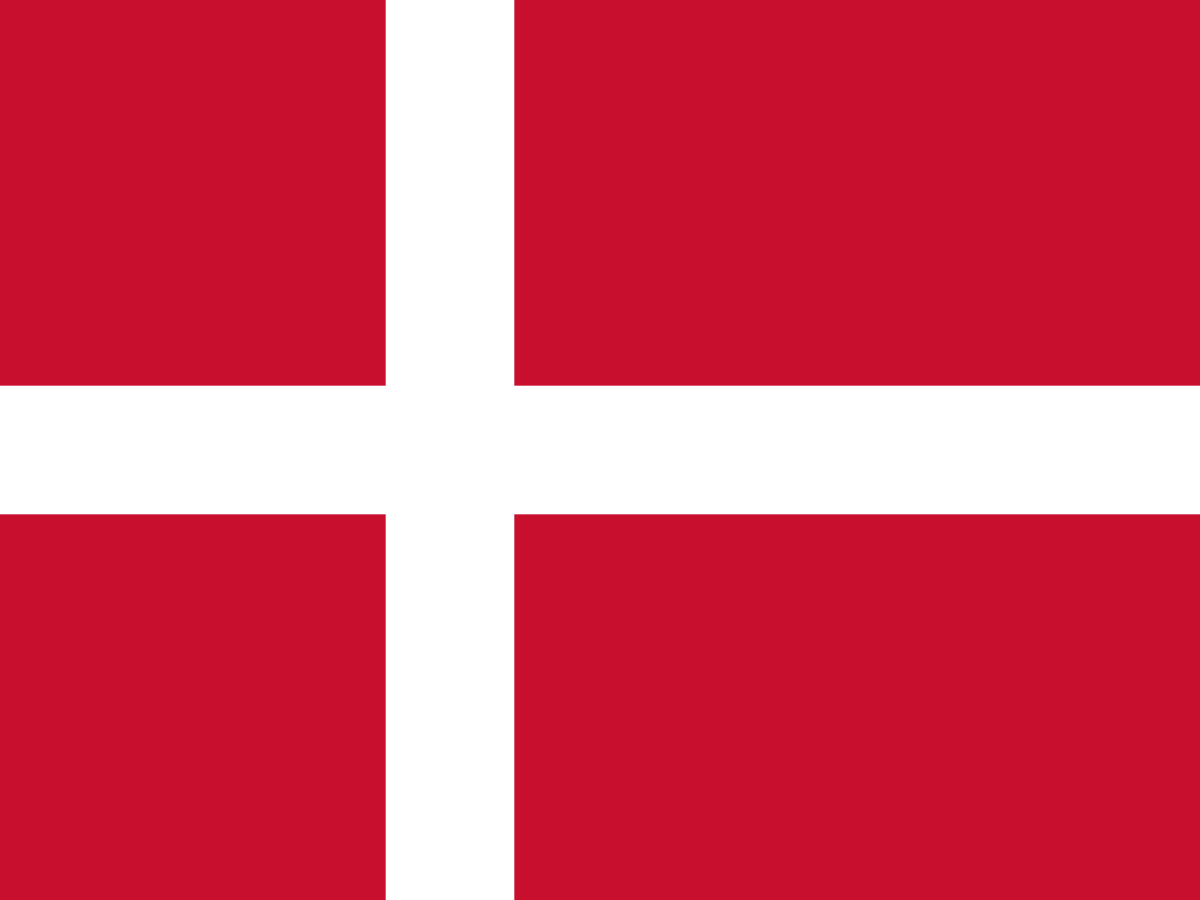
The flag of Denmark
The Danish flag is called the Dannebrog. It consists of a red field with a white Scandinavian or Nordic cross extending to the edges.
The Dannebrog is one of the world's oldest continuously used national flags.
A famous Danish legend says that the flag fell from the sky during the Battle of Lyndanisse in Estonia in 1219.
The exact historical origin is less certain than the legend suggests, but the red flag with a white cross has been associated with Denmark for centuries.
What does the Nordic cross mean?
The white cross reflects Denmark's long Christian history and belongs to the Nordic cross tradition. The cross is shifted towards the hoist rather than placed in the centre, which distinguishes Scandinavian flags from many other European crosses.
Denmark's design became the model for several later Nordic flags. Sweden, Norway, Finland and Iceland all use variations of the same basic cross layout.
The legend of the Dannebrog
According to Danish tradition, the Dannebrog appeared in the sky on 15 June 1219 during a battle at Lyndanisse, near modern-day Tallinn in Estonia. King Valdemar II's forces were said to have been losing when the red banner with the white cross appeared.
The story says the Danish army regained courage and won the battle. The date is still remembered in Denmark as Valdemarsdag.
Historians are cautious about treating the story as literal fact. Written evidence for the legend appeared centuries after the supposed event, but the story has become an important part of Danish national tradition.
How old is Denmark's flag?
The Dannebrog is often described as the oldest national flag still in continuous use. The design is certainly medieval, although historians cannot prove that the exact modern flag has flown continuously since 1219.
What is clear is that the white cross on red became firmly associated with Danish kings and Denmark during the Middle Ages and has remained a national symbol ever since.
A short history of Denmark
Denmark has a long history stretching from prehistoric settlements through the Viking Age, medieval monarchy and the development of the modern Danish state.
During the Viking Age, Danish rulers controlled or influenced territories across parts of northern Europe. The kingdom later became more centralised and developed a powerful medieval monarchy.
Denmark became a constitutional monarchy in the nineteenth century. It is now a parliamentary democracy with the monarch as head of state.
Flag history timeline
Viking AgeDanish rulers used a variety of banners and symbols before the familiar Dannebrog became established.
1219 — traditional originThe legend says the Dannebrog fell from the sky during a Danish battle in Estonia.
Middle AgesThe white cross on red became increasingly associated with the Danish monarchy and kingdom.
1625 — early flag regulationsHistorical sources show established rules for the use and proportions of the Danish flag.
1849 — constitutional DenmarkDenmark adopted a constitution and moved towards its modern constitutional monarchy.
TodayThe Dannebrog remains one of Denmark's most recognisable national symbols.
Copenhagen — the capital
Copenhagen sits on the eastern coast of Zealand and includes parts of the island of Amager. It is Denmark's political, economic and cultural centre.
The city is known for landmarks including Amalienborg Palace, Nyhavn, the Round Tower and Christiansborg Palace. Copenhagen is also famous for cycling and urban design.
The Danish monarchy
Denmark has one of the world's oldest monarchies. The modern monarchy is constitutional, meaning elected institutions and the government exercise political power while the monarch has mainly ceremonial and representative duties.
The Danish royal family remains an important part of national tradition, and royal buildings and ceremonies attract visitors from around the world.
The Viking Age
Denmark was one of the heartlands of the Viking world. From the late eighth century onwards, Danish Vikings travelled, traded and raided across northern Europe.
King Harald Bluetooth is one of Denmark's most famous Viking rulers. He helped consolidate the kingdom and is associated with the spread of Christianity in Denmark.
Harald Bluetooth and the runestones
The Jelling Stones in central Jutland are among Denmark's most important historical monuments. Harald Bluetooth erected the larger stone in the tenth century and described himself as the king who united Denmark and made the Danes Christian.
The stones and nearby burial mounds are a UNESCO World Heritage Site and provide valuable evidence about the transition from Viking paganism to Christianity.
The Jelling Stones
The Jelling monuments contain carved runic inscriptions, images and burial mounds associated with the early Danish kingdom.
The larger Jelling Stone is sometimes described as Denmark's 'birth certificate' because its inscription connects Harald Bluetooth with the unification of the Danish kingdom and the Christianisation of the Danes.
Denmark's geography
Denmark is relatively flat compared with many European countries. Its landscape includes agricultural plains, low hills, forests, wetlands, dunes and a highly indented coastline.
The country consists of Jutland and many islands, including Zealand, Funen, Lolland and Bornholm. The sea has played a major role in Danish history, trade and culture.
Greenland and the Faroe Islands
The Kingdom of Denmark also includes the self-governing territories of Greenland and the Faroe Islands. Both have extensive autonomy and their own local governments.
Greenland is geographically part of North America, while the Faroe Islands are located in the North Atlantic between Iceland and Norway. Their relationship with Denmark is an important example of how a kingdom can include territories with distinct identities.
The Danish coastline
Denmark has a very long coastline for its size because of its many islands and inlets. Beaches, dunes, cliffs, fjords and sheltered waters are common features.
The sea has historically supported fishing, shipping and trade, while modern coastal areas are also important for tourism and recreation.
Denmark and renewable energy
Denmark has become internationally known for renewable energy, particularly wind power. Its location and coastal environment provide favourable conditions for both onshore and offshore wind farms.
The country has invested heavily in wind technology and energy infrastructure and has become an important centre for the development of modern wind turbines.
Danish design and architecture
Danish design is famous for combining simple forms, functionality and high-quality materials. Designers such as Arne Jacobsen and Hans Wegner helped make Danish furniture internationally famous.
Copenhagen also has a strong reputation for modern architecture, sustainable urban planning and public spaces designed around walking and cycling.
Cycling in Denmark
Cycling is deeply embedded in Danish daily life, particularly in Copenhagen and other cities. Dedicated cycle lanes and relatively flat terrain make cycling a practical form of transport.
Denmark's cycling culture has also influenced urban planning, with infrastructure designed to make cycling safer and more convenient for everyday journeys.
Danish food
Danish cuisine includes rye bread, open sandwiches known as smørrebrød, pastries, seafood and meat dishes. Denmark is also known internationally for its modern Nordic cuisine.
The country's food culture combines traditional ingredients with a modern focus on seasonal produce, fermentation and careful presentation.
The Danish pastry
The pastry commonly called a 'Danish' in English is known in Denmark as wienerbrød, meaning 'Viennese bread'. Its history reflects the influence of Austrian bakers who worked in Denmark during the nineteenth century.
The pastry developed into many Danish varieties and became one of the country's most recognisable food exports.
Hans Christian Andersen
Hans Christian Andersen was one of Denmark's most famous writers. He wrote fairy tales including The Little Mermaid, The Ugly Duckling and The Emperor's New Clothes.
His stories have been translated into many languages and remain part of children's literature around the world.
Football and Danish sport
Football is Denmark's most popular sport. The national team produced one of its greatest achievements by unexpectedly winning the UEFA European Championship in 1992.
Denmark has also achieved international success in handball, cycling, sailing and other sports.
Denmark and the European Union
Denmark joined the European Economic Community in 1973 and is a member of the European Union today. It has retained the Danish krone rather than adopting the euro.
Denmark is also a member of NATO and plays an important role in Nordic and European cooperation.
Denmark today
Denmark is a constitutional monarchy and parliamentary democracy. Its economy is based on services, manufacturing, shipping, pharmaceuticals, food production, technology and renewable energy.
The country consistently ranks highly on measures of living standards, social trust and quality of life, although like other countries it faces challenges involving housing, ageing populations, climate change and the cost of living.
Why is Denmark's flag interesting?
The Dannebrog is more than a simple red-and-white cross. It is a symbol with a remarkable medieval history and one of the strongest flag traditions in the world.
Its Nordic cross also became the visual foundation for the flags of several other northern European countries. This makes Denmark particularly important when studying how national flag designs influence one another.
Explore Denmark on FlagAtlas
Continue exploring Denmark and the world's flags with these FlagAtlas resources.