Americas
Ecuador Flag
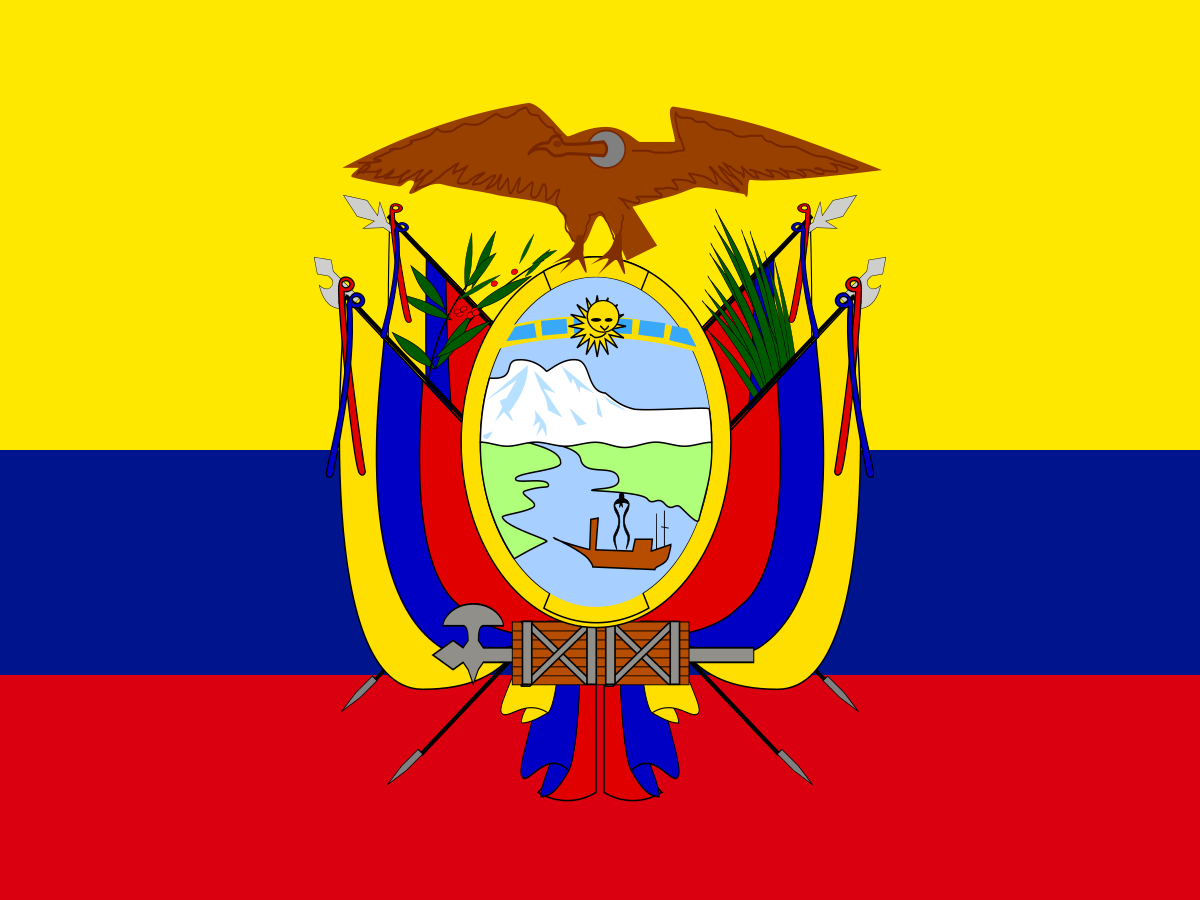
Same colours as Colombia and Venezuela — yellow, blue, and red — as they were all once part of Gran Colombia. The coat of arms shows Mount Chimborazo and the Guayas River.
Capital
Quito
Continent
Americas
Population
18.0 million
Development indicators
GDP per capita
$6,490
USD per year (approx. 2023)
Human Development Index
0.765
High development
World Bank income classification
Upper-Middle Income (UMIC)
UMIC
🌡️ Climate: Tropical / Highland
Flag symbolism
Same colours as Colombia and Venezuela — yellow, blue, and red — as they were all once part of Gran Colombia. The coat of arms shows Mount Chimborazo and the Guayas River.
coat of arms
Did you know?
Ecuador is the first country in the world to give constitutional rights to nature.
Test your knowledge
Think you know your world flags? Try the FlagAtlas daily challenge, speed quiz, or explore all Americas flags.
📚 Revising for GCSE Geography? Visit our free revision page →
About Ecuador
Ecuador is a country on the north-western coast of South America, named after the Equator which passes through it. It is famous for the Andes, Amazon rainforest, Pacific coastline and Galápagos Islands.
Quito is the capital and one of the world's highest national capitals.
CapitalQuito
RegionSouth America
PopulationAbout 18 million
CurrencyUS dollar
Official languageSpanish
Highest pointChimborazo
The flag of Ecuador
The Ecuador flag has three horizontal bands of yellow, blue and red. The yellow band is twice the height of the blue and red bands. The national coat of arms is placed in the centre.
Ecuador shares its basic colours with Colombia and Venezuela.
The three countries inherited them from the period of Gran Colombia.
What do the colours mean?
Yellow represents natural resources and agricultural wealth. Blue represents the sky and sea, while red represents the blood shed by those who fought for independence.
The unusually wide yellow band makes the Ecuador flag immediately recognisable beside Colombia and Venezuela.
The coat of arms
The coat of arms contains Mount Chimborazo, the Guayas River and a steamship. An Andean condor spreads its wings above the shield, while national flags, weapons and branches surround it.
The design brings together Ecuador's geography, independence history and national identity.
The Andean condor
The Andean condor above the coat of arms represents strength, freedom and Ecuador's Andean heritage. It is one of the world's largest flying birds and is associated with the high mountains of South America.
Mount Chimborazo
Chimborazo is Ecuador's highest mountain. Because Earth bulges at the Equator, its summit is farther from the planet's centre than the summit of Mount Everest. It is both a geographical landmark and an important national symbol.
A short history of Ecuador
The territory of modern Ecuador was home to Indigenous peoples long before the Inca expansion. Spanish conquest followed in the sixteenth century and Quito became an important colonial centre.
Ecuador joined Gran Colombia after independence before becoming a separate republic in 1830.
Flag history timeline
Before European arrivalIndigenous societies developed across the coast, Andes and Amazon.
15th centuryInca influence expanded into the region.
1530sSpanish forces established colonial rule.
1822Ecuador's territory was liberated from Spanish rule.
1822–1830The territory formed part of Gran Colombia.
1830Ecuador became a separate republic.
Gran Colombia and the flag colours
Ecuador, Colombia and Venezuela share the yellow, blue and red colour scheme because all three were once part of Gran Colombia, the republic associated with Simón Bolívar's independence movement.
Quito — the capital
Quito lies high in the Andes at roughly 2,850 metres. It is surrounded by mountains and volcanoes. Its historic centre is a UNESCO World Heritage Site and contains important colonial architecture.
The Equator
The Equator passes through Ecuador and gives the country its name. The line crosses the northern part of the country. Altitude means that Ecuador is not uniformly hot despite its equatorial location.
The Andes
The Andes run north to south through Ecuador, creating mountains, valleys and volcanoes. The range has shaped settlement, agriculture, transport and culture for centuries.
Cotopaxi
Cotopaxi is one of Ecuador's best-known volcanoes and one of the world's highest active volcanoes. Its symmetrical cone is a famous feature of the Andean landscape.
The Amazon rainforest
Eastern Ecuador extends into the Amazon Basin, with extensive rainforest and major river systems. The region contains exceptional biodiversity and Indigenous communities.
The Galápagos Islands
The Galápagos Islands lie about 1,000 kilometres west of mainland Ecuador. Their isolated ecosystems contain many species found nowhere else. The islands are a UNESCO World Heritage Site and an important tourism destination.
Galápagos wildlife
Galápagos wildlife includes giant tortoises, marine iguanas, blue-footed boobies, sea lions and penguins. Many species evolved in isolation and are adapted to the islands' unusual environments.
Ecuador's Pacific coast
Ecuador has a Pacific coastline with beaches, fishing communities and ports. Guayaquil is the country's largest city and an important commercial centre. Coastal agriculture includes bananas, cocoa and other tropical crops.
Climate
Ecuador has several climate zones. The coast is generally warm, the Andes have cooler highland climates, and the Amazon region is hot and humid. Altitude can create major temperature differences over short distances.
Wildlife
Ecuador is one of the world's most biodiverse countries for its size. Its ecosystems range from Pacific waters and dry forests to cloud forests, high Andes and Amazon rainforest. Species include jaguars, spectacled bears, condors, monkeys and many birds.
Indigenous peoples
Ecuador is home to many Indigenous peoples, including Kichwa, Shuar, Achuar and Waorani communities. Indigenous cultures remain an important part of the country's identity.
Languages
Spanish is the main official language. Kichwa and Shuar have official recognition for intercultural relations, alongside numerous other Indigenous languages.
Food and culture
Ecuadorian cuisine varies between the coast, Andes and Amazon. Common foods include plantains, maize, potatoes, rice and seafood. Traditional dishes include locro de papa, encebollado and ceviche.
The economy
Ecuador's economy includes petroleum, agriculture, manufacturing, services and tourism. Major agricultural exports include bananas, cocoa, flowers and shrimp. The US dollar has been the official currency since 2000.
Rights of nature
Ecuador became the first country to recognise the rights of nature in its constitution, adopted in 2008. This is particularly significant given the country's extraordinary biodiversity.
Ecuador today
Ecuador is a democratic republic with a presidential system. Its geography and biodiversity make it one of South America's most distinctive countries. The country continues to balance economic development with conservation.
Why is Ecuador's flag interesting?
Ecuador's flag is a strong example of a simple tricolour made distinctive by a detailed national emblem. The colours connect Ecuador to Gran Colombia, while the coat of arms adds the condor, Chimborazo, Guayas River and other national symbols.
Explore Ecuador on FlagAtlas
Continue exploring Ecuador and the world's flags.