About El Salvador
El Salvador is the smallest country in mainland Central America and one of the region's most densely populated. It lies on the Pacific coast and is known for volcanoes, beaches, coffee-growing highlands and a strong cultural identity.
San Salvador is the capital and largest city. The country shares borders with Guatemala and Honduras.
CapitalSan Salvador
RegionCentral America
PopulationAbout 6.5 million
CurrencyUS dollar
Official languageSpanish
Highest pointEl Pital
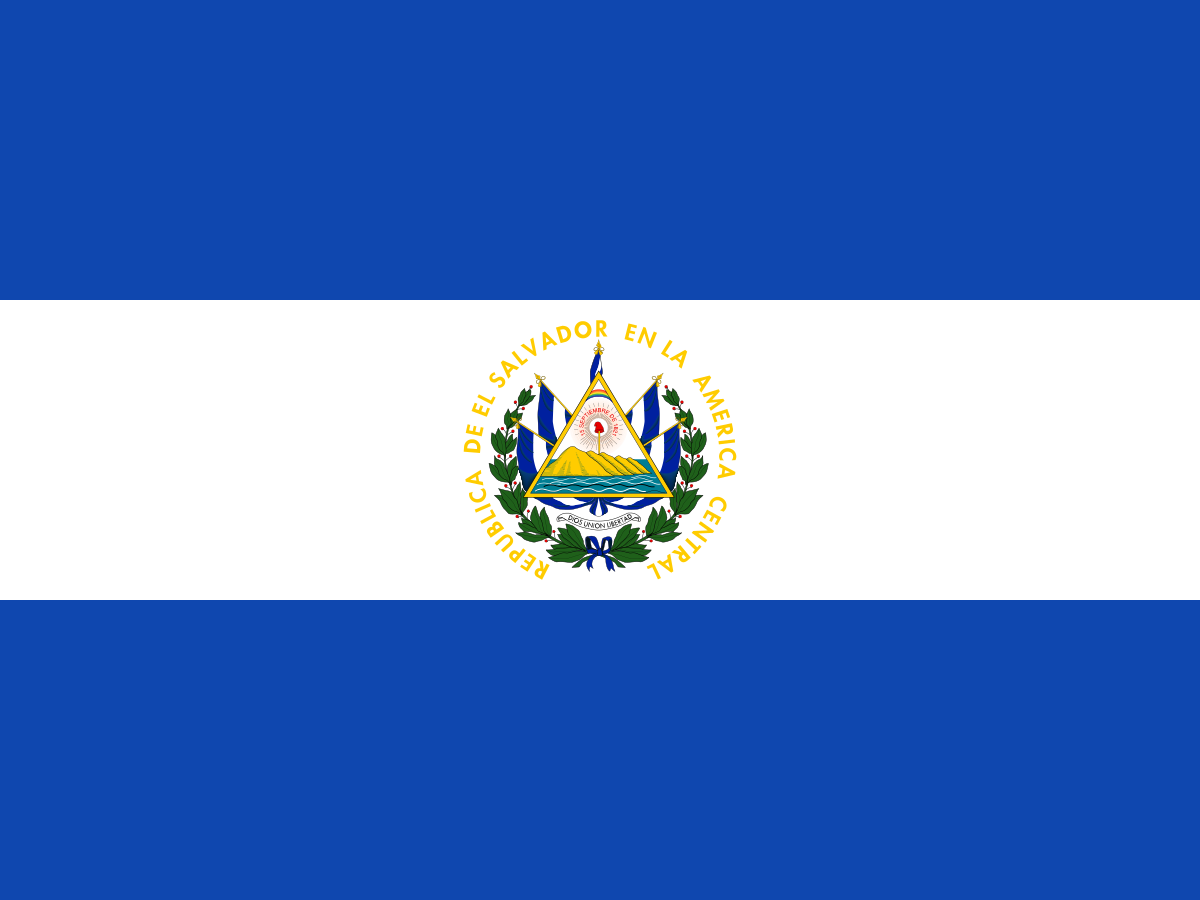
The flag of El Salvador
The El Salvador flag has three horizontal bands of blue, white and blue, with the national coat of arms placed in the centre of the white band on the state flag.
The design is closely related to the flags of other Central American countries.
The blue and white colours are associated with the sky, the sea and peace, while the coat of arms contains symbols of Central American unity.
The flag's basic design is derived from the flag of the United Provinces of Central America, linking modern El Salvador with the region's nineteenth-century history.
What do the colours mean?
The blue stripes are traditionally associated with the sky and the Pacific and Atlantic Oceans surrounding Central America. White represents peace.
The blue and white combination is shared by several Central American countries and reflects the region's history of political union.
The coat of arms
The coat of arms contains a triangle with the words REPÚBLICA DE EL SALVADOR EN LA AMÉRICA CENTRAL, together with five volcanoes rising from the sea.
Above the volcanoes is a rainbow, while a Phrygian cap and rays of light appear above the triangle. The emblem is surrounded by the date of independence and branches of laurel.
The five volcanoes
The five volcanoes on the coat of arms represent the original five members of the United Provinces of Central America: Guatemala, El Salvador, Honduras, Nicaragua and Costa Rica.
The symbol connects the modern flag with the historical idea of Central American unity.
The rainbow and Phrygian cap
The rainbow represents peace. The Phrygian cap, or cap of liberty, is a traditional symbol of freedom and independence.
Together these elements turn the coat of arms into a visual summary of independence and political history.
A short history of El Salvador
The region of modern El Salvador was home to Indigenous peoples including the Pipil before Spanish conquest. Spanish rule began in the sixteenth century and lasted until the independence movements of the early nineteenth century.
El Salvador became independent from Spain in 1821 and was briefly part of the Central American Federation before becoming a separate republic.
Flag history timeline
Before Spanish ruleIndigenous communities, including the Pipil, developed societies across the region.
16th century — Spanish conquestSpanish forces incorporated the territory into the colonial system.
1821 — independenceCentral America declared independence from Spain.
1823–1841 — Central American FederationEl Salvador formed part of the United Provinces of Central America.
1841 — separate republicEl Salvador became a separate republic after the federation dissolved.
1912 — modern coat of armsThe national emblem used on the state flag was adopted.
Central American Federation
El Salvador was part of the United Provinces of Central America, a federation formed after independence from Spain. It included Guatemala, El Salvador, Honduras, Nicaragua and Costa Rica.
The federation dissolved during the nineteenth century, but its legacy survives in the blue-and-white flags used by several Central American countries.
San Salvador — the capital
San Salvador is the capital and largest city of El Salvador. It sits in a valley surrounded by mountains and volcanoes and is the country's main political, economic and cultural centre.
The city has experienced major earthquakes throughout its history because of El Salvador's active tectonic and volcanic setting.
A country of volcanoes
El Salvador is sometimes called the Land of Volcanoes. It lies along the Pacific Ring of Fire and contains numerous volcanic peaks and landscapes.
Volcanic soils are important for agriculture, especially coffee production.
Lake Ilopango
Lake Ilopango occupies the caldera of a large volcanic system east of San Salvador. The lake is surrounded by steep volcanic terrain and is one of the country's best-known natural landmarks.
Santa Ana Volcano
Santa Ana Volcano, also called Ilamatepec, is the highest volcano in El Salvador. Its crater contains a striking turquoise-green lake created by volcanic activity.
The volcano is a popular hiking destination.
Pacific coastline
El Salvador has a Pacific coastline with sandy beaches, rocky shores and famous surfing locations. Places such as El Tunco and El Zonte are internationally known among surfers and travellers.
The coastline also supports fishing and coastal communities.
Climate
El Salvador has a tropical climate with a distinct wet season and dry season. Temperatures vary with altitude, so the highlands can be cooler than the lowlands and coast.
Heavy rainfall can sometimes cause flooding and landslides, particularly in mountainous areas.
Wildlife
El Salvador's forests, wetlands, mountains and coastal habitats support wildlife including monkeys, iguanas, sea turtles and many tropical birds.
Habitat loss and population pressure make conservation particularly important in this densely populated country.
Coffee and agriculture
Coffee has historically been one of El Salvador's most important agricultural products. It is grown mainly in cooler volcanic highlands with rich volcanic soils.
Other crops include sugar cane, maize, beans and tropical fruits.
Languages
Spanish is the official and dominant language of El Salvador. Indigenous languages have declined substantially, although efforts continue to preserve cultural and linguistic heritage.
Culture and traditions
El Salvador has cultural influences from Indigenous, Spanish and wider Central American heritage. Music, dance, religious festivals, crafts and food all contribute to national identity.
Salvadoran food
Popular Salvadoran dishes include pupusas, thick corn or rice-flour flatbreads filled with ingredients such as cheese, beans or pork. They are commonly served with curtido and tomato sauce.
Other foods include yuca frita, tamales, soups and seafood.
The economy
El Salvador's economy includes services, manufacturing, agriculture, tourism and remittances. The country adopted the US dollar as legal tender in 2001.
Tourism has grown around beaches, volcanoes, historic towns and outdoor activities.
Bitcoin and El Salvador
El Salvador became internationally notable when it adopted Bitcoin as legal tender in 2021 alongside the US dollar. The policy generated international debate about cryptocurrency and economic policy.
This has become an unusual part of the country's recent economic and political history.
El Salvador today
El Salvador is a presidential republic and one of the smallest countries in the Americas. Its volcanic landscape and Pacific coastline give it a distinctive geography.
The country continues to develop tourism, infrastructure and its economy while managing the challenges associated with high population density and exposure to earthquakes, volcanoes and tropical storms.
Why is El Salvador's flag interesting?
The El Salvador flag is interesting because its blue-and-white design connects the modern country directly to the history of Central American union. The coat of arms adds five volcanoes, a rainbow, liberty symbolism and the date of independence, turning the flag into a compact piece of regional history.
Explore El Salvador on FlagAtlas
Continue exploring El Salvador and the world's flags with these FlagAtlas resources.