About Ethiopia
Ethiopia is one of Africa's largest and most historically significant countries. It lies in the Horn of Africa and borders Eritrea, Djibouti, Somalia, Kenya, South Sudan and Sudan.
Addis Ababa is the capital and one of Africa's most important diplomatic centres. Ethiopia is also the headquarters of the African Union and the United Nations Economic Commission for Africa.
CapitalAddis Ababa
RegionHorn of Africa
PopulationAbout 120 million
CurrencyBirr
LanguagesAmharic + many others
Highest pointRas Dashen
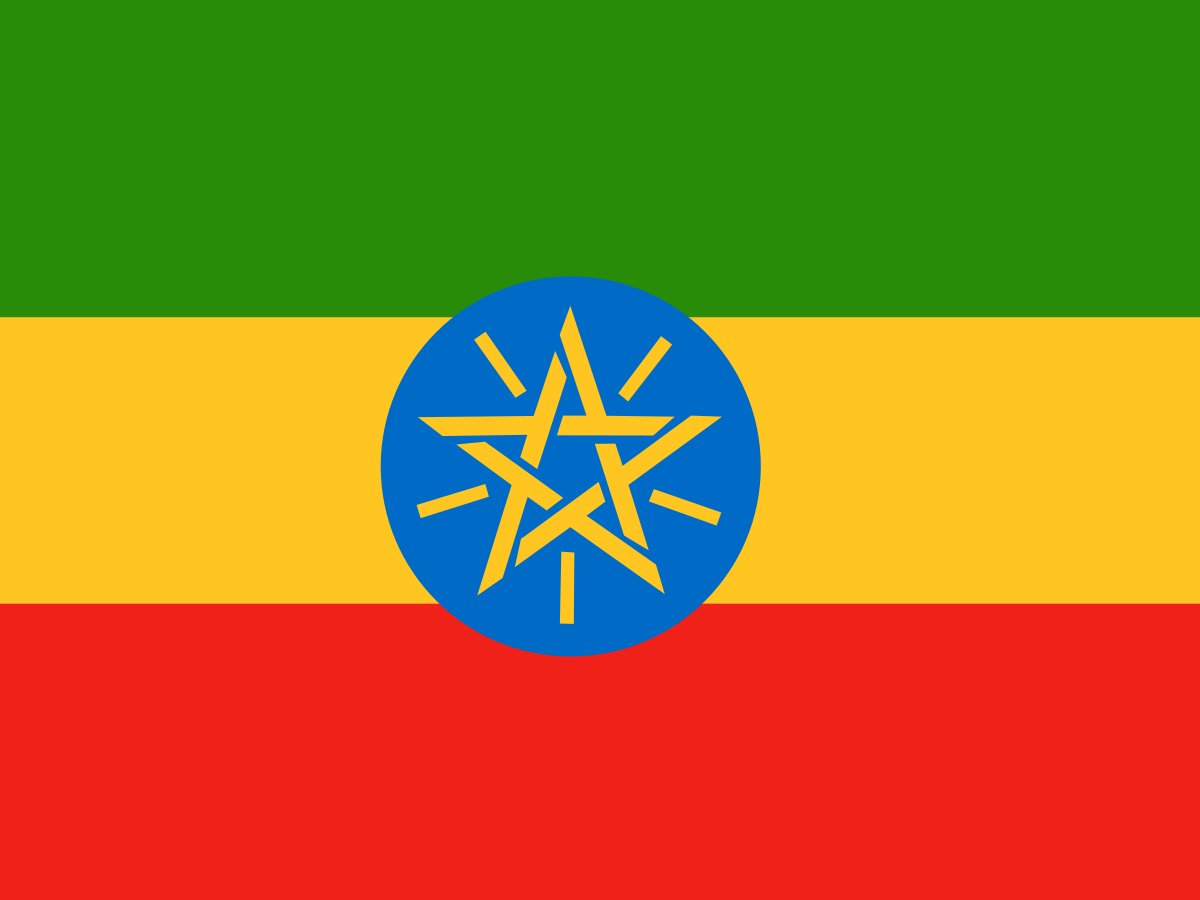
The flag of Ethiopia
The Ethiopian flag has three horizontal bands of green, yellow and red, with a blue disc and yellow pentagram emblem on the modern state flag.
Ethiopia is central to the history of the Pan-African colours.
Its green, yellow and red combination inspired many other African countries and became strongly associated with African independence and solidarity.
The current emblem was introduced after changes to the national flag following the fall of the Derg regime in 1991.
What do the colours mean?
The three colours have several traditional interpretations. Green is associated with the land and fertility, yellow with peace and hope, and red with sacrifice and the struggle for independence.
The colours also became the basis of the wider Pan-African colour tradition, although different countries have their own interpretations.
The green stripe
The upper green band is commonly associated with Ethiopia's fertile land, agriculture and natural environment.
Ethiopia contains highlands, grasslands, forests and agricultural regions, making the connection between green and the land particularly appropriate.
The yellow stripe
The central yellow band is traditionally associated with peace, hope and prosperity. It also creates the bright middle section of the Ethiopian tricolour.
Yellow is a common symbolic colour in Ethiopian religious and cultural traditions.
The red stripe
The lower red band is associated with sacrifice and the struggle to defend Ethiopia's independence.
Red has particular historical importance because Ethiopia's military victories against invading forces became powerful symbols of African resistance to colonialism.
The blue disc and star
The blue disc contains a golden pentagram and rays, commonly known as the Emblem of Ethiopia. The design is associated with unity and equality among the country's peoples.
The five-pointed star is often interpreted as representing the equality of Ethiopia's peoples, while the rays represent brightness and prosperity.
Pan-African colours
Ethiopia played an enormous role in the history of the green, yellow and red Pan-African colours. After African countries gained independence during the twentieth century, many adopted combinations inspired by the Ethiopian flag.
These colours therefore became associated not only with Ethiopia but with African independence, solidarity and resistance to colonial rule.
A short history of Ethiopia
Ethiopia has one of the world's oldest continuous historical traditions. Ancient kingdoms in the region included D'mt and Aksum, while later Ethiopian states developed a distinctive Christian civilisation in the highlands.
The Solomonic dynasty ruled Ethiopia for centuries, although power changed hands at various points in the country's history.
Flag history timeline
1897 — early tricolourA green, yellow and red national colour scheme was formally associated with Ethiopia during the reign of Menelik II.
1930s — imperial flagEmperor Haile Selassie's reign strengthened the international recognition of the Ethiopian colours.
1936–1941 — Italian occupationItaly occupied Ethiopia, but Ethiopian resistance continued.
1974 — monarchy overthrownThe Derg removed Emperor Haile Selassie and established a socialist military government.
1991 — Derg fallsThe Ethiopian People's Revolutionary Democratic Front took power and national symbols changed.
1996 — current emblemThe blue disc and yellow star emblem became part of the modern national flag.
The Kingdom of Aksum
The ancient Kingdom of Aksum was one of the major powers of the ancient Red Sea world. It developed extensive trade links and adopted Christianity in the fourth century.
Aksum left behind monumental stone stelae, inscriptions and other archaeological remains that form an important part of Ethiopian heritage.
The Ethiopian Orthodox tradition
Christianity has been central to Ethiopian history for many centuries. The Ethiopian Orthodox Tewahedo Church developed distinctive traditions, architecture, manuscripts and religious art.
Churches carved from rock, ancient monasteries and illuminated manuscripts are important parts of Ethiopia's cultural heritage.
The Battle of Adwa
In 1896, Ethiopian forces defeated an invading Italian army at the Battle of Adwa. The victory became a landmark in African history because Ethiopia successfully resisted European colonial expansion.
Adwa is an important reason Ethiopia became such a powerful symbol of African independence and why its colours later influenced Pan-African movements.
The Italian occupation
Italy invaded Ethiopia in 1935 and occupied much of the country until Ethiopian and Allied forces expelled Italian forces in 1941.
The occupation was relatively brief compared with many European colonial regimes in Africa, but it remains an important part of Ethiopian twentieth-century history.
Emperor Haile Selassie
Haile Selassie was Emperor of Ethiopia from 1930 until 1974, apart from the period of Italian occupation. He became an important international figure and represented Ethiopia at the League of Nations and later the United Nations.
His reign also became closely connected with the history of the Ethiopian flag and the spread of its colours around the world.
The Derg period
In 1974, a military committee known as the Derg overthrew the monarchy. Ethiopia then became a socialist state under a military government led by Mengistu Haile Mariam.
The period was marked by political repression, conflict and severe famine before the government was overthrown in 1991.
Addis Ababa — the capital
Addis Ababa is Ethiopia's capital and largest city. At more than 2,000 metres above sea level, it has a cooler climate than many other cities at similar latitude.
The city hosts the headquarters of the African Union and is a major diplomatic centre for the continent.
The Ethiopian Highlands
The Ethiopian Highlands form one of Africa's great mountainous regions. Deep valleys, plateaus and dramatic escarpments have shaped settlement, agriculture and transport.
The highlands are sometimes called the "Roof of Africa" because of their elevation.
Ras Dashen
Ras Dashen is the highest mountain in Ethiopia and one of the highest peaks in Africa. It rises in the Simien Mountains in the north of the country.
The surrounding Simien landscape contains dramatic cliffs and endemic wildlife.
The Great Rift Valley
The Great Rift Valley passes through Ethiopia and contains a chain of lakes, volcanic landscapes and fertile areas. It is part of the much larger geological rift system running through eastern Africa.
The region is also important to human evolution because some of the world's most significant early hominin fossils have been discovered in Ethiopia.
Lucy and human origins
Ethiopia is famous for the discovery of Australopithecus afarensis, including the celebrated fossil known as "Lucy", discovered in the Afar region in 1974.
The country's fossil sites provide important evidence about early human evolution and make Ethiopia a major destination for palaeoanthropological research.
Climate
Ethiopia's climate varies greatly with elevation. The highlands are generally cooler, while the lowlands can be hot and arid. Rainfall also varies considerably between regions.
Seasonal rainfall is extremely important for agriculture, while drought can have serious effects on food security.
Wildlife
Ethiopia has distinctive wildlife including the gelada, Ethiopian wolf and mountain nyala. Many species are adapted to the country's highlands and are found nowhere else.
National parks and protected areas play an important role in conserving these species and their habitats.
The Simien Mountains
The Simien Mountains National Park contains some of Ethiopia's most dramatic scenery, with deep valleys, cliffs and high plateaus.
It is home to endemic species such as the gelada and Ethiopian wolf and is recognised as a UNESCO World Heritage Site.
Agriculture and coffee
Agriculture employs a large share of Ethiopia's population. Important products include coffee, teff, maize, wheat, barley, sorghum and pulses.
Ethiopia is widely regarded as the birthplace of Arabica coffee, and coffee remains an important part of both the economy and everyday culture.
Teff and injera
Teff is a tiny grain native to the Ethiopian region and is used to make injera, a fermented flatbread that is central to Ethiopian cuisine.
Injera is commonly served with spicy stews, vegetables and pulses and is eaten communally using the bread to pick up food.
Languages
Ethiopia is linguistically diverse, with dozens of languages spoken. Amharic is the federal working language, while Oromo, Somali, Tigrinya, Afar and many others are widely used in different regions.
The country therefore has a much more complex linguistic landscape than a single-language description suggests.
Ethiopian culture
Ethiopian culture includes distinctive music, dance, clothing, food, religious traditions and calendar customs. The country follows its own traditional calendar, which is approximately seven to eight years behind the Gregorian calendar.
Ethiopia also has a strong manuscript, church-art and architectural heritage.
Ethiopian food
Ethiopian cuisine is known for dishes such as doro wat, tibs, shiro and injera. Food is often shared from a communal platter.
Spice blends such as berbere and ingredients including lentils, chickpeas, vegetables and meat are central to many dishes.
The economy
Ethiopia has a large and growing economy based on agriculture, manufacturing, construction and services. Coffee, flowers, textiles and other agricultural products are important exports.
The country has invested heavily in infrastructure and industrial development while continuing to face challenges linked to poverty, conflict and climate variability.
Ethiopia today
Ethiopia is a federal parliamentary republic and one of Africa's most populous countries. Its huge population, strategic location and long history give it an important role in the Horn of Africa.
The country continues to balance rapid economic development with political, regional and environmental challenges.
Why is Ethiopia's flag interesting?
The Ethiopia flag is one of the most influential flags in the world. Its green, yellow and red colours helped inspire the Pan-African colour tradition, while the modern blue-and-yellow emblem adds a powerful symbol of unity.
Understanding Ethiopia's flag therefore means understanding not just one country, but a major part of the history of modern Africa.
Explore Ethiopia on FlagAtlas
Continue exploring Ethiopia and the world's flags with these FlagAtlas resources.