About Georgia
Georgia is a country at the crossroads of Eastern Europe and Western Asia, in the Caucasus region between the Black Sea and the Greater Caucasus Mountains. It borders Russia, Azerbaijan, Armenia and Türkiye.
Tbilisi is the capital and largest city. Georgia is known for its ancient Christian heritage, distinctive alphabet, mountain landscapes and exceptionally old wine-making traditions.
CapitalTbilisi
RegionCaucasus
PopulationAbout 3.7 million
CurrencyLari
Official languageGeorgian
Highest pointShkhara
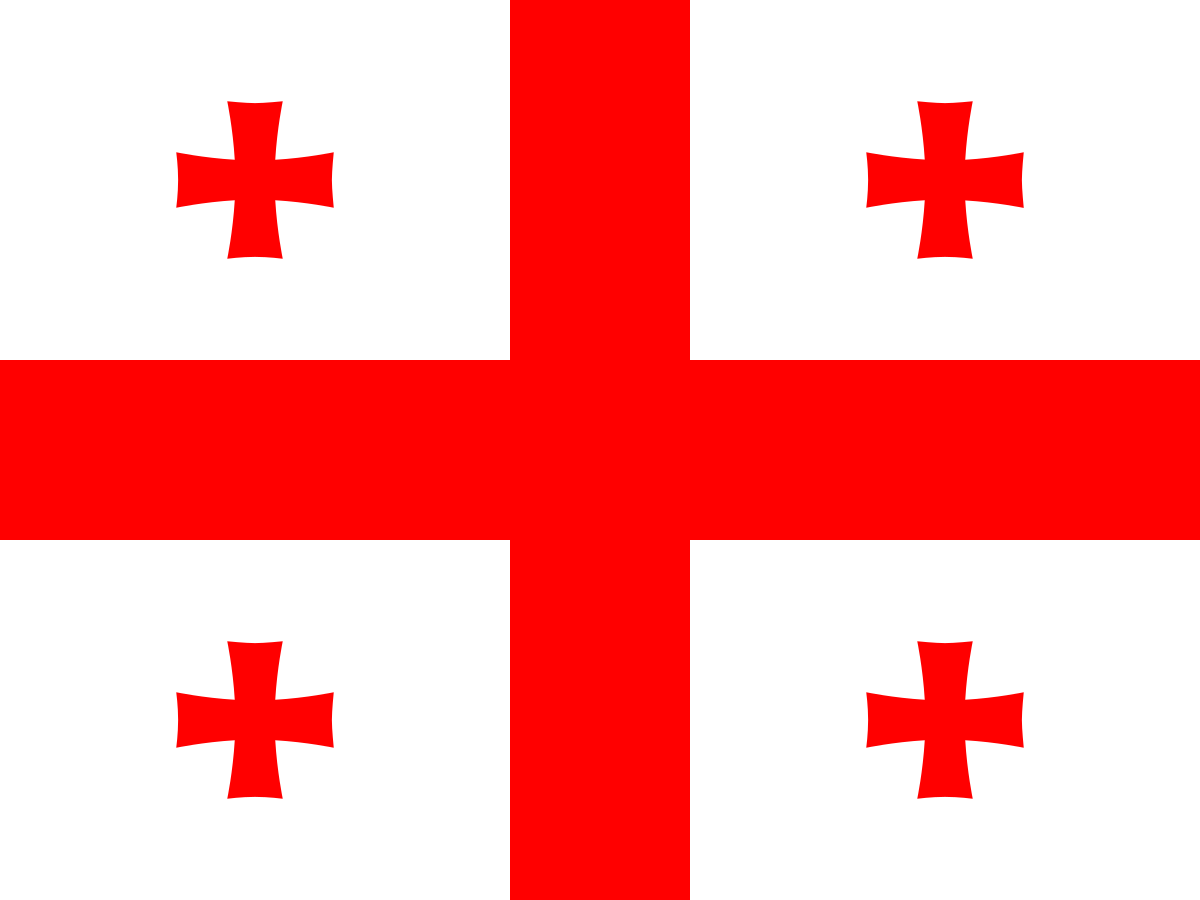
The flag of Georgia
The Georgian flag is a white field featuring a large red cross reaching the edges and four smaller red crosses in the four white quarters.
It is known as the Five Cross Flag.
The design has medieval associations and became the official national flag of Georgia in 2004 after the Rose Revolution.
The flag is closely connected with Georgia's Christian history and medieval identity.
The Five Cross Flag
The flag contains five red crosses: one large central cross and four smaller crosses. The design is often associated with Christian symbolism and Georgia's medieval kingdom.
The central cross is commonly understood as representing Christ, while the four smaller crosses have been associated with the four evangelists, although historical interpretations vary.
The white field
White forms the background of the Georgian flag and is commonly associated with purity and innocence in modern explanations of the design.
It also provides a strong contrast with the red crosses, making the flag highly recognisable.
The red crosses
The red crosses are the defining feature of Georgia's national flag. Red has strong associations with Christianity, sacrifice and the country's medieval religious heritage.
The five-cross arrangement gives the flag a distinctive appearance unlike most modern European national flags.
Christian heritage
Georgia has one of the world's oldest Christian traditions. Christianity became the state religion of the Georgian kingdom of Iberia in the fourth century, traditionally associated with Saint Nino's missionary work.
Churches, monasteries and religious art remain central to Georgian cultural heritage.
A short history of Georgia
Georgia's history stretches back thousands of years and includes ancient kingdoms such as Colchis and Iberia. Medieval Georgia became a major regional power under the Bagrationi dynasty.
The country was later divided between larger empires before joining the Russian Empire, briefly becoming independent in 1918 and then being incorporated into the Soviet Union. Georgia restored independence in 1991.
Flag history timeline
Ancient periodKingdoms including Colchis and Iberia developed in the Caucasus.
4th century — ChristianityChristianity became central to Georgian state and cultural identity.
11th–13th centuries — medieval golden ageGeorgia became a powerful regional kingdom and developed a rich literary and artistic culture.
1801 — Russian annexationThe Georgian kingdom of Kartli-Kakheti was annexed by the Russian Empire.
1918 — First RepublicGeorgia declared independence after the collapse of the Russian Empire.
1921 — Soviet ruleThe Red Army invaded Georgia and the country became part of the Soviet Union.
1991 — independence restoredGeorgia restored its independence following the collapse of the Soviet Union.
2004 — current flag adoptedThe Five Cross Flag became Georgia's official national flag.
Georgia's medieval Golden Age
Georgia experienced a major cultural and political Golden Age during the eleventh to thirteenth centuries. Kings such as David IV and Queen Tamar expanded Georgian influence.
Queen Tamar's reign is particularly celebrated in Georgian history and literature, while the period produced important churches, monasteries and works of art.
King David IV
David IV, known as David the Builder, ruled Georgia from 1089 to 1125 and is one of the country's most celebrated monarchs.
He strengthened the Georgian state, defeated major enemies and helped establish the foundations of Georgia's medieval Golden Age.
Queen Tamar
Queen Tamar ruled Georgia around the turn of the thirteenth century and became one of the most important figures in Georgian history.
Her reign is remembered as a period of political strength, cultural development and military success. She is also a major figure in Georgian literature and national memory.
The Russian Empire
During the nineteenth century, Georgian territories were gradually incorporated into the Russian Empire. Tbilisi became an important administrative and cultural centre of the Caucasus.
Russian rule lasted until the upheavals of the First World War and Russian Revolution created an opportunity for Georgian independence.
The First Georgian Republic
Georgia declared independence in 1918 and established the Democratic Republic of Georgia. The republic existed for only a few years before Soviet forces took control in 1921.
This short period remains an important part of modern Georgian national history.
Soviet Georgia
Georgia became part of the Soviet Union in 1921 and remained under Soviet rule until 1991. The Soviet period transformed the country's economy, cities and political institutions.
Georgia declared independence again as the Soviet Union collapsed.
The Rose Revolution
The Rose Revolution of 2003 was a peaceful political movement that led to the resignation of President Eduard Shevardnadze.
The movement became an important turning point in modern Georgian politics and was followed by the adoption of the current Five Cross Flag in 2004.
Tbilisi — the capital
Tbilisi is Georgia's capital and largest city. It sits along the Kura River and has a history stretching back more than 1,500 years.
The city is known for its old town, sulphur baths, churches, balconies and mixture of Georgian, Persian, Russian and European architectural influences.
The Caucasus Mountains
The Greater Caucasus Mountains form a dramatic natural barrier along northern Georgia. Peaks, glaciers and deep valleys make the region one of Europe's and Asia's most spectacular mountain landscapes.
The mountains are important for tourism, agriculture, water resources and traditional communities.
Mount Shkhara
Shkhara is Georgia's highest mountain, rising to more than 5,000 metres in the Greater Caucasus.
The surrounding Svaneti region is famous for high mountain villages and distinctive defensive towers.
Svaneti
Svaneti is a mountainous region in northwestern Georgia known for medieval stone towers, dramatic peaks and the distinctive culture of the Svan people.
Upper Svaneti is recognised by UNESCO for its cultural landscape and historic settlements.
The Black Sea coast
Western Georgia borders the Black Sea. The coast has a warmer, more humid climate than much of the interior and supports subtropical vegetation.
Batumi is the best-known coastal city and an important tourism and commercial centre.
Climate
Georgia has varied climates because of its mountains and position between the Black Sea and continental interior. Western areas are generally humid and subtropical, while eastern Georgia is drier.
Mountain areas have cold winters and alpine conditions, creating remarkable climatic diversity within a relatively small country.
Wildlife
Georgia's varied landscapes support wildlife including brown bears, wolves, lynx, chamois, wild goats and many bird species.
The Caucasus is an important biodiversity region, and protected areas help conserve mountain, forest and wetland habitats.
Georgian wine
Georgia is famous for its ancient wine-making tradition. Archaeological evidence suggests that wine was being produced in the region at least 8,000 years ago.
Traditional Georgian wine is often made in large clay vessels called qvevri, which are buried underground during fermentation and storage.
Qvevri wine-making
A qvevri is a large egg-shaped clay vessel used in traditional Georgian wine-making. The technique has been passed down through generations and is recognised as an important part of Georgian cultural heritage.
Both red and white wines can be produced using qvevri methods.
The Georgian language
Georgian is the official language and belongs to the unique Kartvelian language family. It is not closely related to the major Indo-European or Turkic languages spoken around it.
Georgian has its own distinctive writing system, which is one of the country's most recognisable cultural features.
The Georgian alphabet
The modern Georgian writing system uses the Mkhedruli script, recognised by its distinctive rounded letters. Georgia's writing traditions are centuries old.
The Georgian alphabet is an important part of national identity and is used in everyday life, education, literature and public signs.
Georgian culture
Georgian culture includes polyphonic singing, traditional dance, literature, religious architecture and distinctive regional customs. Georgian polyphonic singing is particularly famous and is recognised by UNESCO.
Family, hospitality and communal meals are important features of Georgian social life.
Georgian food
Georgian cuisine is known for dishes such as khachapuri, khinkali, lobio and mtsvadi. Walnuts, herbs, cheese and bread are common ingredients.
Khachapuri, a cheese-filled bread with many regional varieties, is one of the country's best-known foods.
The Georgian economy
Georgia's economy is based on services, tourism, agriculture, manufacturing, transport and trade. Its location between Europe and Asia makes it an important transport corridor.
Wine, agricultural products, tourism and services are important parts of the modern economy.
Georgia today
Georgia is a parliamentary republic with a strong national identity shaped by its language, Christian heritage and distinctive Caucasus culture. It has close links with Europe while remaining geographically positioned at the crossroads of Europe and Asia.
The country's modern history has included political reforms, territorial conflicts and a strong focus on national sovereignty and international integration.
Why is Georgia's flag interesting?
Georgia's flag is unusual because its design comes from a much older Christian and medieval tradition rather than a modern political colour scheme. The five red crosses make it instantly recognisable.
The flag also connects directly with Georgia's long history as a Christian kingdom and its modern revival of national symbols after independence.
Explore Georgia on FlagAtlas
Continue exploring Georgia and the world's flags with these FlagAtlas resources.