About Grenada
Grenada is a small island country in the eastern Caribbean, famous for its spices, beaches, rainforests and volcanic landscape. It includes the main island of Grenada and smaller islands such as Carriacou and Petite Martinique.
St. George's is the capital and largest town. Grenada is often called the “Spice Isle” because of its production of nutmeg, mace, cinnamon, cloves and other spices.
CapitalSt. George's
RegionCaribbean
PopulationAbout 113,000
CurrencyEast Caribbean dollar
Official languageEnglish
Independence7 February 1974
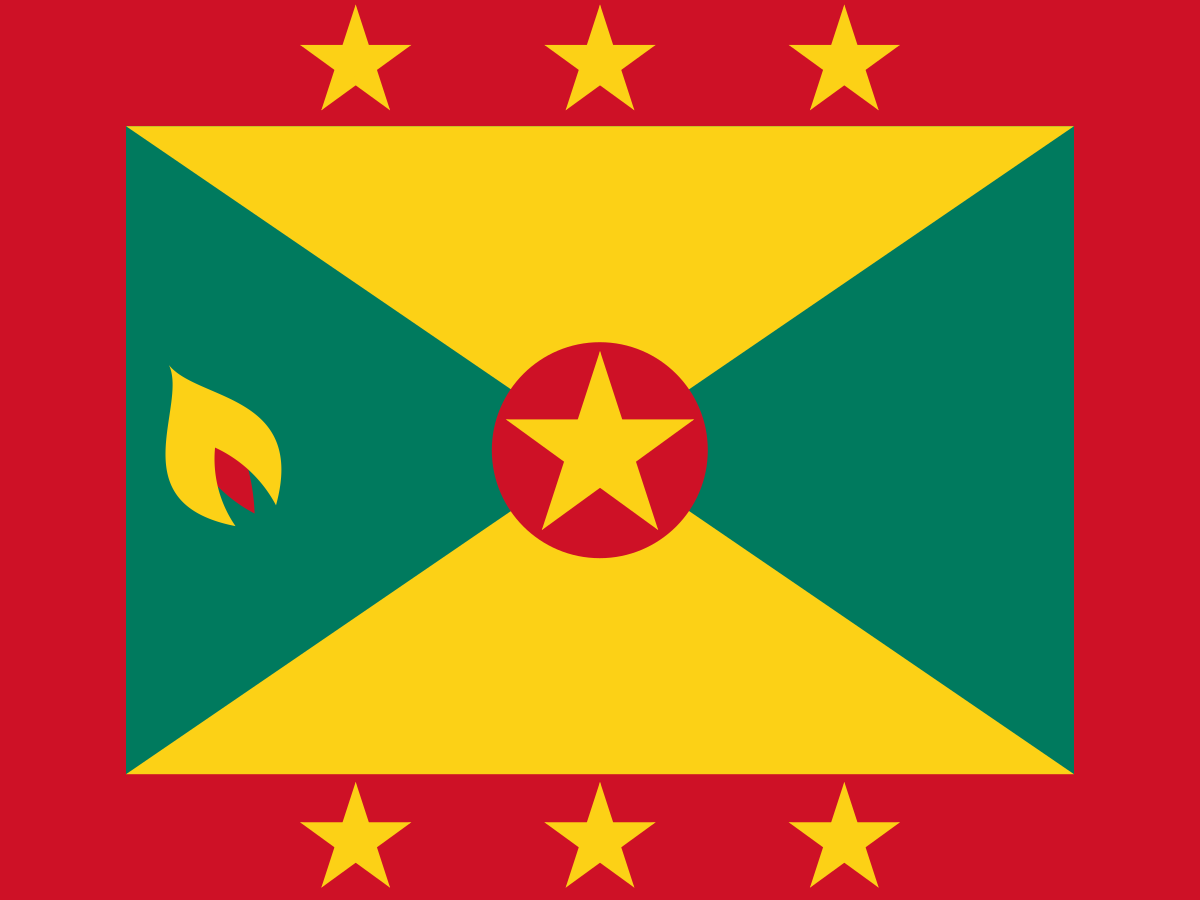
The flag of Grenada
Grenada's flag is one of the Caribbean's most distinctive national designs. It features red, gold and green, with six stars around the border, a central star and a nutmeg symbol near the hoist.
The nutmeg is especially important.
Grenada has long been associated with spice production, so the nutmeg pod directly reflects the country's nickname, the “Spice Isle”.
The current flag was adopted at independence in 1974 and was designed by Anthony C. George.
What do the colours mean?
The flag's colours have commonly stated meanings: red represents courage and vitality, gold represents wisdom and warmth, and green represents vegetation and agriculture.
The design also uses stars and the nutmeg symbol to represent the islands, parishes and Grenada's famous spice industry.
The red border
The red sections represent courage and vitality. Red forms the outer frame of the flag and gives the design a strong visual identity.
The colour is balanced by the gold and green areas in the centre.
The gold sections
Gold represents wisdom and warmth. It also gives the flag a bright Caribbean appearance and separates the red and green elements.
Gold is one of the three principal colours of the Grenadian flag.
The green triangle
Green represents vegetation and agriculture. Grenada's tropical climate supports forests, fruit crops, spices and other agricultural products.
The green areas also reflect the island's lush mountainous landscape.
The stars on the flag
The flag contains seven stars. Six stars are arranged around the red border and a larger star appears in the centre.
The six outer stars represent Grenada's six parishes, while the central star represents Carriacou and Petite Martinique in common explanations of the design.
The nutmeg symbol
A stylised nutmeg pod appears in the green triangle at the hoist. It is a direct reference to Grenada's spice industry and its nickname, the Spice Isle.
Few national flags feature a crop or spice so prominently, making Grenada's design particularly distinctive.
A short history of Grenada
Grenada was inhabited by Indigenous Caribbean peoples before European colonisation. The island became a French and later British colony, with its economy shaped by plantation agriculture and the production of spices.
Grenada became independent from Britain on 7 February 1974.
Flag history timeline
Before European colonisationIndigenous peoples lived on Grenada and the surrounding islands.
17th century — French settlementFrance established colonial control and developed plantation agriculture.
1763 — British ruleGrenada was ceded to Britain under the Treaty of Paris.
19th–20th centuriesGrenada's economy increasingly became associated with nutmeg, cocoa and other agricultural exports.
1974 — independenceGrenada became independent on 7 February and adopted its distinctive national flag.
1979 — revolutionThe New Jewel Movement overthrew the government and established a revolutionary administration.
1983 — interventionA US-led Caribbean military intervention followed political turmoil and the killing of Prime Minister Maurice Bishop.
TodayGrenada is a parliamentary democracy and an independent Caribbean state.
European colonisation
Grenada was colonised by the French in the seventeenth century before passing to British control in 1763. Plantation agriculture became central to the colonial economy.
The island's fertile volcanic soils were well suited to crops including sugar, cocoa and spices.
Independence in 1974
Grenada became independent from Britain on 7 February 1974. The country remained within the Commonwealth and adopted a new national flag designed specifically for the independent state.
Independence Day is one of Grenada's major national celebrations.
The Grenada Revolution
In 1979, the New Jewel Movement led by Maurice Bishop overthrew the government. The revolutionary government introduced major political and economic changes.
Internal divisions eventually led to Bishop's death in 1983, followed by a US-led military intervention involving several Caribbean countries.
St. George's — the capital
St. George's is Grenada's capital and is famous for its picturesque harbour and steep hillsides. The city developed around a natural horseshoe-shaped harbour.
Historic buildings, colourful streets and waterfront areas make St. George's one of the Caribbean's most recognisable small capitals.
Grenada's volcanic landscape
Grenada is volcanic in origin and has a mountainous interior. Mount Saint Catherine is the island's highest point.
The volcanic soils contribute to fertile agricultural land, while the mountains support rainforest, rivers and dramatic waterfalls.
Grand Etang National Park
Grand Etang National Park protects rainforest in the mountainous centre of Grenada. It includes Grand Etang Lake, a volcanic crater lake surrounded by dense vegetation.
The park is home to monkeys, birds, reptiles and many tropical plant species.
The Underwater Sculpture Park
Grenada is home to one of the world's best-known underwater sculpture parks. British artist Jason deCaires Taylor created a series of submerged sculptures that have become an artificial reef.
The sculptures attract divers and snorkellers while providing surfaces for marine life to colonise.
Carriacou and Petite Martinique
Carriacou and Petite Martinique are smaller islands belonging to Grenada. Carriacou is known for boatbuilding, beaches and a strong local cultural identity.
The islands are quieter than the main tourist areas of Grenada and have their own traditions and communities.
Climate
Grenada has a tropical climate with warm temperatures throughout the year. The rainy season generally runs from around June to December, while the drier months are usually earlier in the year.
The mountainous interior receives more rainfall than the coastal areas.
Wildlife
Grenada's forests, wetlands and surrounding seas support a variety of wildlife including monkeys, tropical birds, reptiles and marine species.
Protected forests and marine areas help conserve the island's biodiversity.
Nutmeg and spices
Nutmeg is one of Grenada's best-known agricultural products. The island also produces mace, cinnamon, cloves, ginger and other spices.
Spice cultivation is an important part of Grenada's identity and explains its famous nickname, the “Spice Isle”.
Cocoa production
Grenada also has a long tradition of cocoa farming. The tropical climate and fertile volcanic soils provide good growing conditions.
Grenadian cocoa is used in chocolate production and contributes to the country's agricultural exports.
Agriculture
Agriculture remains important in Grenada, with crops including nutmeg, cocoa, bananas, fruit and vegetables.
The mountainous terrain means many farms are relatively small, and agriculture is closely connected with rural communities.
Grenadian food
Grenadian cuisine combines Caribbean, African, European and Indigenous influences. A famous local dish is oil down, a hearty one-pot meal made with breadfruit, coconut milk, turmeric, vegetables and meat or fish.
Nutmeg and other local spices feature prominently in cooking and drinks.
Grenadian culture
Grenadian culture includes African, Caribbean, European and Indigenous influences. Music, carnival, dance, storytelling and community celebrations are important parts of national life.
Spicemas, Grenada's carnival celebration, is one of the country's biggest annual cultural events.
Spicemas Carnival
Spicemas is Grenada's annual carnival and combines colourful costumes, music, dancing, parades and competitions.
It is one of the best-known cultural celebrations in the eastern Caribbean and attracts both residents and visitors.
Languages
English is Grenada's official language. Grenadian communities also use forms of English Creole and French-influenced patois in informal speech.
The country's language reflects its British and French colonial history as well as wider Caribbean culture.
The economy
Grenada's economy is based largely on tourism, services, agriculture and construction. Tourism is particularly important because of the country's beaches, diving, forests and climate.
Spices and agricultural products remain an important part of the country's identity even as services dominate the modern economy.
Tourism
Visitors come to Grenada for beaches, diving, rainforest, waterfalls, sailing, food and culture. The island's compact size allows travellers to combine coastal and mountain experiences.
The underwater sculpture park and Grand Anse Beach are among the country's best-known attractions.
Grenada today
Modern Grenada is an independent parliamentary democracy and a member of the Commonwealth and Caribbean regional organisations. Its economy relies heavily on tourism and services.
The country continues to promote its identity as the Spice Isle, with nutmeg, cocoa, food and nature all forming important parts of its international image.
Why is Grenada's flag interesting?
Grenada's flag is unusual because it combines a traditional Caribbean colour scheme with a very specific national symbol: the nutmeg pod.
The seven stars, the red-gold-green colours and the nutmeg together tell a compact story about Grenada's islands, people, landscape and famous spice industry.
Explore Grenada on FlagAtlas
Continue exploring Grenada and the world's flags with these FlagAtlas resources.