About Guatemala
Guatemala is a country in Central America bordered by Mexico, Belize, Honduras and El Salvador, with coastlines on both the Pacific Ocean and Caribbean Sea.
Guatemala City is the capital and largest city. The country is famous for its Maya heritage, volcanoes, highland landscapes, colourful textiles, coffee, cacao and Lake Atitlán.
CapitalGuatemala City
RegionCentral America
PopulationAbout 17 million
CurrencyQuetzal
Official languageSpanish
Highest pointTajumulco
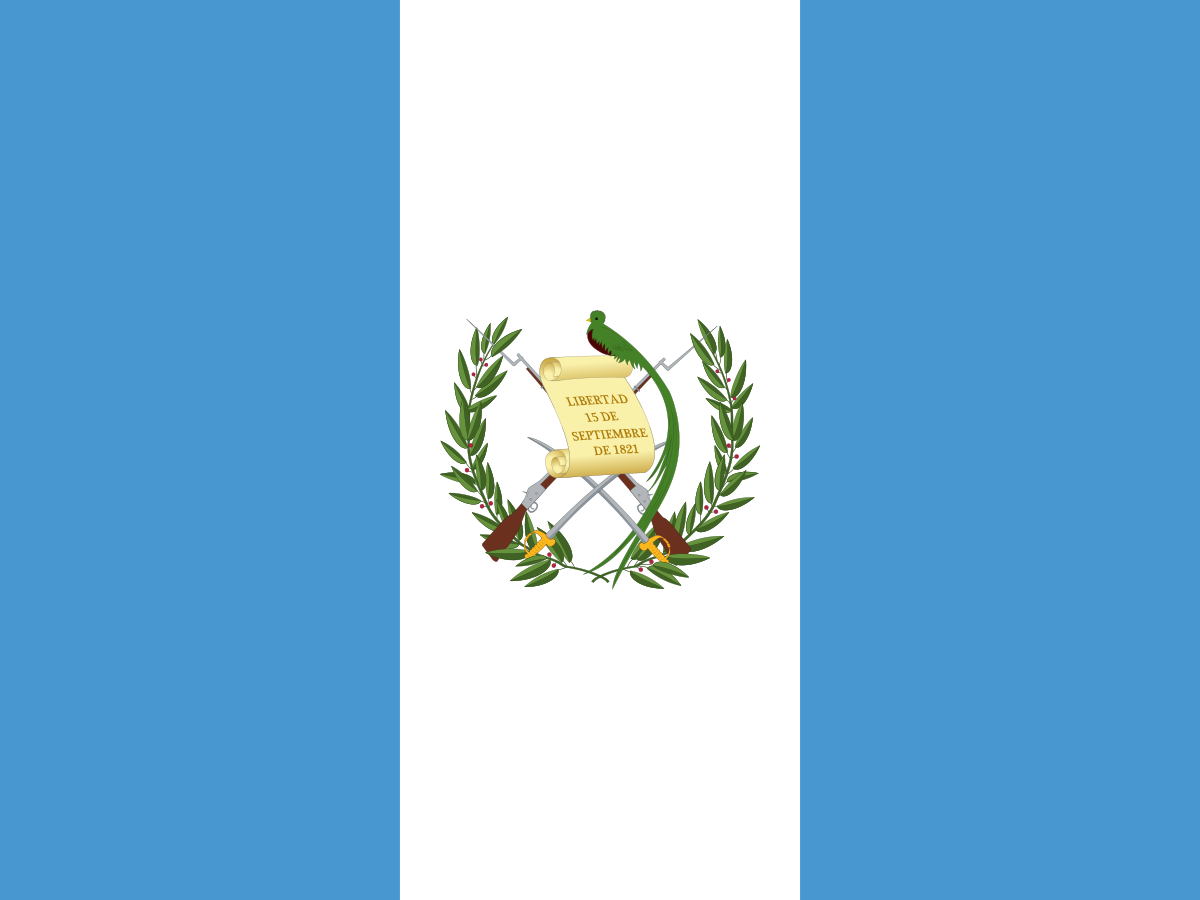
The flag of Guatemala
Guatemala's national flag is a vertical blue-white-blue tricolour with the national coat of arms centred in the white band.
The blue bands are commonly associated with Guatemala's position between the Pacific and Atlantic oceans and with the sky, while white represents peace and purity.
The central coat of arms makes Guatemala's flag distinctive and contains several symbols of national independence and liberty.
The current flag design dates from the nineteenth century, with the detailed coat of arms revised over time.
What do the colours mean?
The blue stripes are commonly associated with the sky and Guatemala's location between the Pacific and Atlantic Oceans. White is traditionally associated with peace and purity.
The blue-and-white colours also have a longer Central American historical connection, appearing in the flags of the former United Provinces of Central America.
The blue stripes
The two blue bands frame the central white stripe. They are commonly interpreted as representing the sky and the two oceans that border Guatemala.
The colours also connect Guatemala with the blue-and-white flag traditions of Central American independence.
The white stripe
The central white band is traditionally associated with peace and purity. It also provides the background for Guatemala's detailed national coat of arms.
Placing the emblem in the centre gives the flag a very different appearance from the simpler blue-and-white flags used elsewhere in Central America.
The quetzal
The quetzal is Guatemala's national bird and one of the most important symbols in the coat of arms. It has long been associated with liberty.
The quetzal is also the name of Guatemala's national currency, the quetzal.
The coat of arms
The centre of the flag contains Guatemala's coat of arms, including the quetzal, parchment, crossed rifles, crossed swords, bayonets, wreath and dates.
The emblem commemorates Guatemala's independence and represents liberty, defence and the country's national history.
The parchment and independence date
A parchment scroll in the coat of arms carries the date associated with Central American independence: 15 September 1821.
This date marks the declaration of independence from Spanish rule by the provinces of Central America.
The crossed rifles and swords
The coat of arms includes crossed rifles and swords. These are military symbols connected with Guatemala's history and the defence of the country.
They sit behind the parchment and help give the emblem its distinctive appearance.
A short history of Guatemala
Guatemala has one of the richest archaeological and cultural histories in the Americas. Maya civilisation developed sophisticated cities, writing, mathematics, astronomy and monumental architecture across the region.
Spanish conquest in the sixteenth century brought colonial rule, followed by Central American independence in 1821 and the creation of the modern Guatemalan republic.
Flag history timeline
Before the 16th centuryMaya civilisation flourished across what is now Guatemala, producing major cities and cultural achievements.
1520s — Spanish conquestSpanish forces and Indigenous allies conquered much of the region, beginning centuries of colonial rule.
1821 — independenceGuatemala and the other Central American provinces declared independence from Spain.
1823 — United Provinces of Central AmericaGuatemala joined the Central American federation, whose blue-and-white colours influenced later national flags.
1840s — separate republicGuatemala emerged as a separate independent state after the Central American federation broke apart.
1871 — Liberal ReformPolitical reforms under Justo Rufino Barrios led to changes in the national symbols and government.
1871 onwards — modern flagThe vertical blue-white-blue design was established, with the coat of arms added to the centre.
TodayGuatemala remains a Central American republic with a strong Maya cultural heritage.
The Maya civilisation
The Maya developed one of the most sophisticated civilisations of the ancient Americas. They created complex writing systems, calendars, mathematics, astronomy, architecture and political institutions.
Guatemala contains many important Maya archaeological sites and remains home to large Maya communities today.
Tikal
Tikal is one of the most famous Maya archaeological sites in Guatemala. It was a major Maya city surrounded by rainforest in the Petén region.
Its enormous temples and pyramids rise above the forest canopy and demonstrate the scale and sophistication of Maya architecture.
Spanish conquest
Spanish conquest began in the early sixteenth century. Spanish forces and Indigenous allies gradually brought the region under colonial control.
Guatemala became part of the Spanish colonial system, with Guatemala City eventually becoming an important administrative centre.
Independence in 1821
Guatemala and the other Central American provinces declared independence from Spain on 15 September 1821.
The region briefly became part of the Mexican Empire before forming the United Provinces of Central America.
The United Provinces of Central America
From 1823, Guatemala formed part of the United Provinces of Central America, a federation that also included several neighbouring states.
The federation used blue and white colours that influenced the flags of several modern Central American countries.
The Liberal Reform
The Liberal Reform of 1871 transformed Guatemala's government and economy. Justo Rufino Barrios became a major figure in the reform movement.
The period also helped establish the modern vertical blue-white-blue flag design used today.
Guatemala City
Guatemala City is the country's capital and largest urban centre. It is the political, economic and cultural heart of modern Guatemala.
The city sits in a highland valley and has developed into a major Central American metropolis.
Antigua Guatemala
Antigua Guatemala is a historic colonial city surrounded by volcanoes. It was the capital of the Captaincy General of Guatemala before a series of earthquakes led to the capital being moved.
Its cobbled streets, churches and colonial architecture make it one of Guatemala's most visited historic destinations.
Lake Atitlán
Lake Atitlán is a deep volcanic lake surrounded by mountains and volcanoes. Villages around the lake are home to communities with strong Maya cultural traditions.
The lake is widely regarded as one of Guatemala's most spectacular landscapes.
Guatemala's volcanoes
Guatemala has many volcanoes because it lies along the Pacific Ring of Fire. Famous peaks include Volcán de Fuego, Acatenango, Pacaya and Tajumulco.
Volcán de Fuego is particularly active, while Tajumulco is the highest point in Central America.
Tajumulco
Volcán Tajumulco rises to more than 4,200 metres and is Guatemala's highest mountain and the highest point in Central America.
The summit offers dramatic views across the highlands on clear days.
Climate
Guatemala has a varied climate because of its mountains and elevation. Lowland areas are generally hot and tropical, while the highlands are cooler and can have mild spring-like conditions.
Rainfall is strongly seasonal in many parts of the country, with a wetter period during the middle and later part of the year.
Wildlife
Guatemala's forests, mountains, wetlands and reefs support diverse wildlife including jaguars, pumas, spider monkeys, howler monkeys, crocodiles, sea turtles and many bird species.
The resplendent quetzal is one of the country's most famous birds and a powerful national symbol.
The resplendent quetzal
The resplendent quetzal is a striking green and red bird found in the forests of Central America. It was important in Maya and later Mesoamerican traditions.
Its association with liberty became especially powerful in modern Guatemala, where it appears on the national emblem and gives its name to the national currency.
Coffee
Guatemala is internationally known for high-quality coffee, much of it grown in highland areas with volcanic soils and suitable climates.
Major coffee-growing regions include Antigua, Huehuetenango, Atitlán and Cobán.
Cacao and chocolate
Cacao has deep roots in Mesoamerican history. Maya communities cultivated and consumed cacao long before European arrival.
Chocolate was used as a drink and in ceremonial and social contexts. Modern Guatemala continues to produce cacao and chocolate products.
Maya textiles
Colourful woven textiles are an important part of Maya culture in Guatemala. Different communities have distinctive patterns, colours and styles.
Traditional huipiles and other garments can communicate information about community identity and heritage.
Languages
Spanish is Guatemala's official language, but the country is highly multilingual. More than twenty Maya languages are spoken, alongside Garifuna and Xinca.
This linguistic diversity reflects the survival and continuing importance of Indigenous cultures.
Guatemalan food
Guatemalan cuisine includes dishes such as pepian, kak'ik, tamales, tortillas and fiambre. Corn, beans, chillies, tomatoes and herbs are important ingredients.
Many foods combine Indigenous Maya traditions with ingredients and techniques introduced during the colonial period.
Guatemalan culture
Guatemalan culture combines Maya, Spanish, African and wider Central American influences. Music, textiles, festivals, food and religious traditions vary considerably between regions.
Many communities maintain Maya languages and customs alongside modern Guatemalan national identity.
The Guatemalan economy
Guatemala has the largest economy in Central America. Important sectors include services, manufacturing, agriculture, remittances, mining and tourism.
Coffee, bananas, sugar and other agricultural products are major exports, while Guatemala also has a significant textile and apparel industry.
Tourism
Tourism is an important part of Guatemala's economy. Visitors come for Maya ruins, colonial cities, volcanoes, lakes, markets and Indigenous culture.
Tikal, Antigua Guatemala, Lake Atitlán and volcano trekking are among the country's best-known attractions.
Guatemala today
Modern Guatemala is a republic with a population of around 17 million. Its identity is strongly shaped by its Maya heritage, Spanish colonial history and spectacular volcanic geography.
The blue-and-white flag with the quetzal-bearing coat of arms remains a distinctive symbol of the country's independence and liberty.
Why is Guatemala's flag interesting?
Guatemala's flag is unusual because it places a detailed national coat of arms directly in the centre of a blue-and-white design. The quetzal, parchment, weapons and wreath each connect the flag with different parts of Guatemala's history.
The flag therefore tells a much bigger story than its simple colours suggest — from Maya heritage and Central American independence to the modern republic.
Explore Guatemala on FlagAtlas
Continue exploring Guatemala and the world's flags with these FlagAtlas resources.