About Haiti
Haiti occupies the western part of the island of Hispaniola in the Caribbean, sharing the island with the Dominican Republic. Port-au-Prince is the capital and largest city.
Haiti is historically significant as the first independent state in Latin America and the Caribbean created by a successful slave revolution, and the world's first Black republic.
CapitalPort-au-Prince
RegionCaribbean
PopulationAbout 11.4 million
CurrencyGourde
Official languagesHaitian Creole & French
Independence1 January 1804
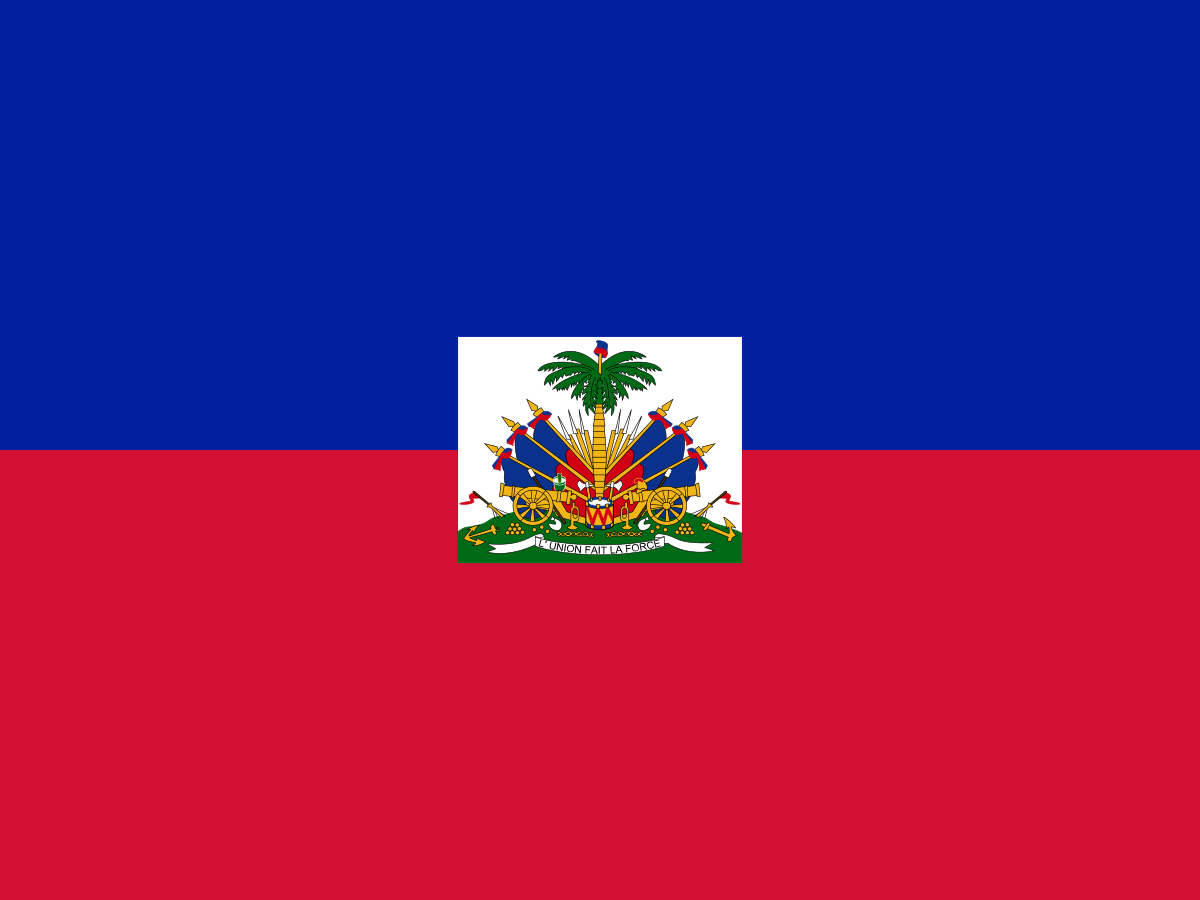
The flag of Haiti
Haiti's flag consists of blue and red horizontal bands with the national coat of arms on a white panel in the centre.
The flag is closely tied to the Haitian Revolution.
The traditional story says that the revolutionaries removed the white stripe from the French tricolour and brought the blue and red sections together. The colours came to symbolise the people of Haiti rather than French colonial rule.
The central coat of arms contains a trophy of weapons beneath a palm tree, with the national motto “L'Union fait la Force” — “Unity makes strength”.
The blue stripe
Blue is one of the two principal colours of the Haitian flag. The famous revolutionary story connects it to the French tricolour after the white section was removed.
In modern Haiti, the blue and red colours are commonly associated with the unity of the country's people.
The red stripe
Red forms the other principal colour of the flag. Alongside blue, it became part of the revolutionary national identity created during Haiti's struggle for independence.
The blue-and-red combination is also strongly associated with Haitian national identity today.
The white panel
The white panel in the centre contains Haiti's coat of arms. Its imagery is much more detailed than the simple blue and red background.
The revolutionary symbolism of removing the white stripe from the French flag is an important part of Haiti's flag story, although the precise historical development of the flag involved several stages.
The coat of arms
Haiti's coat of arms shows a trophy of weapons beneath a palm tree, with flags, cannon, anchors and other objects around it.
The imagery reflects independence, defence and national sovereignty. A banner carries the motto “L'Union fait la Force”.
The palm tree
The palm tree at the centre of the coat of arms is topped by a liberty cap. The palm and cap form a powerful symbol of freedom and independence.
The palm is surrounded by military and maritime objects representing the defence of the nation.
A short history of Haiti
Haiti's modern history begins with the Spanish and French colonisation of Hispaniola and the development of the plantation economy. The French colony of Saint-Domingue became one of the world's richest colonies through enslaved labour.
Enslaved people launched a revolution in 1791. After years of war, Haiti declared independence in 1804.
History timeline
Before European colonisationThe island was inhabited by Taíno peoples, who called the island Ayiti or related names.
1492 — Spanish arrivalChristopher Columbus reached Hispaniola, beginning a period of European colonisation and catastrophic population loss among Indigenous people.
17th century — French Saint-DomingueFrance established control over the western part of the island, which became the colony of Saint-Domingue.
1791 — Haitian Revolution beginsA major uprising of enslaved people began in the northern part of Saint-Domingue.
1802 — French expeditionNapoleon Bonaparte sent forces to restore French control and the plantation system.
1804 — independenceJean-Jacques Dessalines declared Haiti independent on 1 January 1804.
1825 — French indemnityFrance forced Haiti to agree to a large indemnity in exchange for diplomatic recognition, creating a major long-term financial burden.
TodayHaiti remains a sovereign Caribbean republic with a rich cultural heritage and a complex modern political and economic history.
The Taíno people
Before European arrival, Hispaniola was home to the Taíno, an Indigenous Caribbean people. They lived in organised communities and cultivated crops including cassava.
European conquest brought disease, warfare and forced labour, causing a catastrophic decline in the Indigenous population.
Saint-Domingue
The western part of Hispaniola became the French colony of Saint-Domingue. By the eighteenth century it was one of the world's most profitable colonies, producing sugar, coffee and other commodities through enslaved labour.
The enormous wealth of the colony was built on an extremely violent plantation system.
The Haitian Revolution
The Haitian Revolution began in 1791 and became the most successful large-scale revolt of enslaved people in modern history. Revolutionary armies fought French, Spanish and British forces during the conflict.
The revolution ultimately destroyed slavery in the colony and created an independent Haitian state.
Toussaint Louverture
Toussaint Louverture became the most famous early leader of the Haitian Revolution. He was a skilled military and political leader who helped establish control over much of Saint-Domingue.
Louverture was captured by French forces in 1802 and died in prison in France the following year, before Haiti achieved independence.
Jean-Jacques Dessalines
Jean-Jacques Dessalines was one of the revolution's leading military commanders. On 1 January 1804 he declared Haiti independent.
He became the first ruler of independent Haiti and is one of the central figures in Haitian national history.
Independence in 1804
Haiti declared independence on 1 January 1804. The new state took the name Haiti, reviving an Indigenous name associated with the island.
The declaration made Haiti the first independent country in Latin America and the Caribbean and the first modern state created through a successful slave revolution.
The French indemnity
In 1825, France recognised Haiti diplomatically but demanded a huge financial indemnity in compensation for property and lost colonial wealth.
Haiti borrowed heavily to make the payments, creating a debt burden whose effects lasted for generations.
Port-au-Prince
Port-au-Prince is Haiti's capital and largest city. It is the country's main political, commercial and cultural centre.
The city and surrounding region were devastated by the catastrophic 2010 earthquake, and rebuilding has remained a major challenge.
Citadelle Laferrière
The Citadelle Laferrière is a huge fortress in northern Haiti built after independence. It was designed to defend the new country against a possible French invasion.
Its mountain location and massive stone walls make it one of the most impressive monuments of the Haitian Revolution.
Sans-Souci Palace
The ruins of Sans-Souci Palace near Milot form part of Haiti's UNESCO-listed National History Park. The palace was built under King Henri Christophe after independence.
Together with the Citadelle, it represents the ambitious state-building efforts of early independent Haiti.
Climate
Haiti has a predominantly tropical climate, although mountains create significant local differences. The country experiences wet and dry seasons and is exposed to hurricanes and tropical storms.
Deforestation and land degradation can increase the impact of heavy rainfall and flooding.
Mountains and landscape
Haiti is a mountainous country, and the landscape includes steep ranges, valleys, caves, rivers and coastal plains.
Much of the country's natural environment has been altered by agriculture, population pressure and deforestation, but important forests and protected areas remain.
Wildlife
Haiti's wildlife includes Hispaniolan solenodons, hutias, iguanas, flamingos and many bird species. Several species are endemic to Hispaniola.
Habitat loss is a major conservation challenge, making protected forests and national parks especially important.
The Hispaniolan solenodon
The Hispaniolan solenodon is a rare nocturnal mammal found only on Hispaniola. It is an ancient lineage with unusual features including venomous saliva.
Its survival is threatened by habitat loss and introduced predators.
Haitian Creole
Haitian Creole is one of Haiti's two official languages and is spoken by the overwhelming majority of the population. It developed from French and West African languages, with influences from Taíno, Spanish and other sources.
French is also an official language and remains important in government, education and formal communication.
Haitian culture
Haitian culture combines West African, French, Caribbean and Indigenous influences. Music, dance, art, storytelling, food and religion are central to national identity.
Haiti has produced internationally recognised artists, musicians and writers despite enormous economic and political challenges.
Haitian art
Haiti is famous for its colourful and distinctive visual art. Artists have worked in painting, metal sculpture, wood carving and other forms.
Haitian art often combines everyday life, religious imagery, history and imaginative symbolism.
Music and kompa
Kompa is one of Haiti's best-known popular music styles. Haitian music also includes rara, traditional percussion, gospel, folk music and many modern genres.
Music is deeply connected with community celebrations, carnival and Haitian identity at home and in the diaspora.
Haitian food
Haitian cuisine includes dishes such as griot, diri ak pwa, soup joumou, tassot, pikliz and bannann peze. Rice, beans, plantains, meat, seafood and spicy sauces are common.
Food also carries historical meaning: soup joumou is especially associated with Haitian independence and the end of slavery.
Soup joumou
Soup joumou is a pumpkin-based soup traditionally associated with Haitian independence. Under French colonial rule, enslaved people were forbidden from consuming the soup; after independence it became a symbol of freedom.
It is traditionally eaten on New Year's Day, Haiti's Independence Day.
Religion
Religion in Haiti includes Roman Catholicism, Protestant Christianity and Vodou, among other beliefs. Vodou developed from West and Central African spiritual traditions combined with Catholic influences.
Religion and spirituality have played important roles in Haitian community life and history.
The economy
Haiti's economy includes agriculture, manufacturing, services and remittances. The country has also developed textile and apparel manufacturing for export.
Poverty, political instability, natural disasters and infrastructure challenges have all affected economic development.
The 2010 earthquake
On 12 January 2010, a devastating earthquake struck near Port-au-Prince. Hundreds of thousands of people were killed or affected, and enormous damage was caused to homes, infrastructure and public buildings.
The disaster had long-lasting humanitarian and economic consequences for Haiti.
Hurricanes and natural disasters
Haiti is highly exposed to hurricanes, floods, earthquakes and landslides. Its location in the Caribbean places it in a region frequently affected by tropical storms.
Deforestation and fragile infrastructure can make natural disasters particularly destructive.
Haiti today
Modern Haiti remains a sovereign Caribbean republic with a population of more than 11 million. Its history, revolutionary heritage, languages and culture give it a distinctive place in the Americas.
The country continues to face major political, economic, environmental and humanitarian challenges, alongside a strong and influential cultural identity.
Why is Haiti's flag interesting?
Haiti's flag is one of the world's most historically powerful national flags. Its blue and red design emerged from the rejection of French colonial rule, while the coat of arms celebrates the defence of the new nation.
The flag therefore represents not simply a country, but a revolution that fundamentally changed the history of slavery, colonialism and independence.
Explore Haiti on FlagAtlas
Continue exploring Haiti and the world's flags with these FlagAtlas resources.