About Iraq
Iraq is a country in Western Asia at the heart of ancient Mesopotamia. Baghdad is the capital and largest city. Iraq lies between the Tigris and Euphrates rivers and has a history reaching back to some of the world’s earliest cities, writing systems, states and civilisations.
CapitalBaghdad
RegionWestern Asia
PopulationAbout 40 million
CurrencyIraqi dinar
Official languagesArabic & Kurdish
Independence1932
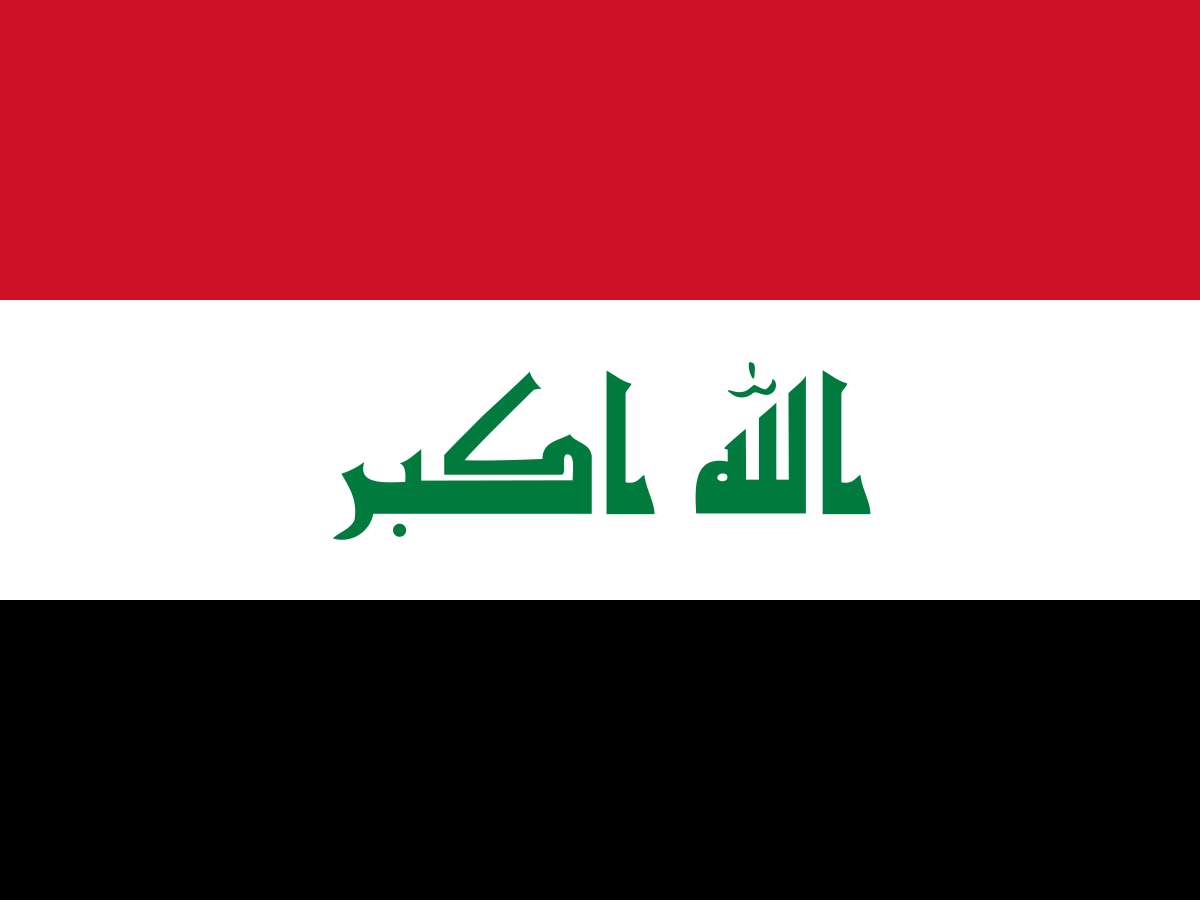
The flag of Iraq
Iraq’s national flag has three horizontal bands of red, white and black. In the centre of the white band is Allahu Akbar, meaning “God is Greatest”, written in green Kufic-style script. The current design was adopted in 2008.
What do the colours mean?
The four colours of the Iraqi flag are part of the Pan-Arab colour tradition. Red is commonly associated with courage and sacrifice, white with peace, black with historic Arab dynasties and green with Islam. Interpretations vary across historical sources.
The green Takbir
The central inscription reads Allahu Akbar, meaning “God is Greatest”. It is written in green and is a prominent Islamic element of the modern flag. The current form replaced an earlier Saddam-era version of the calligraphy.
Kufic script
The inscription uses a stylised Kufic-inspired form of Arabic calligraphy. Kufic is one of the oldest forms of Arabic script and is strongly associated with early Islamic manuscripts and monumental inscriptions.
The Pan-Arab colours
Red, white, black and green are commonly called the Pan-Arab colours. They appear in the flags of several Arab states and connect modern national identity with Arab history, political movements and Islamic heritage.
A short history of Iraq
Iraq is often described as one of the birthplaces of civilisation. Ancient Mesopotamia produced some of the world’s earliest cities, writing systems and states. Later history included Persian empires, the Islamic conquest, the Abbasid Caliphate, Ottoman rule, British influence, the Iraqi monarchy, the Ba’athist period and the wars and political upheavals of the modern era.
History timeline
c. 3500 BCE — Sumerian citiesUruk, Ur and other city-states developed in southern Mesopotamia.
c. 2334 BCE — Akkadian EmpireSargon of Akkad created one of the earliest territorial empires.
c. 1792 BCE — HammurabiThe Babylonian king became famous for his surviving law code.
7th century BCE — Neo-Babylonian periodBabylon became a major centre under rulers including Nebuchadnezzar II.
539 BCE — Persian conquestCyrus the Great conquered Babylon.
7th century CE — Islamic conquestArab Muslim armies conquered Mesopotamia.
762 CE — Baghdad foundedThe Abbasid caliph al-Mansur founded Baghdad.
1258 — Mongol sack of BaghdadBaghdad was captured and devastated by Mongol forces.
1534 onward — Ottoman ruleMuch of modern Iraq became part of the Ottoman Empire.
1932 — independenceIraq became independent and joined the League of Nations.
1958 — republicThe monarchy was overthrown and a republic established.
2003 — Iraq WarThe US-led invasion overthrew Saddam Hussein’s government.
TodayIraq is a federal parliamentary republic with major oil resources and a rich cultural heritage.
Ancient Mesopotamia
Mesopotamia means “land between the rivers” and refers to the region around the Tigris and Euphrates. Much of ancient Mesopotamia lies within modern Iraq. It was a centre of early urbanisation, irrigation, writing and organised government.
The Sumerians
The Sumerians developed some of the world’s earliest cities in southern Mesopotamia. Scribes used cuneiform to record trade, administration, religion and literature.
Cuneiform writing
Cuneiform is one of the earliest known writing systems. It was impressed into clay tablets and used for several languages over thousands of years.
The Epic of Gilgamesh
The Epic of Gilgamesh is one of the world’s oldest surviving works of literature. It follows the legendary king Gilgamesh and his search for meaning and immortality.
The Akkadian Empire
The Akkadian Empire, founded by Sargon of Akkad, united large areas of Mesopotamia and is often regarded as one of the world’s earliest empires.
Babylon
Babylon became one of the ancient world’s most famous cities. Under Nebuchadnezzar II it was a magnificent capital associated with monumental walls, temples and the Ishtar Gate.
Hammurabi’s Code
The Code of Hammurabi is one of the best-known ancient law collections. It records laws concerning property, trade, family matters and punishments and provides valuable evidence about Babylonian society.
The Assyrians
The Assyrian Empire became a major power in the ancient Near East. Cities such as Nineveh and Nimrud contained monumental palaces decorated with detailed stone reliefs.
Nineveh
Nineveh, near modern Mosul, became the capital of the Neo-Assyrian Empire. Ashurbanipal’s library preserved thousands of cuneiform tablets, including versions of the Epic of Gilgamesh.
The Persian Empires
Mesopotamia was incorporated into the Achaemenid Persian Empire under Cyrus the Great and later became part of other Persian states, including the Sasanian Empire.
The Islamic conquest
Arab Muslim armies conquered Iraq during the seventh century. Islam transformed the region’s political, religious and cultural life and Iraq became a major centre of Islamic scholarship.
Baghdad and the Abbasid Caliphate
The Abbasid caliph al-Mansur founded Baghdad in 762 CE. The city became one of the world’s great centres of learning, trade and culture during the Islamic Golden Age.
The House of Wisdom
The Abbasid-era Bayt al-Hikma, or House of Wisdom, is a famous symbol of Baghdad’s intellectual life. Scholars translated and studied works from Greek, Persian and Indian traditions.
The Mongol sack of Baghdad
In 1258, Mongol forces under Hulagu Khan captured Baghdad. The city was devastated and Abbasid political power there ended, marking a major turning point in Iraqi history.
Ottoman Iraq
From the sixteenth century, much of Iraq became part of the Ottoman Empire. Baghdad, Basra and Mosul developed as important regional centres, although control varied over time.
British influence and independence
During the First World War, British forces occupied Mesopotamia. The modern Iraqi state emerged under a British mandate and became independent in 1932, with King Faisal I as its first king.
The Iraqi Republic
A revolution in 1958 overthrew the monarchy and established a republic. Iraq subsequently experienced political instability, military rule and competing political movements before Ba’athist rule became dominant.
Saddam Hussein
Saddam Hussein ruled Iraq from 1979 until 2003. His government was highly authoritarian and Iraq fought wars with Iran and Kuwait. The 2003 invasion removed his government.
The Iran-Iraq War
The Iran-Iraq War lasted from 1980 to 1988 and caused enormous casualties and destruction. It began after Iraq invaded Iran amid disputes over borders and regional power.
The Gulf War
In 1990 Iraq invaded Kuwait. A US-led international coalition expelled Iraqi forces in 1991, followed by severe international sanctions.
The 2003 Iraq War
The US-led invasion of Iraq in 2003 overthrew Saddam Hussein’s government. The following years brought insurgency, sectarian violence and major political change.
Baghdad
Baghdad is Iraq’s capital and largest city, situated on the Tigris. Founded in 762 CE, it became one of the most important intellectual and commercial cities of the medieval world.
Mosul
Mosul lies on the Tigris in northern Iraq, near ancient Nineveh. It has historically been an important trading and cultural centre and suffered severe destruction during the conflict with ISIS.
The Tigris and Euphrates
The Tigris and Euphrates define Iraq’s geography and supported ancient Mesopotamian civilisation. Today the country faces serious water-management challenges involving climate change, upstream dams, salinity and rainfall.
The Mesopotamian Marshes
The Mesopotamian Marshes are distinctive wetlands in southern Iraq. They support fish, birds and traditional communities and have undergone major restoration after extensive twentieth-century drainage.
Climate
Iraq has a predominantly arid and semi-arid climate. Summers can be extremely hot, while northern mountain areas are cooler and wetter. Dust storms and water scarcity are major environmental challenges.
Kurdistan mountains
Northern Iraq contains the Kurdistan mountain ranges, with cooler climates, forests and snow in winter. The region has a distinctive Kurdish cultural identity and includes Erbil and Sulaymaniyah.
Wildlife
Iraq supports gazelles, wild goats, wolves, foxes, otters, wild boar and many migratory birds. Wetlands are particularly important for birdlife.
Iraqi culture
Iraqi culture combines ancient Mesopotamian heritage with Arab, Kurdish, Turkmen, Assyrian, Islamic and other traditions. Music, poetry, calligraphy, architecture and food vary between communities.
Arabic and Kurdish
Arabic and Kurdish are Iraq’s official languages. The country’s linguistic landscape reflects its diverse ethnic and regional communities.
Iraqi food
Iraqi cuisine includes masgouf, dolma, kebabs, kubba, rice dishes, dates and flatbreads. Masgouf, traditionally grilled carp, is particularly associated with Iraqi cuisine.
Dates
Iraq has a long history of date-palm cultivation. The river valleys and southern regions have supported date production for thousands of years and dates remain an important agricultural product.
Oil and the economy
Iraq has some of the world’s largest proven oil reserves, making petroleum central to exports and government revenue. Diversification into services, agriculture, manufacturing and infrastructure remains important.
Erbil Citadel
The Erbil Citadel is a historic fortified settlement in central Erbil. Archaeological evidence suggests occupation over a very long period and the site is a UNESCO World Heritage Site.
Iraq today
Modern Iraq is a federal parliamentary republic with a young and diverse population, major oil resources and extraordinary archaeological heritage. It continues to rebuild infrastructure and institutions while managing political, economic, environmental and security challenges.
Why is Iraq’s flag interesting?
Iraq’s flag connects a simple Pan-Arab colour scheme with an Islamic inscription. Behind the red, white and black bands is a much deeper story stretching from the world’s earliest cities and writing systems to the modern Middle East.
Explore Iraq on FlagAtlas
Continue exploring Iraq and the world’s flags.