About Jordan
Jordan is a country in the Levant in Western Asia. Amman is the capital and largest city.
Jordan sits at a crossroads between the Mediterranean region and the Arabian Peninsula and is famous for Petra, the Dead Sea, Wadi Rum and its long history of trade and civilisation.
CapitalAmman
RegionWestern Asia
PopulationAbout 10.3 million
CurrencyJordanian dinar
Official languageArabic
Independence1946
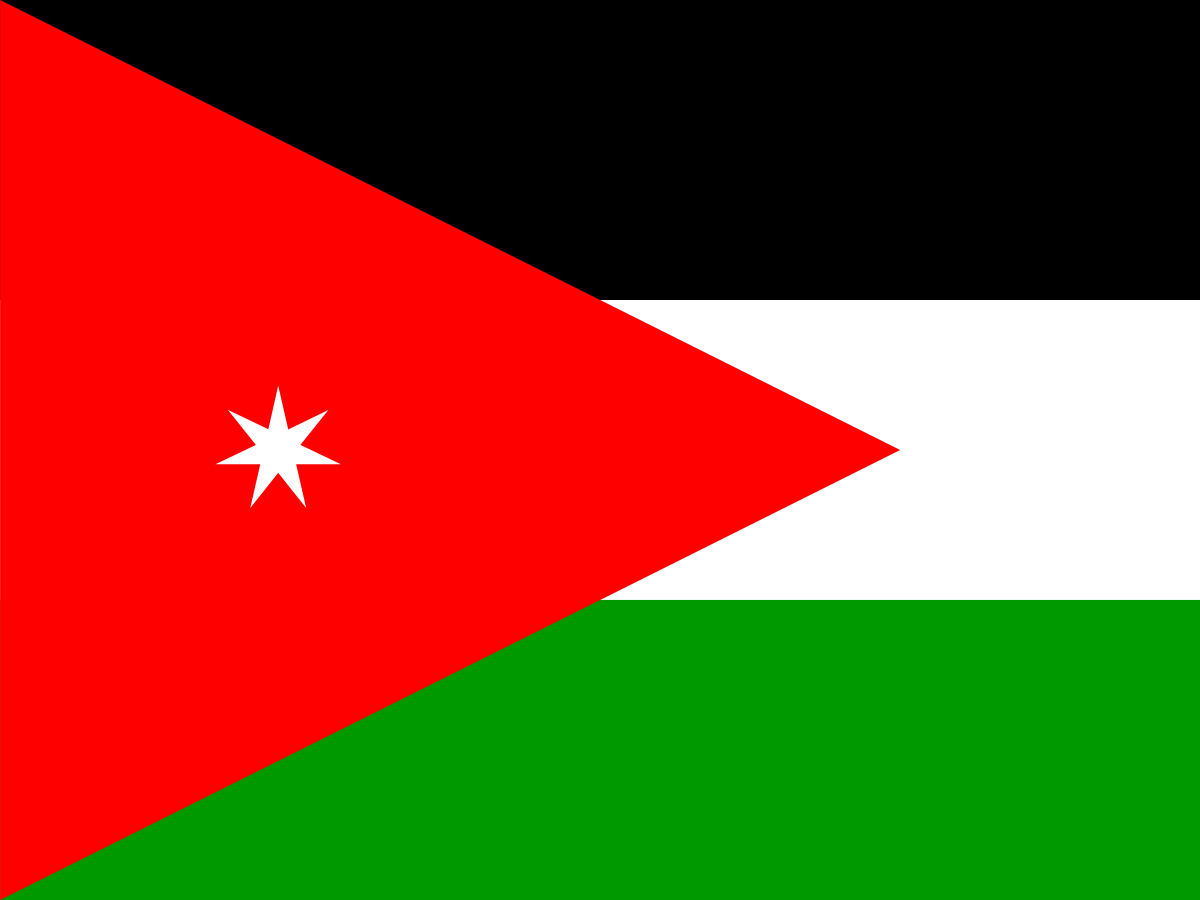
The flag of Jordan
Jordan's national flag uses the Pan-Arab colours of black, white and green, with a red triangle at the hoist containing a seven-pointed white star.
The design reflects Arab history and the Hashemite dynasty.
The three horizontal colours are associated with major Arab dynasties, while red represents the Hashemite family. The seven-pointed star has several traditional interpretations.
The flag was adopted in its present form in 1928, based on the flag of the Arab Revolt and wider Arab nationalist symbolism.
What do the colours mean?
Jordan's flag uses the four colours commonly associated with Pan-Arab symbolism: black, white, green and red.
Black is associated with the Abbasid dynasty, white with the Umayyads, green with the Fatimids, and red with the Hashemite dynasty and the Arab Revolt.
The black stripe
Black is traditionally associated with the Abbasid dynasty, which ruled a major Islamic caliphate from the eighth century.
The colour forms the upper horizontal band of the Jordanian flag.
The white stripe
White is traditionally associated with the Umayyad dynasty, whose caliphate was centred in Damascus and ruled much of the early Islamic world.
It forms the middle band of Jordan's flag.
The green stripe
Green is traditionally associated with the Fatimid dynasty. Green also has broad associations with Islam and the natural world.
It forms the lower horizontal band of the flag.
The red triangle
The red triangle represents the Hashemite dynasty and connects the Jordanian flag to the Arab Revolt against Ottoman rule during the First World War.
The Hashemites played a major role in the political history of the modern Arab world and the establishment of Jordan.
The seven-pointed star
The white star has seven points, making it one of the most distinctive features of Jordan's flag.
It is commonly explained as representing the seven verses of the opening surah of the Qur'an, while Jordanian interpretations also associate its points with values including faith, humanity, national spirit, humility, virtue, social justice and aspirations.
The Arab Revolt flag
Jordan's flag developed from the flag of the Arab Revolt, which began in 1916 against the Ottoman Empire.
The Revolt flag used black, white, green and red — colours that subsequently became powerful symbols of Arab nationalism and were incorporated into several modern Arab flags.
A short history of Jordan
Jordan's territory has been inhabited for thousands of years and has been part of ancient kingdoms, Roman and Byzantine territories, early Islamic caliphates and the Ottoman Empire.
The modern state emerged from the political changes surrounding the First World War and the collapse of Ottoman rule.
History timeline
c. 9th–7th centuries BCE — Iron Age kingdomsThe ancient kingdoms of Ammon, Moab and Edom occupied parts of the territory of modern Jordan.
4th century BCE onward — Nabataean kingdomThe Nabataeans developed a wealthy trading kingdom centred on Petra.
106 CE — Roman annexationRome incorporated the Nabataean kingdom as the province of Arabia Petraea.
4th–7th centuries — Byzantine periodChristian communities and cities flourished under Byzantine rule.
7th century — Islamic conquestThe region became part of the early Islamic caliphates.
12th century — Crusader periodCrusader fortresses were established in parts of the region.
16th–20th centuries — Ottoman ruleThe territory became part of the Ottoman Empire and remained so until the First World War.
1916 — Arab RevoltThe Hashemite-led Arab Revolt began against Ottoman rule.
1921 — Emirate of TransjordanAbdullah bin Hussein became emir of Transjordan under British influence.
1928 — Flag adoptedThe modern Jordanian flag was formally adopted.
1946 — IndependenceTransjordan became the independent Hashemite Kingdom of Transjordan.
1949 — Name becomes JordanThe country's official name became the Hashemite Kingdom of Jordan.
1967 — Six-Day WarJordan lost control of the West Bank and East Jerusalem during the war.
1994 — Peace with IsraelJordan and Israel signed a peace treaty.
TodayJordan is a constitutional monarchy and an important regional diplomatic and humanitarian centre.
Ancient Ammon
The ancient kingdom of Ammon occupied territory around modern-day Amman. Its capital, Rabbath-Ammon, eventually developed into the city known today as Amman.
The region was part of a network of ancient kingdoms and trade routes linking the Levant and Arabia.
Moab and Edom
The ancient kingdoms of Moab and Edom occupied areas east and south of the Dead Sea. Their history is recorded in archaeological remains and ancient Near Eastern sources.
These kingdoms formed part of the complex political landscape of the Iron Age Levant.
The Nabataeans
The Nabataeans built a powerful trading kingdom centred on Petra. They controlled important caravan routes carrying incense, spices and other valuable goods.
Their ability to manage water in the arid landscape was central to the success of their settlements.
Petra
Petra is Jordan's most famous archaeological site and one of the New Seven Wonders of the World. The Nabataeans carved monumental buildings into rose-coloured sandstone cliffs.
Its location between Arabia, the Levant and Egypt helped make Petra an important centre of trade.
The Romans in Jordan
Rome annexed the Nabataean kingdom in 106 CE and incorporated it into the Roman Empire as Arabia Petraea.
Roman roads, cities and military installations transformed the region, and several important ruins survive today.
Jerash
Jerash is one of the best-preserved Roman provincial cities in the Middle East. Its ruins include colonnaded streets, temples, theatres and plazas.
The city formed part of the Decapolis, a group of important Greco-Roman cities in the region.
The Byzantine period
Under the Byzantine Empire, Jordan contained thriving Christian communities and towns. Churches decorated with mosaics were built across the region.
Sites such as Madaba preserve important evidence of Byzantine-era Christianity.
The early Islamic period
Arab Muslim armies conquered the region during the seventh century. Jordan subsequently became part of successive Islamic caliphates.
The area remained strategically important because it connected Syria, Arabia and Egypt.
The Crusaders
During the Crusades, European Christian forces established fortifications in parts of what is now Jordan. Karak Castle became one of the region's most important Crusader strongholds.
The castle later came under Muslim control as Crusader power declined.
Ottoman Jordan
For several centuries Jordan was part of the Ottoman Empire. Ottoman control was often relatively light in the more sparsely populated interior.
The Hejaz Railway, built in the early twentieth century, connected Damascus with Medina and passed through the region.
The Arab Revolt
The Arab Revolt of 1916 was launched by Sharif Hussein of Mecca and his sons against Ottoman rule. British support helped the Hashemite forces campaign across the Hejaz and Levant.
The revolt became an important symbol of Arab nationalism and its flag inspired several later national flags.
Abdullah and Transjordan
In 1921, Abdullah bin Hussein became emir of Transjordan. The new emirate developed under British influence while gradually building its own institutions.
Abdullah became the first king of the independent Jordanian state in 1946.
Jordanian independence
Jordan became independent on 25 May 1946. The country was initially known as the Hashemite Kingdom of Transjordan before its name was shortened to the Hashemite Kingdom of Jordan in 1949.
The Hashemite monarchy has remained central to the country's political identity.
Jordan and the Arab-Israeli conflict
Jordan played a major role in the Arab-Israeli conflict after independence. In 1948, Jordanian forces took control of the West Bank and East Jerusalem.
Jordan lost control of these territories during the 1967 Six-Day War.
The 1967 Six-Day War
During the Six-Day War in June 1967, Israel captured the West Bank and East Jerusalem from Jordan.
The war fundamentally changed Jordan's geography and politics and contributed to the displacement of many Palestinians into Jordan.
Jordan and the peace treaty with Israel
Jordan and Israel signed a peace treaty in 1994, becoming the second Arab state after Egypt to formally establish peace with Israel.
The treaty established diplomatic relations and addressed borders, water and security cooperation.
Jordan and Palestinian refugees
Jordan has hosted large Palestinian refugee communities for decades, including people displaced during the conflicts of 1948 and 1967.
Jordan has also hosted refugees from other regional conflicts, placing significant demands on its infrastructure and public services.
Amman
Amman is Jordan's capital and largest city. Modern Amman grew rapidly during the twentieth century while incorporating older archaeological sites such as the Citadel and Roman Theatre.
The city is Jordan's political, commercial and cultural centre.
The Dead Sea
The Dead Sea lies on Jordan's western border and is one of the lowest places on Earth's land surface. Its extremely salty water makes it unusually buoyant.
The sea has also become an important tourism destination, although falling water levels are a major environmental concern.
Wadi Rum
Wadi Rum is a spectacular desert landscape of sandstone mountains, valleys and red sand. It is closely associated with Bedouin culture and the history of the Arab Revolt.
Its dramatic scenery has also made it a popular filming location for science-fiction and adventure films.
Jordan's climate
Jordan is predominantly arid and semi-arid, although the western highlands receive more rainfall and have a Mediterranean-influenced climate.
The eastern and southern deserts are much drier, with hot summers and large temperature differences between day and night.
Jordanian wildlife
Jordan's varied environments support ibex, gazelles, foxes, hyenas, wolves, birds of prey and many desert species.
Protected areas help conserve wildlife in deserts, mountains and wetlands.
Dana Nature Reserve
The Dana Biosphere Reserve protects a large range of landscapes from high mountains to desert valleys. It is one of Jordan's most important nature conservation areas.
The reserve contains many plant and animal species and supports ecotourism.
Jordanian culture
Jordanian culture combines Arab traditions, Bedouin heritage, Islamic history and influences from the many communities that have settled in the country.
Hospitality, family and communal meals are important parts of everyday cultural life.
Arabic in Jordan
Arabic is Jordan's official language. Jordanian Arabic has several regional varieties, while Modern Standard Arabic is used in formal writing and official contexts.
English is also widely taught and used in business and education.
Jordanian food
Jordanian cuisine includes dishes such as mansaf, maqluba, falafel, hummus, mezze and knafeh.
Food is closely connected to hospitality, and sharing meals is an important part of Jordanian social life.
Mansaf
Mansaf is widely regarded as Jordan's national dish. It traditionally combines lamb with a fermented dried-yoghurt sauce called jameed and rice or bulgur.
Mansaf is particularly associated with celebrations, hospitality and Bedouin traditions.
Jordan's economy
Jordan's economy includes services, tourism, manufacturing, mining, pharmaceuticals and information technology.
The country has limited natural water and energy resources and has historically depended heavily on imports and international support.
Tourism
Tourism is an important part of Jordan's economy. Major attractions include Petra, Wadi Rum, the Dead Sea, Jerash, Aqaba and religious and archaeological sites.
Jordan's position at the crossroads of ancient civilisations gives it an unusually rich concentration of historical attractions.
Jordan today
Modern Jordan is a constitutional monarchy and an important regional diplomatic centre. It has maintained relative political stability despite the conflicts surrounding it.
Jordan continues to face challenges involving water scarcity, economic pressures, refugee populations and regional instability.
Why is Jordan's flag interesting?
Jordan's flag tells a story of Arab history, the Hashemite dynasty and the creation of the modern Jordanian state. Its black, white and green bands represent major Arab dynasties, while the red triangle connects it to the Hashemites and the Arab Revolt.
The seven-pointed star gives Jordan's flag an especially distinctive identity among Pan-Arab flags.
Explore Jordan on FlagAtlas
Continue exploring Jordan and the world's flags with these FlagAtlas resources.