About Laos
Laos is a landlocked country in mainland Southeast Asia, bordered by China, Vietnam, Cambodia, Thailand and Myanmar. Vientiane is the capital and largest city.
Laos has a rich history shaped by the ancient Lao kingdom of Lan Xang, French colonial rule, the conflicts of the twentieth century and the establishment of the Lao People's Democratic Republic in 1975.
CapitalVientiane
RegionSoutheast Asia
PopulationAbout 7.3 million
CurrencyLao kip
Official languageLao
Republic established1975
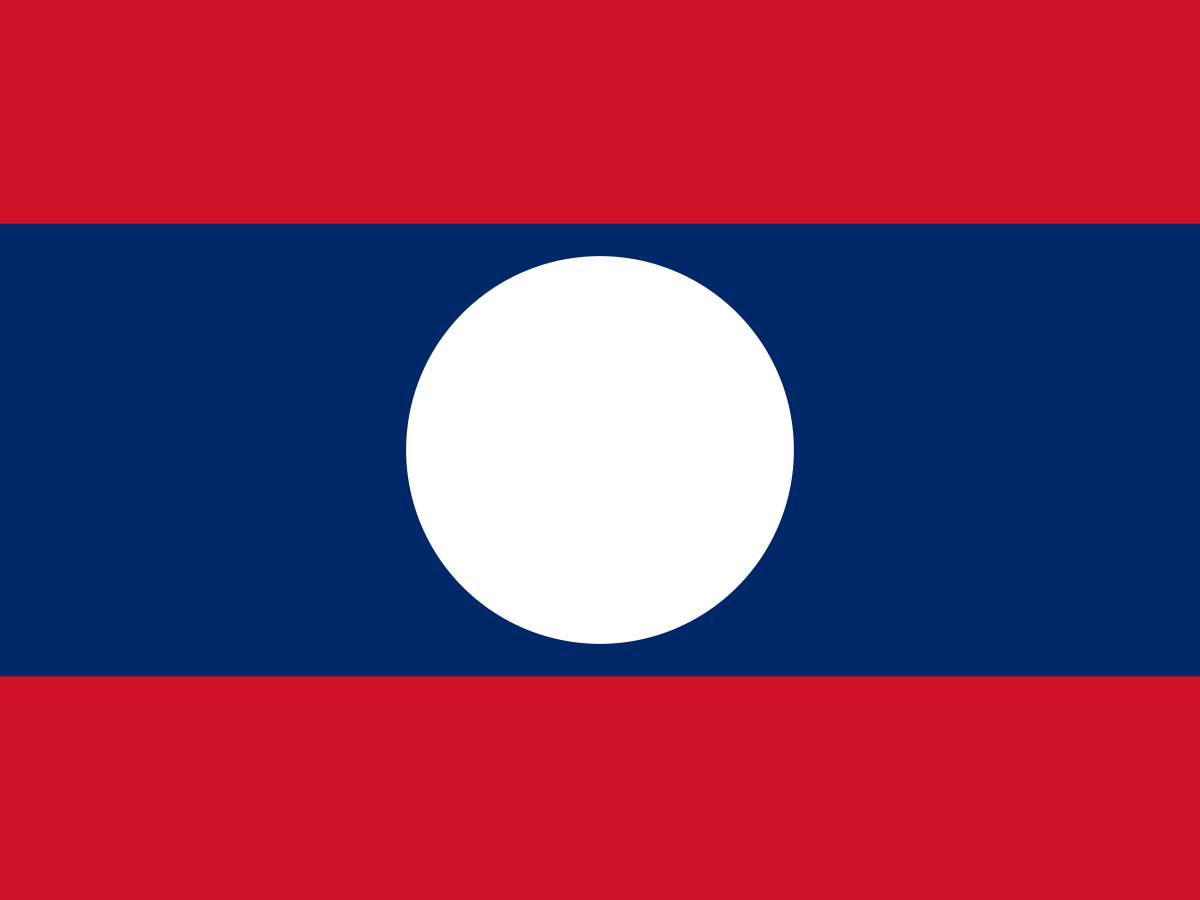
The flag of Laos
Laos's national flag has a red-blue-red horizontal design with a large white circle in the centre of the blue band.
The flag's symbolism combines sacrifice, the Mekong and national unity.
Red is associated with the blood shed for independence, blue represents the country's wealth and the Mekong, and the white disc is commonly interpreted as the full moon over the Mekong and the unity of the Lao people.
The current flag was adopted in 1975 when the Lao People's Democratic Republic was established.
The red bands
The two red bands represent the blood shed by the Lao people in the struggle for independence.
They frame the central blue band and give the flag its distinctive three-colour structure.
The blue band
The broad blue band is associated with the country's wealth and prosperity and is often connected with the Mekong River, which is central to life in Laos.
The blue field also provides the contrast that makes the white disc highly visible.
The white circle
The large white circle is commonly interpreted as the full moon shining over the Mekong River. It is also associated with national unity.
The circular design is one of the most distinctive features of the Lao flag.
Why is Laos's flag unusual?
Laos's flag is unusual because the central white disc sits on a wide blue band between two red bands. Among national flags, large central discs are relatively uncommon.
The design was associated with the Lao revolutionary movement before becoming the national flag in 1975.
A short history of Laos
Laos has a long history of Lao kingdoms, Buddhist culture and regional trade. The kingdom of Lan Xang became a major power in mainland Southeast Asia before the territory was divided among competing regional powers.
Laos later became part of French Indochina, experienced the Vietnam War era and became a communist republic in 1975.
History timeline
Ancient period — Early Lao and Tai peoplesThe region developed through interactions between indigenous communities and migrating Tai-speaking peoples.
1353 — Lan Xang foundedFa Ngum established the kingdom of Lan Xang, meaning “Land of a Million Elephants”.
16th century — Golden age of Lan XangUnder King Setthathirath, Lan Xang became a powerful regional kingdom and Theravada Buddhism flourished.
1707 — Lan Xang dividesThe kingdom fragmented into separate centres including Luang Prabang, Vientiane and Champasak.
18th–19th centuries — Siamese influenceThe Lao kingdoms increasingly came under the influence of Siam.
1893 — French protectorateFrance established control over Laos as part of French Indochina.
1945 — Independence declaredLaos briefly declared independence following the end of Japanese occupation.
1946 — French returnFrance re-established control before Laos gradually gained greater autonomy.
1953 — IndependenceLaos achieved full independence from France.
1950s–60s — Political conflictRoyalist, neutralist and communist forces competed for power during the Cold War.
1964–73 — Secret WarLaos became deeply involved in the wider Indochina conflict, with extensive aerial bombing and ground fighting.
1975 — Lao People's Democratic RepublicThe Pathet Lao took power and the monarchy was abolished.
1986 — New Economic MechanismEconomic reforms began moving Laos towards a more market-oriented system.
1997 — ASEAN membershipLaos joined the Association of Southeast Asian Nations.
2000s–present — Development and regional integrationLaos expanded infrastructure, hydropower, tourism and trade while remaining a one-party socialist state.
Lan Xang — the Land of a Million Elephants
The kingdom of Lan Xang was founded in 1353 by Fa Ngum. Its name is usually translated as “Land of a Million Elephants”.
Lan Xang helped establish a Lao political and cultural identity across much of the region that is now Laos.
Theravada Buddhism
Theravada Buddhism is central to Lao culture and history. Buddhist temples, monks, festivals and religious traditions remain visible throughout the country.
Luang Prabang is particularly famous for its temples and religious heritage.
Luang Prabang
Luang Prabang was the royal capital of Laos for centuries and remains one of the country's most important historic cities.
Its Buddhist temples and traditional architecture reflect a mixture of Lao and colonial influences, and the historic town is a UNESCO World Heritage Site.
Vientiane
Vientiane is the capital of Laos and sits on the Mekong River opposite Thailand. It is the country's political and economic centre.
Important landmarks include Pha That Luang, Patuxai and Wat Si Saket.
Pha That Luang
Pha That Luang is one of Laos's most important national and religious symbols. The large golden stupa in Vientiane is closely associated with Lao Buddhism and national identity.
Its image appears frequently in Lao art, architecture and official symbolism.
French colonial Laos
Laos became part of French Indochina in the late nineteenth century. French influence affected administration, architecture, education and infrastructure.
Colonial-era buildings can still be seen in cities including Vientiane, Luang Prabang and Savannakhet.
Independence from France
Laos achieved full independence from France in 1953, although political instability continued during the Cold War.
The country became caught between competing international and domestic forces during the wider conflicts in Indochina.
The Secret War in Laos
During the Vietnam War era, Laos became one of the world's most heavily bombed countries. The conflict involved the Pathet Lao, Royal Lao Government, North Vietnamese forces and US-backed operations.
Large areas of the country were affected by bombing and unexploded ordnance remains a serious legacy.
Unexploded ordnance
Decades after the Indochina conflicts, unexploded bombs and other ordnance remain a major humanitarian and development problem in Laos.
Clearance programmes help make farmland, roads and communities safer.
The Lao People's Democratic Republic
In 1975, the Pathet Lao took control and established the Lao People's Democratic Republic. The monarchy was abolished and a socialist political system was introduced.
Laos remains governed by the Lao People's Revolutionary Party.
Economic reforms
From 1986, Laos introduced the New Economic Mechanism, gradually allowing greater use of markets and private enterprise.
The reforms helped Laos expand trade and investment while retaining a socialist political system.
The Mekong River
The Mekong is one of the most important rivers in Laos. It forms much of the country's western border with Thailand and supports agriculture, fishing, transport and settlements.
The river is also central to the symbolism commonly associated with the Lao flag.
Laos's geography
Laos is the only landlocked country in mainland Southeast Asia. Mountains and forest cover much of the country, while the Mekong valley contains many of its major population centres.
The country borders China, Vietnam, Cambodia, Thailand and Myanmar.
Laos's mountains
Mountain ranges cover large areas of Laos, particularly in the north and east. These landscapes have historically made transport difficult and helped preserve distinct local cultures.
They also provide opportunities for trekking, tourism and hydropower.
Laos's climate
Laos has a mainly tropical monsoon climate, with a wet season and a drier season. Mountainous areas can be cooler than the lowlands.
Seasonal rainfall is important for farming and river levels.
Laos's wildlife
Forests and mountains support wildlife including elephants, gibbons, bears, deer and numerous bird species.
Habitat loss, hunting and infrastructure development have created significant conservation challenges.
Lao culture
Lao culture is strongly influenced by Theravada Buddhism, village life, family traditions, music and food.
Traditional festivals such as Pi Mai, the Lao New Year, are celebrated across the country.
Lao language
Lao is the official language and belongs to the Tai-Kadai language family. It is closely related to Thai.
Many ethnic groups in Laos also speak their own languages, reflecting the country's cultural diversity.
Lao food
Lao cuisine is known for sticky rice, larb, tam mak hoong, grilled meats and fresh herbs.
Sticky rice is especially important and is traditionally eaten by hand.
Laos's economy
Laos has a developing economy based on agriculture, hydropower, mining, manufacturing, tourism and trade.
Hydroelectricity is an important source of export revenue, while agriculture remains vital for rural communities.
Hydropower
Laos has invested heavily in hydroelectric dams on the Mekong and its tributaries. The government has promoted hydropower as a way to generate export income.
Dam development has also raised concerns about ecosystems, fisheries, river communities and downstream impacts.
Tourism in Laos
Tourism is an important part of Laos's economy. Visitors are attracted by Luang Prabang, temples, waterfalls, mountains, caves and Mekong landscapes.
The country's slower pace and relatively low population density give it a distinctive appeal within Southeast Asia.
Laos today
Modern Laos is a one-party socialist republic with a rapidly developing economy. It maintains close economic relationships with China, Thailand and Vietnam while participating in ASEAN.
Infrastructure, hydropower, tourism and trade continue to shape the country's future.
Why is Laos's flag interesting?
Laos's flag combines a very simple geometric design with deep historical symbolism. The red bands, blue field and white moon connect the modern republic with sacrifice, the Mekong and national unity.
It is also unusual among Southeast Asian flags because of its large central white disc.
Explore Laos on FlagAtlas
Continue exploring Laos and the world's flags with these FlagAtlas resources.