About Lesotho
Lesotho is a small, mountainous kingdom in southern Africa, completely surrounded by South Africa. Maseru is the capital and largest city.
Known as the “Kingdom in the Sky”, Lesotho has a strong Basotho cultural identity shaped by mountain geography, traditional clothing, horses and the legacy of King Moshoeshoe I.
CapitalMaseru
RegionSouthern Africa
PopulationAbout 2.1 million
CurrencyLoti / South African rand
LanguagesSesotho & English
Independence4 October 1966
The flag of Lesotho
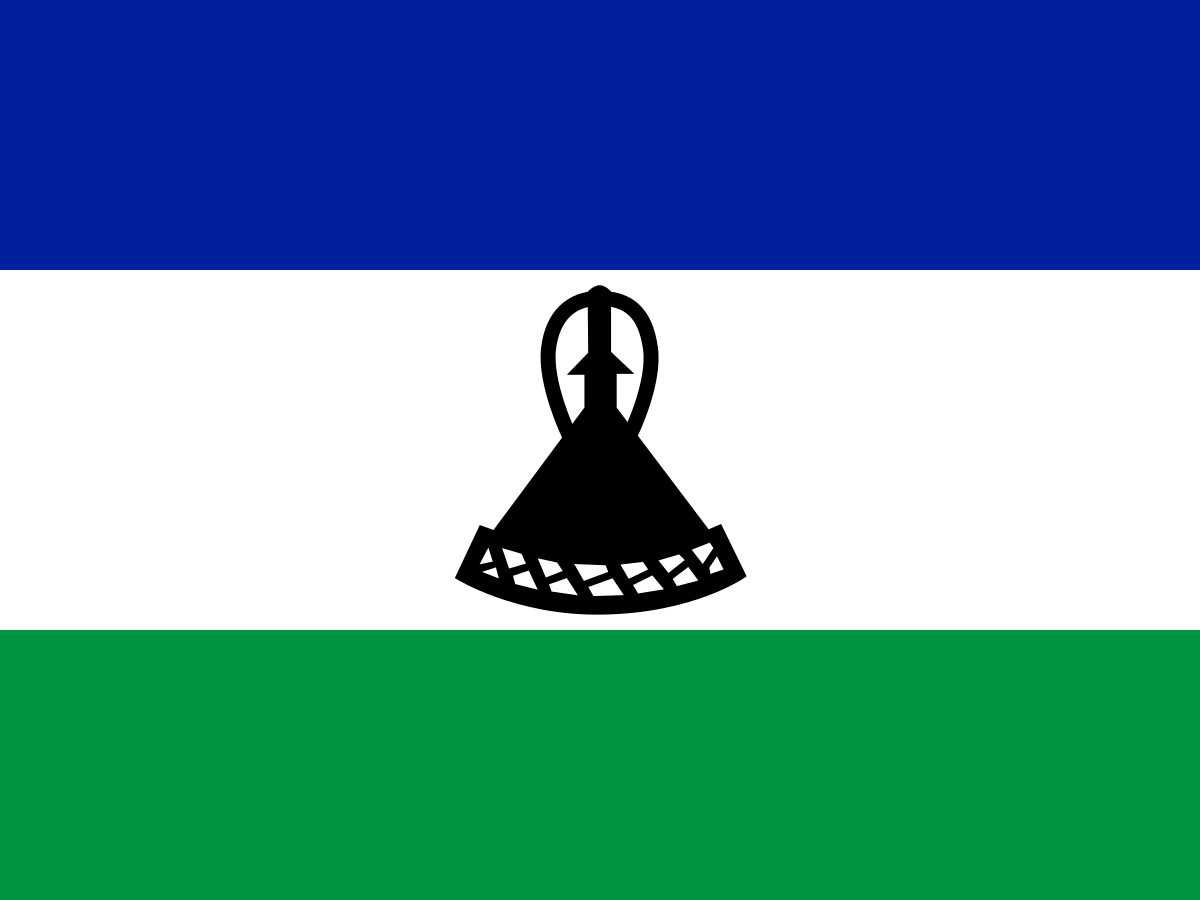
Lesotho's flag consists of three horizontal bands of blue, white and green, with a black Basotho hat called a mokorotlo in the centre.
The flag combines national identity, peace, rain, prosperity and Basotho cultural heritage.
Blue represents rain, white stands for peace, and green represents prosperity. The black mokorotlo is a traditional Basotho hat and a powerful national symbol.
The present flag was adopted in 2006, replacing an earlier design while retaining the central Basotho hat.
The blue band
The blue band is associated with rain and water, both vital to life in Lesotho's highland environment.
Rainfall feeds rivers and mountain streams and is one of the country's most valuable natural resources.
The white band
The white band represents peace. Its position between blue and green gives the flag a strong, balanced appearance.
Peace has particular significance in a country whose modern national identity was forged through the unification of different communities under Moshoeshoe I.
The green band
The green band represents prosperity and the country's land.
It also reflects the importance of agriculture and grazing to rural Basotho communities.
The mokorotlo
The black symbol in the centre is the mokorotlo, a traditional Basotho conical hat made from woven grass.
The hat is one of the most recognisable symbols of Lesotho and is closely associated with Basotho identity, tradition and national pride.
Why is Lesotho's flag interesting?
Lesotho's flag is unusual because it places a distinctive piece of traditional clothing at its centre rather than a conventional coat of arms or shield.
The mokorotlo links the modern state directly to Basotho cultural heritage.
A short history of Lesotho
Lesotho's modern history is closely linked to King Moshoeshoe I, who brought together groups of Basotho people during a period of conflict in southern Africa.
The kingdom later became the British protectorate of Basutoland before achieving independence in 1966.
History timeline
Early 19th century — Basotho consolidationSouthern Africa experienced major upheaval and conflict, encouraging communities to seek protection and new political alliances.
c. 1820s — Moshoeshoe I emergesMoshoeshoe established a stronghold at Thaba Bosiu and began bringing different groups together.
1830s–40s — Basotho kingdom developsMoshoeshoe's influence expanded as communities gathered around the new kingdom.
1850s — Conflicts with the Orange Free StateBasotho territory came under pressure from Boer settlers and the expanding Orange Free State.
1860s — Basotho WarsSeveral wars were fought over land and sovereignty between the Basotho and the Orange Free State.
1868 — British protectionMoshoeshoe requested British protection as pressure from the Orange Free State intensified.
1871 — Basutoland administrationBasutoland was placed under the administration of the Cape Colony.
1884 — British Crown ColonyBasutoland became a directly administered British Crown Colony.
1910 — Union of South AfricaBasutoland remained separate from the Union of South Africa despite strong regional connections.
1950s–60s — Move towards self-governmentPolitical organisations developed and negotiations for independence accelerated.
1966 — IndependenceBasutoland became the independent Kingdom of Lesotho on 4 October 1966.
1970 — Political crisisA disputed election led to a major constitutional and political crisis.
1986 — Military coupA military takeover removed the government and altered the country's political system.
1993 — Return to parliamentary ruleDemocratic elections restored civilian government.
1998 — Political unrestPost-election disputes led to unrest and a regional intervention involving South African and Botswanan forces.
2006 — Current flag adoptedLesotho adopted the present blue, white and green flag with the black mokorotlo.
TodayLesotho remains an independent constitutional monarchy surrounded by South Africa.
King Moshoeshoe I
Moshoeshoe I is regarded as the founder of the Basotho nation. During the upheavals of the early nineteenth century, he built a strong community around the mountain fortress of Thaba Bosiu.
His diplomacy and ability to unite different groups laid the foundations of modern Lesotho.
Thaba Bosiu
Thaba Bosiu is a sandstone plateau that became Moshoeshoe I's mountain stronghold. Its steep sides provided a natural defensive advantage.
The site is one of Lesotho's most important historical and cultural landmarks.
The Basotho nation
The modern Basotho nation developed through the unification of different communities under Moshoeshoe I. The kingdom offered protection during a turbulent period of regional warfare and migration.
Sesotho language and shared cultural traditions remain central to national identity.
The Basotho Wars
During the nineteenth century, the Basotho fought several conflicts with the expanding Orange Free State over land and sovereignty.
The wars ultimately contributed to Lesotho seeking British protection in 1868.
British Basutoland
From the nineteenth century until independence, Lesotho was known as Basutoland. It remained a British territory rather than becoming part of the Union of South Africa.
This separate colonial status helped preserve the territory that later became the modern Kingdom of Lesotho.
Independence in 1966
Lesotho became independent from Britain on 4 October 1966, with King Moshoeshoe II as monarch.
The country retained its constitutional monarchy while developing a parliamentary political system.
Lesotho's monarchy
Lesotho is a constitutional monarchy. The monarchy has deep symbolic importance because of the country's history and the legacy of Moshoeshoe I.
The present royal institution traces its origins to the Basotho kingdom established in the nineteenth century.
Maseru
Maseru is Lesotho's capital and largest city. It lies on the western border near South Africa and is the country's main political, commercial and administrative centre.
The city has grown substantially since independence.
The Maloti Mountains
The Maloti Mountains dominate Lesotho's landscape. Much of the country lies at high elevation, earning it the nickname “Kingdom in the Sky”.
Mountain valleys, plateaus and dramatic escarpments shape transport, farming and settlement.
Lesotho's highest mountains
Lesotho contains some of southern Africa's highest terrain. Thabana Ntlenyana, at around 3,482 metres, is the highest mountain in Lesotho and southern Africa.
High elevations bring cold winters and occasional heavy snowfall.
Lesotho's climate
Lesotho has a highland climate with warm summers, cool to cold winters and substantial seasonal rainfall.
Snow can fall in the mountains during winter, making Lesotho unusual within southern Africa.
Water resources
Lesotho's mountains are an important source of fresh water. The country's highlands feed rivers that flow into South Africa.
The Lesotho Highlands Water Project transfers water to South Africa while also generating hydroelectric power.
The Lesotho Highlands Water Project
The Lesotho Highlands Water Project is one of Africa's major water engineering schemes. It involves dams, tunnels and infrastructure designed to transfer water from Lesotho's mountains to South Africa.
Lesotho receives revenue from the project and also benefits from hydroelectric generation.
Lesotho's wildlife
Lesotho's mountains support bearded vultures, Cape vultures, eland, baboons and other highland wildlife.
Mountain ecosystems are vulnerable to erosion, overgrazing and habitat pressures.
Basotho horses
Horses are deeply important in Lesotho, particularly in the mountains where they provide transport across difficult terrain.
The Basotho pony is famous for its sure-footedness and endurance and has become a cultural symbol.
Traditional Basotho clothing
Traditional Basotho clothing includes the famous woollen Basotho blanket. Blankets are worn for warmth and can also have cultural and ceremonial significance.
The blanket, like the mokorotlo, has become an instantly recognisable symbol of Lesotho.
Sesotho language
Sesotho is the main national language of Lesotho and is spoken throughout the country. English is also an official language and is widely used in government and education.
Sesotho is closely related to other Sotho-Tswana languages of southern Africa.
Basotho culture
Basotho culture is strongly connected to community, cattle, horses, music, oral traditions, blankets and traditional ceremonies.
Village life and mountain communities remain important even as the country becomes increasingly urbanised.
Lesotho's economy
Lesotho's economy is based on agriculture, textiles, manufacturing, water resources, mining and remittances.
The country has close economic links with South Africa because of geography and membership of regional economic organisations.
Diamonds and mining
Lesotho has become known for producing high-quality diamonds from mountain mines. Some exceptionally large diamonds have been discovered there.
Mining is an important source of export earnings but also operates alongside environmental and development challenges.
Textile manufacturing
Textile and garment manufacturing has been an important source of employment and export income in Lesotho.
The sector is closely connected to international clothing supply chains.
Agriculture and livestock
Many Basotho households depend partly on subsistence farming and livestock. Maize, sorghum, wheat and vegetables are grown, while sheep, cattle and goats are widely kept.
Highland terrain and variable rainfall make agriculture challenging.
Lesotho today
Modern Lesotho remains a distinctive mountain kingdom surrounded by South Africa. Its national identity is strongly tied to Moshoeshoe I, the Basotho language, mountain life, horses, blankets and the mokorotlo.
Water, textiles, mining and agriculture remain important to the economy.
Why is Lesotho's flag interesting?
Lesotho's flag is particularly distinctive because the central mokorotlo is a direct representation of Basotho culture rather than an abstract symbol.
It makes the flag immediately recognisable and connects the modern state with its traditional heritage.
Explore Lesotho on FlagAtlas
Continue exploring Lesotho and the world's flags with these FlagAtlas resources.