About Liechtenstein
Liechtenstein is a tiny landlocked principality in the Alps, between Switzerland and Austria. Vaduz is the capital, while Schaan is the country's largest municipality.
It is one of Europe's smallest countries and one of only two doubly landlocked countries in the world.
CapitalVaduz
RegionCentral Europe
PopulationAbout 39,000
CurrencySwiss franc
Official languageGerman
GovernmentConstitutional monarchy
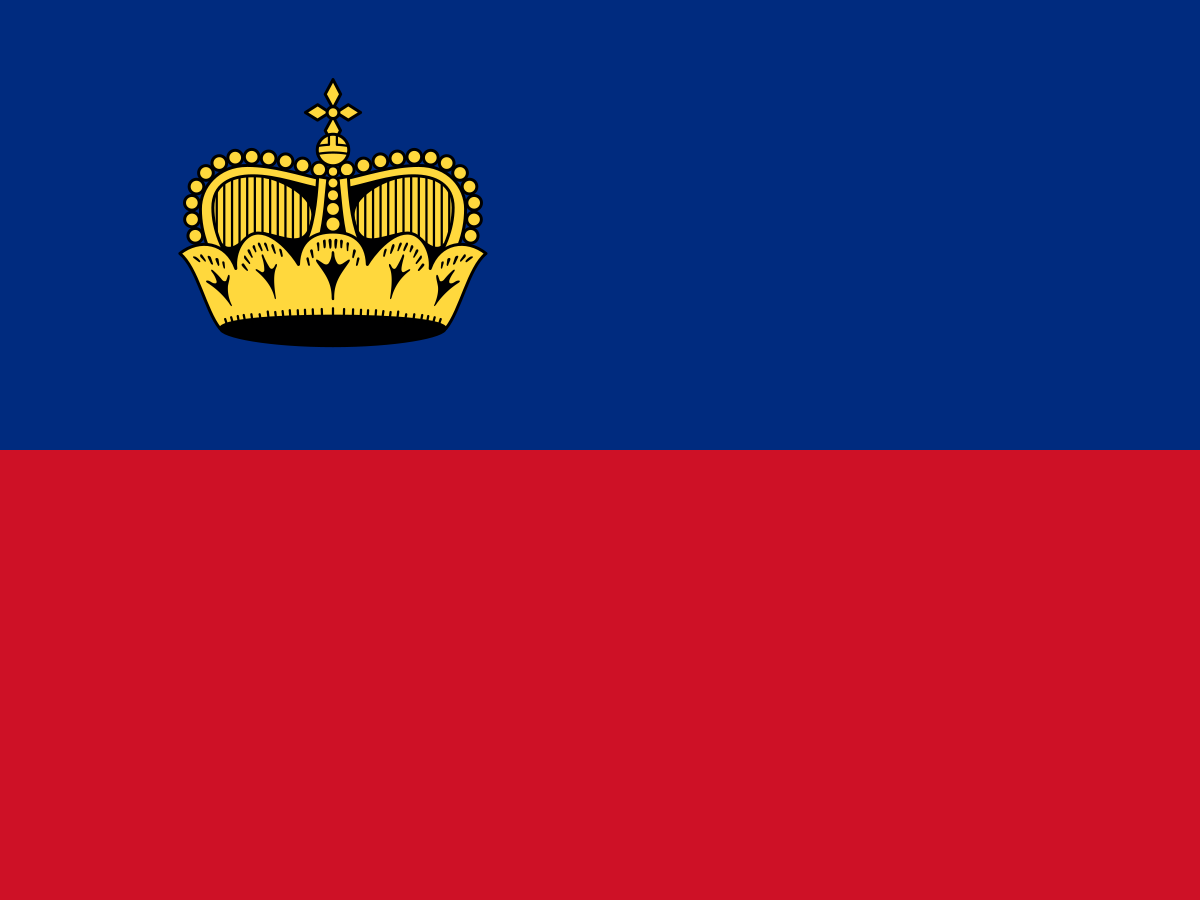
The flag of Liechtenstein
Liechtenstein's flag consists of two horizontal bands of blue and red, with a golden crown in the upper blue band.
The crown was added in 1937 after the 1936 Berlin Olympics revealed that Liechtenstein's flag was identical to Haiti's.
The blue and red colours have been associated with Liechtenstein since the early nineteenth century, while the crown represents the country's monarchy.
The current design therefore combines old national colours with a distinctive royal symbol.
The blue band
The blue band forms the upper half of the flag. Blue and red were established as Liechtenstein's national colours during the early nineteenth century.
The colours were used by the princely household and became established as national symbols.
The red band
The red band forms the lower half of the flag and shares its historical origins with the blue band.
The combination of blue and red gives the flag a simple design that is easy to recognise.
The golden crown
The golden crown represents Liechtenstein's princely monarchy. It was added to the flag in 1937 after officials realised that the national flag was identical to Haiti's flag at the 1936 Olympic Games.
The crown made the two flags immediately distinguishable.
The 1936 Olympics story
At the 1936 Berlin Olympics, Liechtenstein discovered that its flag looked exactly like Haiti's. The country responded by adding the crown to its flag the following year.
It is one of the best-known stories of a national flag being changed because of confusion with another country's flag.
A short history of Liechtenstein
Liechtenstein's history is rooted in the medieval Holy Roman Empire. The present principality was created in 1719 when the territories of Vaduz and Schellenberg were combined into a principality of the Holy Roman Empire.
Liechtenstein later survived the dissolution of the Holy Roman Empire and became a sovereign state.
History timeline
12th–13th centuries — Medieval territoriesThe areas around Vaduz and Schellenberg were divided among various noble families and feudal rulers.
1699 — Schellenberg acquiredPrince Johann Adam Andreas of Liechtenstein purchased the Lordship of Schellenberg.
1712 — Vaduz acquiredThe Liechtenstein family acquired the County of Vaduz, bringing the two territories together under the same ruler.
1719 — Principality createdEmperor Charles VI united Vaduz and Schellenberg and elevated them to the Principality of Liechtenstein.
1806 — SovereigntyLiechtenstein became a sovereign state after joining Napoleon's Confederation of the Rhine.
1815 — German ConfederationLiechtenstein joined the German Confederation following the Napoleonic Wars.
1862 — New constitutionA new constitution established a constitutional framework for the principality.
1868 — Military abolishedLiechtenstein disbanded its small army, which has never been recreated.
1919 — Foreign relations changeAfter Austria-Hungary's collapse, Liechtenstein increasingly turned towards Switzerland for economic and diplomatic cooperation.
1921 — Modern constitutionA new constitution strengthened the role of the prince while establishing modern parliamentary institutions.
1923 — Customs treaty with SwitzerlandLiechtenstein entered a customs union with Switzerland, helping integrate its economy with its western neighbour.
1936–37 — Flag changedThe golden crown was added after the 1936 Olympics revealed the old flag was identical to Haiti's.
1945 — Post-war transformationLiechtenstein remained neutral during the Second World War and entered the post-war period with its economy still closely linked to Switzerland.
1970s–80s — Economic growthIndustry, finance and manufacturing helped transform Liechtenstein into one of Europe's wealthiest states.
1984 — Women gain voting rightsWomen were granted the right to vote in national elections after a referendum.
1990 — United NationsLiechtenstein joined the United Nations, strengthening its international presence.
1995 — European Economic AreaLiechtenstein joined the European Economic Area while remaining outside the European Union.
2003 — Constitutional referendumVoters approved constitutional changes that increased the powers of the reigning prince.
TodayLiechtenstein remains an independent constitutional monarchy with close economic ties to Switzerland and strong links to the wider European economy.
The House of Liechtenstein
The country's ruling dynasty is the House of Liechtenstein, a princely family whose history reaches back centuries.
The family acquired Schellenberg and Vaduz before the two territories were united as the Principality of Liechtenstein in 1719.
Vaduz
Vaduz is Liechtenstein's capital and the seat of the national government. It is situated beside the Rhine valley beneath the Alps.
Vaduz Castle overlooks the town and is the official residence of the princely family.
Vaduz Castle
Vaduz Castle sits high above the capital on a rocky hillside. Parts of the castle date back to the medieval period.
Although it is not generally open to tourists because it remains the private residence of the prince, it is one of Liechtenstein's most recognisable landmarks.
Prince of Liechtenstein
The Prince of Liechtenstein is the country's head of state. The monarchy retains significant constitutional powers compared with many other European monarchies.
The reigning prince also has an important role in appointing the government and approving legislation.
Liechtenstein and Switzerland
Liechtenstein has an exceptionally close relationship with Switzerland. The two countries share the Swiss franc as currency and have operated a customs union since 1923.
Switzerland also represents Liechtenstein diplomatically in some countries where Liechtenstein does not maintain its own embassy.
Liechtenstein and Austria
Liechtenstein borders Austria to the east and north. The country has historical and cultural connections with the Austrian region of Vorarlberg.
German is the official language of both countries, although Liechtenstein has its own Alemannic dialects and distinct identity.
A doubly landlocked country
Liechtenstein is one of only two doubly landlocked countries in the world. This means that every country surrounding it is itself landlocked.
To reach a coastline from Liechtenstein, you must cross at least two national borders. The other doubly landlocked country is Uzbekistan.
The Rhine Valley
Most of Liechtenstein's population lives in the relatively low-lying Rhine Valley on the country's western side.
The Rhine forms much of the border with Switzerland and provides the main corridor for roads, settlements and industry.
Liechtenstein's mountains
The eastern part of Liechtenstein rises sharply into the Rätikon Alps. The country's highest peak is Grauspitz, at about 2,599 metres.
Mountain terrain covers a large part of the country and is important for hiking, skiing and tourism.
Liechtenstein's climate
Liechtenstein has an Alpine climate, with warm summers, cold winters and snowfall at higher elevations.
The Rhine Valley is generally milder than the mountain areas.
Liechtenstein's wildlife
Mountain forests and Alpine meadows provide habitat for chamois, marmots, deer, foxes, golden eagles and other Alpine species.
The country's protected landscapes help conserve mountain biodiversity.
Liechtenstein's economy
Despite its tiny size, Liechtenstein has a highly developed economy based on manufacturing, financial services, engineering, precision products and other specialised industries.
Its companies export goods around the world, while the country benefits from close integration with Switzerland and the European Economic Area.
Industry and manufacturing
Liechtenstein has a surprisingly strong industrial sector. Companies based there produce precision machinery, construction equipment, dental products and other specialised goods.
Manufacturing is an important part of the country's economy and export base.
Financial services
Financial services have historically played an important role in Liechtenstein. The country developed a reputation as an international financial centre.
In recent decades, Liechtenstein has strengthened transparency and cooperation with international financial authorities.
Liechtenstein and the European Economic Area
Liechtenstein is a member of the European Economic Area (EEA) but is not a member of the European Union.
EEA membership gives Liechtenstein access to much of the EU single market while allowing it to remain outside the EU itself.
Liechtenstein's political system
Liechtenstein is a constitutional hereditary monarchy with a parliament called the Landtag.
Citizens vote in parliamentary elections, while the prince retains substantial constitutional powers.
The Landtag
The Landtag of Liechtenstein is the country's parliament. It has 25 members elected by proportional representation.
The parliament passes legislation and approves the national budget.
Liechtenstein's culture
Liechtenstein shares many cultural traditions with the German-speaking Alpine world. Local identity is expressed through music, festivals, traditional costumes, clubs, hiking and winter sports.
The country's small population has a strong sense of local community.
German and the Liechtenstein dialect
German is Liechtenstein's official language. Most residents also speak Alemannic dialects, with the local dialect strongly associated with national identity.
The dialect varies between communities and shares features with neighbouring Swiss and Austrian varieties.
Liechtenstein's national day
Liechtenstein's National Day is celebrated on 15 August. The date combines the Feast of the Assumption with a traditional celebration of the ruling prince's birthday.
Festivities include ceremonies, music, fireworks and celebrations around Vaduz.
Liechtenstein's flag today
The present blue-and-red flag with the golden crown has been in use since the crown was added in 1937.
It is a simple national design, but the crown gives it an immediately distinctive identity.
Why is Liechtenstein's flag interesting?
Liechtenstein's flag has one of the best stories behind a small design: the country discovered that its flag was identical to Haiti's at the 1936 Olympics.
The addition of the golden crown solved the problem and created the flag recognised today.
Explore Liechtenstein on FlagAtlas
Continue exploring Liechtenstein and the world's flags with these FlagAtlas resources.