About Malawi
Malawi is a landlocked country in southeastern Africa, bordered by Tanzania, Zambia and Mozambique. Lilongwe is the capital and largest city.
The country is known for Lake Malawi, its friendly reputation, highland scenery and rich cultural traditions. Malawi gained independence from Britain in 1964.
CapitalLilongwe
RegionSoutheastern Africa
PopulationAbout 19 million
CurrencyMalawian kwacha
Official languageEnglish
Independence6 July 1964
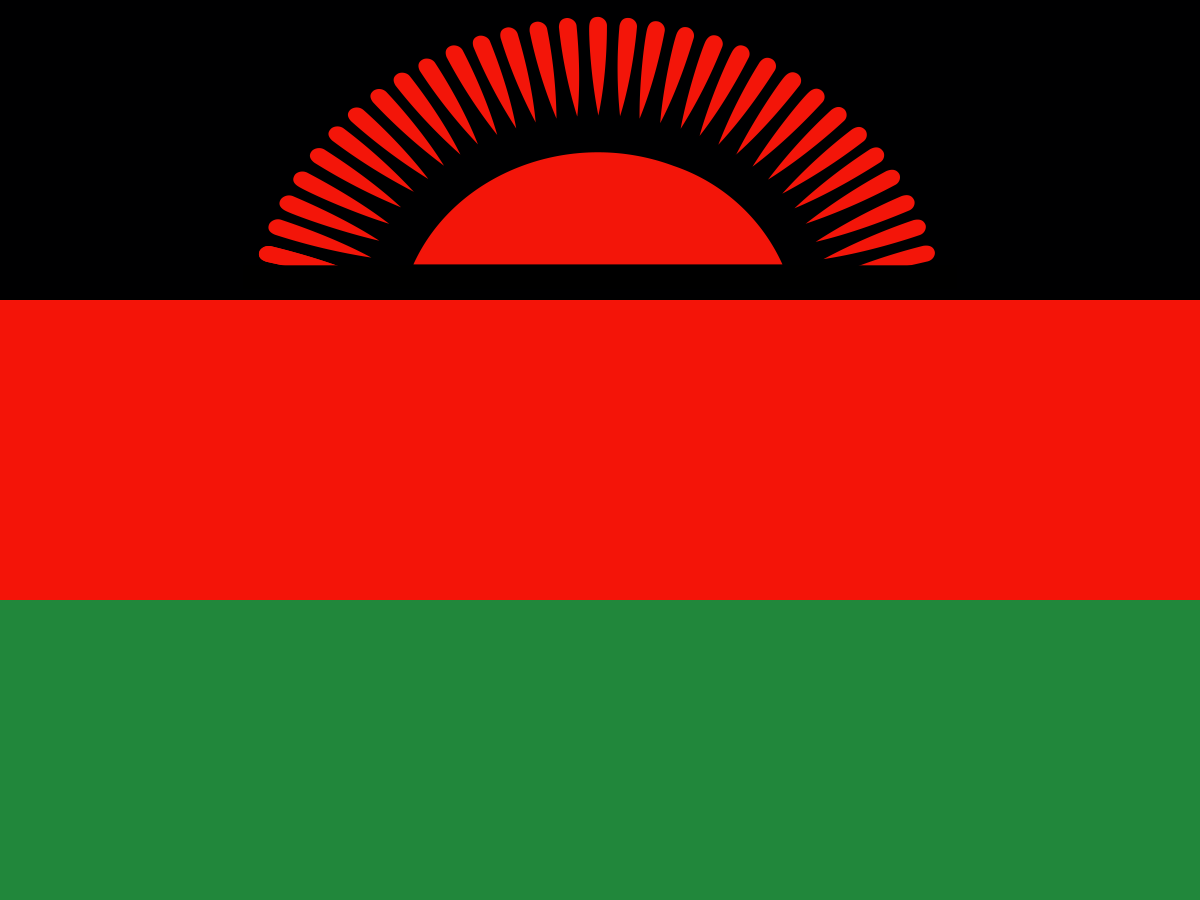
The flag of Malawi
Malawi's flag has three horizontal bands of black, red and green, with a red rising sun centred in the black band.
The flag's symbols express African identity, sacrifice, nature and hope.
Black represents the people of Africa, red represents the blood shed in the struggle for freedom, and green represents Malawi's natural landscape. The rising sun symbolises the dawn of hope and freedom for Africa.
The present design was adopted at independence in 1964 and restored in 2012 after a short-lived alternative flag.
The black band
The black band represents the people of the African continent.
It places African identity at the heart of Malawi's national symbolism.
The red band
The red band represents the blood of martyrs and the sacrifices made during the struggle for African freedom and independence.
The colour connects the flag directly with Malawi's anti-colonial history.
The green band
The green band represents Malawi's natural environment, vegetation and fertile land.
Malawi's economy and everyday life have long been closely connected to agriculture and the land.
The rising sun
The rising red sun represents the dawn of hope and freedom for Africa. It is positioned in the black band and has become one of the flag's most recognisable features.
The sun's rays symbolise a new beginning for the country and continent.
The flag change of 2010–2012
Malawi briefly changed its flag in 2010, moving the sun to the centre of a black, red and green design. The change was controversial.
After a change of government, the original independence-era flag was restored in 2012.
A short history of Malawi
The area now known as Malawi has been home to many African communities and kingdoms. The Maravi Confederacy gave the region its name, while later missionaries and traders increased European involvement.
Britain established colonial rule in the late nineteenth century. Malawi became independent in 1964 and later developed into a multiparty democracy.
History timeline
16th–18th centuries — Maravi statesThe Maravi Confederacy and related communities became major political powers in the region.
16th–19th centuries — Trade and migrationCommunities including the Chewa, Yao and Tumbuka developed across the region, while trade networks linked the area with the wider east African interior.
1859 — David Livingstone reaches Lake MalawiScottish missionary and explorer David Livingstone travelled around the lake, increasing European interest in the region.
1870s–80s — Missionary activityChristian missions expanded and European influence increased.
1889 — British influence growsBritish involvement increased as European powers competed for territory in southeastern Africa.
1891 — British Central Africa ProtectorateBritain established a protectorate over the territory.
1907 — NyasalandThe territory was officially renamed the Nyasaland Protectorate.
1953 — Federation of Rhodesia and NyasalandNyasaland was incorporated into a federation with Northern and Southern Rhodesia.
1958–60 — Hastings Banda returnsDr Hastings Banda became a leading figure in the independence movement and the Malawi Congress Party.
1963 — Self-governmentNyasaland achieved internal self-government as independence negotiations advanced.
6 July 1964 — IndependenceNyasaland became independent as Malawi.
1966 — RepublicMalawi became a republic with Hastings Banda as president.
1971 — Banda becomes president for lifeHastings Banda was declared president for life as Malawi became an increasingly authoritarian one-party state.
1993 — ReferendumMalawians voted overwhelmingly to end one-party rule.
1994 — Multiparty democracyBakili Muluzi won the first multiparty presidential election.
2004 — Bingu wa MutharikaBingu wa Mutharika became president and pursued economic and agricultural policies aimed at improving food security.
2012 — Original flag restoredThe independence-era flag was restored after the controversial 2010 design.
2014 — Capital move completedLilongwe continued as the national capital, while Blantyre remained a major commercial centre.
2020 — Historic election rerunLazarus Chakwera won a fresh presidential election after Malawi's Constitutional Court ordered a rerun of the disputed 2019 result.
TodayMalawi is a multiparty democratic republic whose economy remains strongly dependent on agriculture.
The Maravi Confederacy
The Maravi Confederacy emerged in the sixteenth century and included communities across parts of modern Malawi, Zambia and Mozambique.
The name Maravi is linked to the modern name Malawi and remains an important part of the country's early history.
David Livingstone and Lake Malawi
The explorer and missionary David Livingstone reached Lake Malawi in 1859. He described the region to European audiences and encouraged missionary activity.
Livingstone opposed the slave trade, although later European expansion also contributed to colonial control.
British colonial rule
Britain established the British Central Africa Protectorate in 1891, later renamed Nyasaland. Colonial rule lasted until independence in 1964.
Missionary education, cash-crop agriculture and colonial administration transformed the territory while nationalist movements increasingly demanded self-government.
Hastings Banda
Dr Hastings Banda became the dominant political figure in Malawi's independence movement. He led the country from independence in 1964 and became president when Malawi became a republic in 1966.
His government developed major infrastructure and education programmes but also became highly authoritarian. Multiparty democracy was restored in the 1990s.
Independence in 1964
Malawi became independent from Britain on 6 July 1964. The country chose the name Malawi rather than retaining the colonial name Nyasaland.
The date is celebrated annually as Independence Day.
Lilongwe
Lilongwe is Malawi's capital and one of its major urban centres. The city is divided broadly into an older commercial area and a newer government district.
Blantyre is the country's principal commercial and industrial centre, while Lilongwe is the political capital.
Lake Malawi
Lake Malawi is one of Africa's Great Lakes and dominates the eastern part of the country. It is also known as Lake Nyasa in Tanzania and Lago Niassa in Mozambique.
The lake is famous for its extraordinary diversity of freshwater fish, especially cichlids, many of which are endemic.
Lake Malawi's fish
Lake Malawi contains an exceptional number of cichlid fish species, making it one of the world's most important freshwater biodiversity hotspots.
Many species are found nowhere else and have evolved into highly specialised forms.
Malawi's geography
Malawi is long and relatively narrow, stretching along the western side of Lake Malawi. Much of the country consists of plateaus, mountains, valleys and agricultural land.
The Great Rift Valley has strongly influenced the country's landscape.
Mount Mulanje
Mount Mulanje rises dramatically in southern Malawi. Its highest peak, Sapitwa, reaches about 3,002 metres.
The mountain is famous for hiking, forests and distinctive granite scenery.
Malawi's climate
Malawi has a mainly tropical climate with a wet season and a dry season. Higher elevations are cooler.
Rainfall is particularly important because most agriculture depends on seasonal rains.
Malawi's wildlife
Malawi has a variety of wildlife including elephants, hippos, crocodiles, lions, leopards, antelope and numerous bird species.
National parks and wildlife reserves have become increasingly important for conservation and tourism.
Liwonde National Park
Liwonde National Park is one of Malawi's best-known wildlife areas. It protects habitats along the Shire River and supports elephants, hippos, crocodiles and many other species.
Conservation programmes have helped restore wildlife populations in the park.
Malawi's culture
Malawi has a rich culture shaped by communities including the Chewa, Yao, Tumbuka, Lomwe and Ngoni.
Music, dance, storytelling, traditional ceremonies and community life are central to cultural identity.
The Gule Wamkulu
The Gule Wamkulu is a traditional masked dance associated particularly with the Chewa people. It forms part of the Nyau cultural tradition.
The performance uses masks, costumes, music and dance and has been recognised by UNESCO as intangible cultural heritage.
Malawi's languages
English is the official language and is widely used in government and education. Chichewa is the most widely spoken national language.
Many other languages are used regionally, reflecting Malawi's diverse communities.
Malawi's food
Malawian cuisine commonly features nsima, a maize-based staple served with vegetables, beans, fish or meat.
Lake Malawi provides a major source of fish, while cassava, sweet potatoes and other crops are also widely eaten.
Tea and tobacco
Malawi's agricultural economy includes major exports such as tobacco, tea and sugar.
Tea estates around Mulanje and Thyolo are especially important, although the country is working to diversify its economy.
Malawi's economy
Malawi has a developing economy heavily dependent on agriculture. Most people rely directly or indirectly on farming for their livelihoods.
Tobacco, tea, sugar and other crops are important exports, while tourism, manufacturing and services provide additional income.
Malawi today
Modern Malawi is a peaceful multiparty democracy often known for its welcoming culture and spectacular landscapes. However, it faces serious challenges including poverty, food insecurity, infrastructure constraints and vulnerability to climate shocks.
Lake Malawi, national parks and mountain landscapes provide significant potential for sustainable tourism.
Why is Malawi's flag interesting?
Malawi's flag combines a simple three-colour design with a highly distinctive rising sun. The sun turns the black band into a symbol of a new African dawn.
The flag also has an unusual history because the original independence design was replaced in 2010 and restored only two years later.
Explore Malawi on FlagAtlas
Continue exploring Malawi and the world's flags with these FlagAtlas resources.