About Malta
Malta is a small Mediterranean island country south of Italy and east of Tunisia. Its main islands are Malta, Gozo and Comino, with Valletta as the capital.
Despite its small size, Malta has a remarkably long history because of its strategic position in the centre of the Mediterranean. It has been influenced by Phoenicians, Romans, Arabs, the Knights of St John, France and Britain.
CapitalValletta
RegionSouthern Europe
PopulationAbout 520,000
CurrencyEuro
Official languagesMaltese & English
Independence21 September 1964
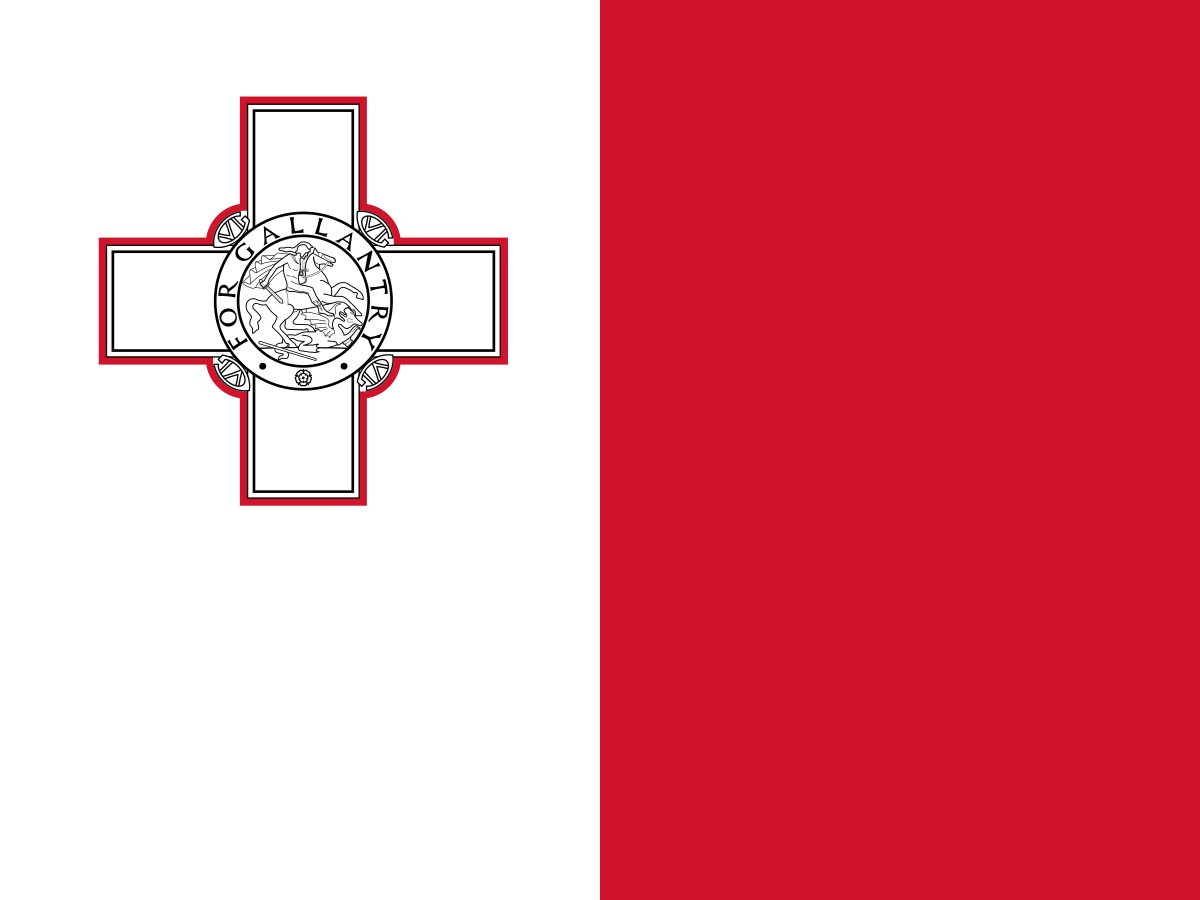
The flag of Malta
Malta's flag has two vertical halves: white at the hoist and red at the fly. A representation of the George Cross appears in the upper hoist corner.
White and red are traditional Maltese colours, while the George Cross recalls Malta's bravery during the Second World War.
King George VI awarded the George Cross to the people of Malta in 1942 in recognition of their courage during the wartime siege and bombing.
The George Cross was incorporated into the national flag after independence and remains one of Malta's most distinctive national symbols.
The white half
The white half of the flag is one of Malta's traditional national colours. White and red have long been associated with the Maltese islands.
The colours are often linked historically with the arms associated with the medieval County and later traditions of Malta.
The red half
The red half is the other traditional Maltese colour.
Together, the white and red halves form one of Europe's most recognisable simple national flags.
The George Cross
The George Cross was awarded to Malta by King George VI in 1942. The award recognised the courage of the Maltese population during the Second World War, when Malta was subjected to intense bombing and blockade.
The medal was originally shown with a blue border and is represented on the flag in the upper hoist corner.
The Knights of St John
The Knights of St John ruled Malta from 1530 until 1798. Their distinctive white Maltese Cross became closely associated with the islands.
The Knights strengthened Malta's fortifications, built Valletta and turned the islands into a major Mediterranean military and naval base.
A short history of Malta
Malta has been inhabited for thousands of years and possesses some of the world's oldest monumental stone structures. Its central Mediterranean location made it strategically important to successive civilisations.
From Phoenician and Roman times through the Knights of St John, French occupation and British rule, Malta's history has been shaped by the struggle for control of the Mediterranean.
History timeline
c. 5900 BC — First settlersEarly farming communities arrived in Malta, probably from Sicily and nearby Mediterranean regions.
c. 3600–2500 BC — Megalithic templesMaltese communities built enormous stone temples including Ħaġar Qim, Mnajdra and Ġgantija.
c. 2500 BC — Temple culture endsThe prehistoric temple-building civilisation declined and later settlement traditions developed.
c. 750 BC — Phoenician settlementPhoenician traders established a presence on Malta and integrated the islands into Mediterranean trading networks.
218 BC — Roman MaltaRome took control of Malta during the Second Punic War. The islands became part of the Roman world.
60 AD — St Paul shipwreckAccording to the Acts of the Apostles, St Paul was shipwrecked on Malta while travelling to Rome.
395–535 — Byzantine periodMalta became part of the Eastern Roman, or Byzantine, sphere after the division of the Roman Empire.
870 — Arab conquestMuslim forces conquered Malta, bringing major changes to agriculture, language and settlement.
1127 — Norman ruleRoger II's forces brought Malta back under Christian European rule as part of the Norman Kingdom of Sicily.
1530 — Knights of St John arriveEmperor Charles V granted Malta to the Knights of St John, who made the islands their Mediterranean headquarters.
1565 — Great Siege of MaltaThe Knights and Maltese defenders resisted a major Ottoman assault in one of the most famous sieges in Mediterranean history.
1566 — Valletta foundedThe Knights began building the fortified city of Valletta after the Great Siege.
1798 — Napoleon captures MaltaFrench forces under Napoleon Bonaparte expelled the Knights and occupied the islands.
1800 — British rule beginsAfter a Maltese uprising and British military intervention, French forces surrendered and Malta came under British control.
1814 — Treaty of ParisMalta formally became part of the British Empire.
1940–42 — Siege of MaltaMalta endured intense Axis bombing and blockade during the Second World War because of its strategic position.
1942 — George Cross awardedKing George VI awarded the George Cross to the people of Malta for their courage.
21 September 1964 — IndependenceMalta became independent from Britain while retaining the British monarch as head of state initially.
1974 — RepublicMalta became a republic, with the president replacing the monarch as head of state.
1979 — British forces leaveThe final British military forces left Malta, marking the end of the country's long British military presence.
2004 — EU membershipMalta joined the European Union as part of the major 2004 enlargement.
2008 — Euro adoptedMalta adopted the euro as its currency.
2018 — Valletta European Capital of CultureValletta was European Capital of Culture, highlighting Malta's cultural heritage.
TodayMalta is an independent parliamentary republic and EU member with a service-based economy centred on tourism, finance, trade and technology.
The prehistoric temples
Malta is home to some of the world's oldest surviving freestanding monumental stone buildings. The Ġgantija temples on Gozo date back thousands of years.
Other major sites include Ħaġar Qim, Mnajdra and Tarxien. These prehistoric monuments are UNESCO World Heritage Sites.
The Phoenicians
The Phoenicians used Malta as a trading and maritime base from around the eighth century BC. The islands' position made them valuable for Mediterranean commerce.
Phoenician influence was followed by Carthaginian and then Roman control.
Roman Malta
Malta became part of the Roman Republic and later Roman Empire in 218 BC. It was known for honey, textiles and maritime trade.
Roman remains can still be seen around the islands, including villas, baths and catacombs.
St Paul and Malta
According to the New Testament, St Paul was shipwrecked on Malta while being transported to Rome. The story is traditionally dated to around AD 60.
St Paul's connection is deeply embedded in Maltese Christian culture and is commemorated by churches and traditions across the islands.
The Arab period
Arab rule beginning in the ninth century had a lasting influence on Malta. Agricultural techniques, irrigation and elements of the Maltese language developed during this period.
Maltese is the only official Semitic language of the European Union.
The Knights of St John
The Knights of St John arrived in Malta in 1530 after losing Rhodes to the Ottoman Empire. They transformed Malta into a heavily fortified military power.
Their rule produced spectacular architecture, hospitals, churches and fortifications that still dominate Valletta and the Grand Harbour.
The Great Siege of 1565
In 1565, the Ottoman Empire launched a major assault on Malta. The Knights of St John, supported by Maltese defenders, resisted the invasion.
The Great Siege became a defining moment in Maltese history and helped establish the islands' reputation as a fortress of the Mediterranean.
Valletta
Valletta was founded in 1566 by the Knights of St John and named after Grand Master Jean Parisot de Valette.
The city is renowned for its fortified walls, Baroque architecture, St John's Co-Cathedral and views across the Grand Harbour.
The French occupation
Napoleon's forces captured Malta in 1798 while sailing towards Egypt. French rule was unpopular and a Maltese uprising followed.
British forces supported the Maltese rebels and French troops surrendered in 1800.
British Malta
Malta became a British possession in the nineteenth century and developed into a major naval and military base.
Its location between Europe, North Africa and the Middle East made the Grand Harbour strategically important to the British Empire.
The Second World War
Malta played a crucial role during the Second World War. Axis forces attempted to isolate the islands through bombing and blockade.
Malta's location allowed Allied forces to attack Axis supply routes across the Mediterranean. The civilian population endured severe shortages and destruction.
Independence in 1964
Malta became independent from Britain on 21 September 1964. The country initially retained the British monarch as head of state.
Independence Day remains an important national celebration.
Malta becomes a republic
In 1974, Malta became a republic. The office of president replaced the monarch as head of state.
Malta's political system is now a parliamentary republic.
Malta and the European Union
Malta joined the European Union in 2004. It later adopted the euro in 2008.
EU membership has strengthened Malta's economic and political connections with continental Europe.
Malta's geography
Malta is an archipelago in the central Mediterranean. The three main inhabited islands are Malta, Gozo and Comino.
The landscape is largely rocky and limestone-based, with steep coastlines, bays and natural harbours.
Gozo
Gozo is Malta's second-largest island and is known for its quieter rural character, dramatic coastline and historic villages.
Victoria, also known as Rabat, is the island's main town and administrative centre.
Comino and the Blue Lagoon
Comino is a small island famous for the Blue Lagoon, whose clear turquoise water attracts large numbers of visitors.
The island is mostly rural and has very few permanent residents.
Malta's climate
Malta has a Mediterranean climate with hot, dry summers and mild, wetter winters.
Rainfall is concentrated in the cooler months, while summers are generally sunny and dry.
Malta's culture
Maltese culture reflects centuries of Mediterranean, European and North African influence. Catholic Christianity remains an important part of national life.
Village festas, brass bands, churches and colourful fireworks are major features of Maltese cultural traditions.
Maltese language
Maltese is the national language and one of Malta's two official languages alongside English. It developed from Arabic varieties and contains substantial Italian and English influence.
Maltese is written using the Latin alphabet and is the only Semitic official language of the European Union.
Maltese food
Maltese cuisine reflects the islands' Mediterranean location and historical connections. Popular foods include pastizzi, rabbit stew, ftira, bigilla and ġbejna.
Fish, tomatoes, olives, capers and local cheese are common ingredients.
The Maltese Cross
The Maltese Cross is strongly associated with Malta because of the Knights of St John. Its eight points have traditionally been given various symbolic meanings.
The cross appears throughout Maltese architecture, souvenirs, military history and cultural imagery.
Malta's economy
Malta has a high-income, service-based economy. Important sectors include tourism, financial services, online gaming, manufacturing, shipping and technology.
Its EU membership and location in the Mediterranean have helped it develop strong international business links.
Tourism
Tourism is one of Malta's most important industries. Visitors come for historic cities, beaches, diving, architecture and Mediterranean weather.
Valletta, the ancient temples, Gozo and the Blue Lagoon are among the country's best-known attractions.
Malta today
Modern Malta is a small but densely populated European Union member with an extraordinary concentration of history and architecture.
Its strategic location, English-speaking population, EU membership and service economy have made it an important Mediterranean business and tourism hub.
Why is Malta's flag interesting?
Malta's flag is unusually distinctive because of the George Cross displayed beside the traditional white and red colours.
The cross is not simply a decorative symbol: it records the extraordinary wartime experience of the Maltese people during the Second World War.
Explore Malta on FlagAtlas
Continue exploring Malta and the world's flags with these FlagAtlas resources.