About Mexico
Mexico is a vast North American country stretching from the Pacific Ocean to the Gulf of Mexico and Caribbean Sea. It borders the United States to the north and Guatemala and Belize to the south. Mexico City is the capital and largest metropolitan centre.
Mexico combines ancient Indigenous civilisations, Spanish colonial heritage and a modern multicultural society. It is one of the world's most populous Spanish-speaking countries and has one of Latin America's largest economies.
CapitalMexico City
RegionNorth America
PopulationAbout 130 million
CurrencyMexican peso
Official languageNo federal official language
Independence16 September 1810
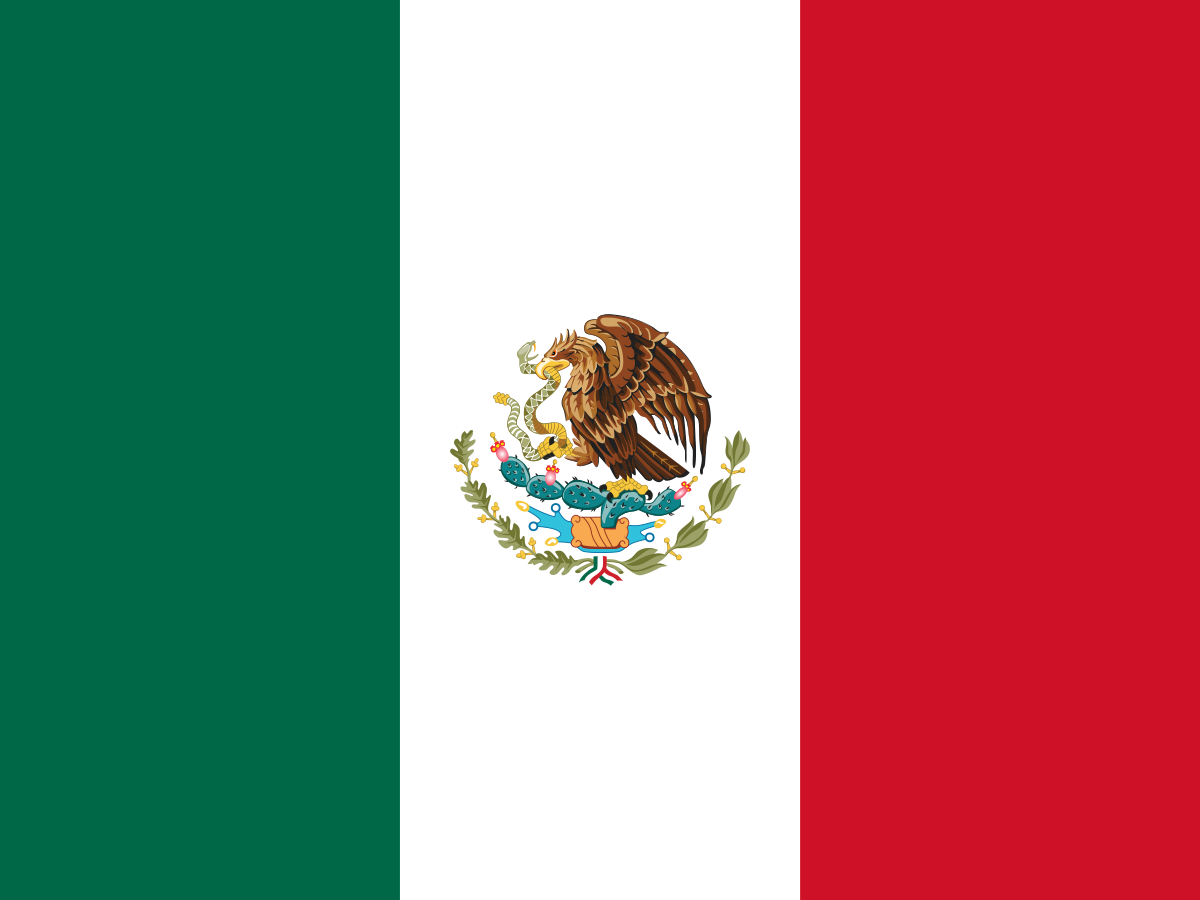
The flag of Mexico
Mexico's flag has three equal vertical bands of green, white and red, with the national coat of arms in the centre of the white band.
The emblem shows a golden eagle perched on a prickly pear cactus while holding a serpent.
The image comes from the Mexica/Aztec tradition describing the sign that would identify the place where their people should establish their great city.
The current flag was adopted in 1968, with the design standardised for the modern Mexican state.
The green band
The traditional interpretation of the green band is hope and independence.
The meaning of the colours has changed over Mexican history. Earlier interpretations connected the colours more directly with independence, religion and unity.
The white band
The white band historically represented religion or purity. Modern interpretations often connect it more broadly with unity and peace.
The national emblem sits at the centre of the white band and is the most distinctive part of the Mexican flag.
The red band
The red band is traditionally associated with the blood of national heroes and the sacrifices made in Mexico's struggle for independence.
It completes the green-white-red combination that became strongly associated with Mexican national identity.
The eagle and serpent
The central emblem shows a golden eagle eating a serpent while standing on a prickly pear cactus.
According to the founding tradition of Tenochtitlan, the Mexica were instructed to establish their city where they saw an eagle on a cactus growing from a rock or island in a lake.
The Aztec founding legend
The emblem refers to the story of the founding of Tenochtitlan. The Mexica are traditionally said to have searched for the sign promised by their deity Huitzilopochtli.
They found an eagle on a cactus on an island in Lake Texcoco and established the city that would become the centre of the Aztec Empire and eventually the location of modern Mexico City.
The nopal cactus
The eagle stands on a nopal, or prickly pear cactus. The cactus is an important native plant in Mexico and has become a powerful national symbol.
The emblem's combination of eagle, serpent, cactus and water connects the modern nation with the landscape and mythology of central Mexico.
A short history of Mexico
Mexico has been home to major civilisations including the Olmec, Maya, Teotihuacan, Toltec and Mexica. Spanish forces conquered the Mexica Empire in the sixteenth century, beginning a long colonial period.
Mexico gained independence in the early nineteenth century, experienced major political and territorial upheaval, and underwent the Mexican Revolution beginning in 1910.
History timeline
c. 1500–400 BC — Olmec civilisationThe Olmec flourished in the Gulf Coast region and are associated with monumental stone heads and influential early Mesoamerican traditions.
c. 100 BC–AD 550 — TeotihuacanTeotihuacan became one of the largest cities in the ancient Americas, famous for the Pyramid of the Sun and Pyramid of the Moon.
c. AD 250–900 — Maya Classic periodMaya cities flourished across southern Mexico and neighbouring parts of Central America, producing major achievements in writing, astronomy, mathematics and architecture.
c. 900–1200 — Toltec influenceThe Toltec civilisation centred around Tula and became influential in later Mesoamerican traditions.
1325 — Tenochtitlan foundedThe Mexica founded Tenochtitlan on islands in Lake Texcoco, according to the tradition represented on the modern Mexican coat of arms.
1428 — Aztec Triple AllianceTenochtitlan joined Texcoco and Tlacopan to form the alliance that created the dominant Aztec/Mexica empire in central Mexico.
1519 — Hernán Cortés arrivesSpanish forces led by Cortés landed on the Gulf Coast and began the campaign against the Mexica Empire.
1521 — Tenochtitlan fallsSpanish and Indigenous allied forces defeated the Mexica after a long siege. The Spanish established Mexico City on the ruins of Tenochtitlan.
1535 — Viceroyalty of New SpainNew Spain became a major Spanish colonial possession covering much of present-day Mexico and other territories.
1810 — Independence movement beginsOn 16 September, Miguel Hidalgo issued the Grito de Dolores, launching the armed struggle against Spanish rule.
1821 — Independence achievedMexico became independent from Spain after the Plan of Iguala and the entry of the Army of the Three Guarantees into Mexico City.
1824 — Federal republicThe Constitution of 1824 established the United Mexican States as a federal republic.
1836 — Texas independenceTexas declared independence from Mexico after conflict between the Mexican government and settlers in the region.
1846–1848 — Mexican-American WarMexico fought the United States in a war that ended with Mexico ceding a vast amount of northern territory.
1857 — Liberal ConstitutionA new constitution established liberal reforms and strengthened the separation of church and state.
1862 — Battle of PueblaMexican forces defeated a larger French army at Puebla on 5 May, an event commemorated as Cinco de Mayo.
1864–1867 — Second Mexican EmpireFrance installed Maximilian of Habsburg as emperor, but Republican forces eventually restored the republic.
1876–1911 — Porfirio Díaz eraDíaz dominated Mexican politics for decades, bringing economic development but also repression and inequality.
1910 — Mexican Revolution beginsFrancisco I. Madero challenged Díaz, beginning a decade of revolution, civil war and political transformation.
1917 — ConstitutionThe Constitution of 1917 established major social, labour and land-reform principles and remains the foundation of Mexico's political system.
1938 — Oil nationalisationPresident Lázaro Cárdenas nationalised the oil industry, creating the foundations for the state-owned petroleum company PEMEX.
1968 — Mexico City OlympicsMexico became the first Latin American country to host the Summer Olympic Games.
1994 — NAFTAThe North American Free Trade Agreement entered into force, greatly increasing economic integration with the United States and Canada.
2000 — Political transitionVicente Fox won the presidency, ending more than seven decades of continuous presidential rule by the Institutional Revolutionary Party.
2018 — Andrés Manuel López ObradorLópez Obrador won the presidency with a large majority and launched a political programme known as the Fourth Transformation.
2024 — Claudia SheinbaumClaudia Sheinbaum was elected president, becoming Mexico's first woman president.
TodayMexico is a federal presidential republic with a diversified economy, major manufacturing industries and strong cultural influence around the world.
The Olmecs
The Olmec civilisation flourished along Mexico's Gulf Coast more than two thousand years ago. It is famous for enormous carved stone heads and distinctive ceremonial centres.
Olmec culture influenced later Mesoamerican societies, although historians continue to debate the exact nature of those connections.
Teotihuacan
Teotihuacan became one of the largest cities in the ancient world. Its enormous Avenue of the Dead and pyramids remain among Mexico's most impressive archaeological sites.
The city's influence extended far beyond central Mexico, but the identity of the people who built it remains uncertain.
The Maya
The Maya developed complex societies across southern Mexico, Guatemala, Belize and neighbouring areas. They created sophisticated writing systems, calendars, mathematics and monumental architecture.
Maya communities still live across the region today, making Maya culture a living as well as archaeological heritage.
The Aztec Empire
The term Aztec Empire is commonly used for the empire dominated by the Mexica and their allies. Tenochtitlan became its powerful capital.
The empire collected tribute from many subject peoples before the arrival of the Spanish in the early sixteenth century.
Tenochtitlan and Mexico City
Tenochtitlan was built on islands in Lake Texcoco and became a huge urban centre with causeways, canals, markets and temples.
After the Spanish conquest, the city was rebuilt as Mexico City. The modern capital therefore sits directly on the site of the former Mexica imperial centre.
The Spanish conquest
Hernán Cortés and his Indigenous allies defeated the Mexica Empire in 1521. Spanish rule transformed religion, language, land ownership and political structures.
Many Indigenous communities survived and retained their own languages, traditions and identities, contributing to modern Mexico's diversity.
New Spain
For almost three centuries, Mexico formed the heart of New Spain, one of the Spanish Empire's richest territories.
Silver mining, agriculture, trade and large colonial cities connected Mexico with Europe, Asia and other parts of the Americas.
Miguel Hidalgo and independence
On 16 September 1810, priest Miguel Hidalgo called for rebellion against Spanish rule in the Grito de Dolores.
The independence war lasted more than a decade before Mexico finally achieved independence in 1821.
Benito Juárez
Benito Juárez was a major nineteenth-century Mexican political leader and president. He led the liberal reform movement and resisted the French-backed Second Mexican Empire.
Juárez remains an important national figure associated with constitutional government and the separation of church and state.
The Mexican-American War
The war of 1846–1848 between Mexico and the United States ended with the Treaty of Guadalupe Hidalgo.
Mexico ceded a huge area of northern territory, including land that later became parts of California, Nevada, Utah, Arizona, New Mexico, Colorado and Wyoming.
Cinco de Mayo
Cinco de Mayo commemorates the Mexican victory over French forces at the Battle of Puebla on 5 May 1862.
It is celebrated much more extensively in parts of the United States than across Mexico, where it is primarily associated with Puebla.
The Mexican Revolution
The Mexican Revolution began in 1910 and involved figures including Francisco Madero, Emiliano Zapata, Pancho Villa and Venustiano Carranza.
The conflict helped produce major changes in land ownership, labour rights and the political structure of the country.
The Constitution of 1917
Mexico's 1917 Constitution remains one of the world's longest-standing national constitutions. It included provisions concerning land, labour, education and the relationship between church and state.
It was created during the revolutionary period and became a major foundation of modern Mexican government.
Mexico's geography
Mexico has an extraordinary range of landscapes including deserts, mountains, tropical forests, high plateaus, volcanoes and long coastlines.
The country sits across several tectonic regions and is part of the Pacific Ring of Fire.
Mexico's volcanoes
Mexico has numerous volcanoes, including Popocatépetl, Iztaccíhuatl, Colima and Pico de Orizaba.
Pico de Orizaba is Mexico's highest mountain and the highest volcano in North America.
Mexico's deserts
Northern Mexico contains extensive arid regions including the Chihuahuan Desert and parts of the Sonoran Desert.
These landscapes support specially adapted plants and animals, including cacti and desert mammals.
Mexico's climate
Mexico's climate ranges from arid desert to tropical rainforest and cool highland conditions.
Altitude is a major influence, so temperatures can vary greatly even between places at similar latitudes.
Mexico's wildlife
Mexico is one of the world's most biologically diverse countries. Its wildlife includes jaguars, pumas, monarch butterflies, sea turtles, whales and many bird species.
Its location between North and Central America also makes it an important migration route for many species.
Monarch butterflies
Millions of monarch butterflies migrate to mountain forests in central Mexico each winter after travelling from Canada and the United States.
The Monarch Butterfly Biosphere Reserve protects important overwintering habitat.
Mexican culture
Mexican culture blends Indigenous, Spanish, African and other influences. Music, food, art, festivals and family traditions vary widely between regions.
Mexico's cultural heritage includes both ancient traditions and modern global influences.
The Day of the Dead
Día de los Muertos, or Day of the Dead, is a Mexican tradition that honours deceased family members and loved ones.
Families may create ofrendas, visit graves and use flowers, candles, food and photographs as part of remembrance.
Mexican food
Mexican cuisine is one of the world's most influential food traditions. Common ingredients include maize, beans, chilli peppers, tomatoes and avocado.
Tacos, tamales, mole, pozole and many regional dishes reflect centuries of Indigenous and international influences.
Mexican Spanish and Indigenous languages
Spanish is the dominant language in Mexico, but the country also recognises a large number of Indigenous languages.
Náhuatl, Maya languages, Mixtec, Zapotec and many others are spoken by communities across the country.
Mexico's economy
Mexico has one of Latin America's largest economies. Important sectors include manufacturing, automobiles, electronics, oil, tourism, agriculture and services.
Its close economic relationship with the United States makes North American trade particularly important.
Manufacturing
Mexico is a major manufacturing centre for cars, aircraft components, electronics and machinery.
Factories close to the US border form part of highly integrated North American supply chains.
Mexico and North America
Mexico is a member of the USMCA trade agreement with the United States and Canada, replacing NAFTA in 2020.
North American integration has made cross-border manufacturing and trade central to the Mexican economy.
Mexico today
Modern Mexico is a large federal republic with a population of around 130 million and a huge diversity of landscapes, cultures and communities.
Its major challenges include inequality, security, environmental pressures and managing rapid urban growth, while its cultural and economic influence continues to grow internationally.
Why is Mexico's flag interesting?
Mexico's flag is particularly distinctive because its central emblem is a complete historical and mythological scene rather than a simple symbol.
The eagle, serpent, cactus and water all connect the modern nation to the founding traditions of Tenochtitlan.
Explore Mexico on FlagAtlas
Continue exploring Mexico and the world's flags with these FlagAtlas resources.