About Micronesia
The Federated States of Micronesia (FSM) is an island country spread across the western Pacific Ocean. It is made up of four states — Yap, Chuuk, Pohnpei and Kosrae — containing hundreds of islands and atolls scattered across a huge area of ocean.
Palikir, on the island of Pohnpei, is the national capital. The country's geography has shaped its culture, traditional navigation, economy and close relationship with the sea.
CapitalPalikir
RegionMicronesia / Oceania
PopulationAbout 115,000
CurrencyUS dollar
States4
Independence3 November 1986
The flag of Micronesia
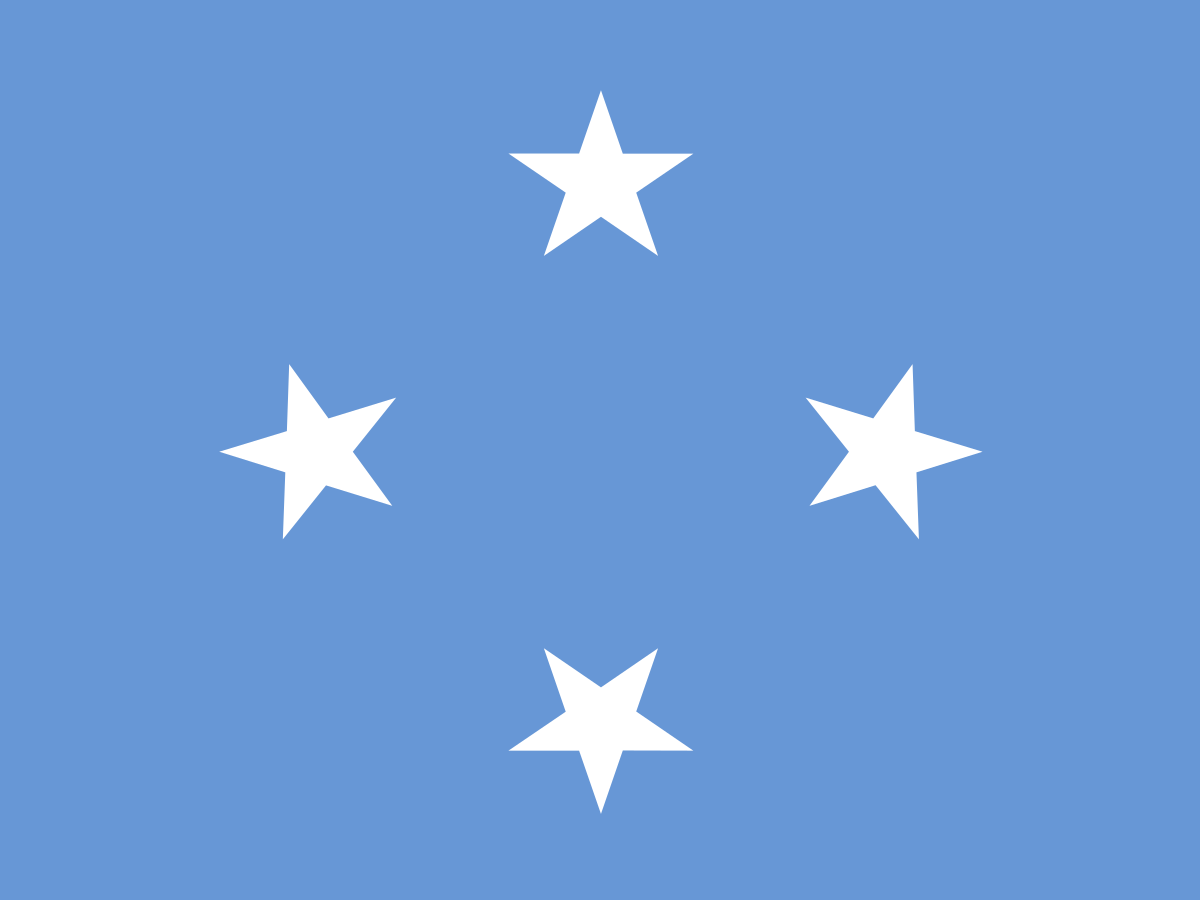
The flag of the Federated States of Micronesia has a light blue field with four white five-pointed stars arranged in a diamond pattern.
The four stars represent the four states of the federation: Chuuk, Kosrae, Pohnpei and Yap.
The light blue background represents the Pacific Ocean.
The design deliberately echoes the blue-and-star imagery of the wider Pacific region while representing the country's federal structure.
The light blue field
The light blue field represents the Pacific Ocean that surrounds and connects the islands of Micronesia.
The colour also gives the flag a strong visual connection to the country's identity as a Pacific island federation.
The four stars
The flag's four white stars represent the four states of the Federated States of Micronesia: Chuuk, Kosrae, Pohnpei and Yap.
The stars are arranged in a diamond, reflecting the geographical and political relationship between the four states.
The four states
The FSM consists of Chuuk, Kosrae, Pohnpei and Yap. Each state has its own islands, communities, traditions and local government.
Pohnpei contains the capital, Palikir, while Chuuk is famous for its lagoon and sunken wartime ships. Yap is renowned for its traditional culture and stone money, and Kosrae is known for its forests and ancient ruins.
A short history of Micronesia
The islands of Micronesia were settled by Pacific peoples thousands of years ago. Communities developed distinctive languages, cultures and systems of navigation long before European contact.
Spain, Germany, Japan and later the United States administered parts of the region. The modern FSM emerged from the former US-administered Trust Territory of the Pacific Islands.
History timeline
Thousands of years ago — Pacific settlementOcean-going peoples settled the islands of Micronesia, developing sophisticated maritime cultures adapted to life across widely separated islands.
Ancient era — Island societies developDistinct communities and political systems developed across Yap, Chuuk, Pohnpei and Kosrae.
c. 1200–1600 — Nan Madol flourishesOn Pohnpei, the remarkable stone complex of Nan Madol developed as a ceremonial and political centre.
16th century — Spanish contactSpanish navigators reached and mapped parts of the Caroline Islands, beginning a period of increasing European contact.
19th century — Missionaries and tradersChristian missionaries and foreign traders became increasingly active across the islands.
1899 — Germany acquires the Caroline IslandsGermany purchased Spain's remaining Pacific possessions and administered the Caroline Islands.
1914 — Japanese occupationJapan took control of the islands during the First World War and later administered them under a League of Nations mandate.
1940s — Second World WarThe islands became strategically important during the Pacific War. Chuuk Lagoon in particular became a major Japanese naval base.
1947 — US-administered trust territoryThe islands became part of the United Nations Trust Territory of the Pacific Islands, administered by the United States.
1979 — FSM ConstitutionThe Federated States of Micronesia was established as a constitutional federation.
3 November 1986 — IndependenceThe Compact of Free Association came into force and the FSM became a sovereign state in free association with the United States.
1990 — UN trust territory endsThe United Nations formally ended the Trust Territory status for the FSM.
1991 — UN membershipThe Federated States of Micronesia joined the United Nations.
2004 — Typhoon SudalMajor storms and natural disasters highlighted the vulnerability of the islands and their infrastructure.
21st century — Climate pressuresSea-level rise, coastal erosion, extreme weather and changing ocean conditions have become major concerns for the island federation.
TodayThe FSM remains a sovereign Pacific island federation with strong constitutional, economic and security links to the United States.
Traditional navigation
Micronesian societies developed some of the world's most sophisticated systems of traditional ocean navigation.
Skilled navigators used stars, ocean swells, winds, clouds, birds and other environmental clues to travel between islands without modern instruments.
Yap
Yap is famous for its traditional culture, including stone money known as rai. These enormous stone discs were quarried on Palau and transported across the sea.
Yap also has distinctive traditional dances, houses and social customs that remain important today.
Chuuk
Chuuk is best known for its huge lagoon and its World War II underwater wrecks. The lagoon contains numerous Japanese ships and aircraft sunk during Operation Hailstone in 1944.
It is now one of the world's best-known destinations for wreck diving.
Pohnpei
Pohnpei is one of the largest and wettest islands in the FSM. It contains the national capital, Palikir, and the ancient stone city of Nan Madol.
The island's mountainous interior is covered by lush tropical vegetation.
Kosrae
Kosrae is the easternmost of the four FSM states. It is heavily forested and known for coral reefs, waterfalls and archaeological sites.
The island has a relatively small population and a strong connection to traditional culture and the natural environment.
Nan Madol
Nan Madol is a remarkable ancient city built on a series of artificial islets off Pohnpei. Its structures were constructed from huge basalt stones and coral.
It served as a ceremonial and political centre associated with the Saudeleur dynasty and is now a UNESCO World Heritage site.
Spanish rule and contact
Spain claimed the Caroline Islands during the age of European expansion. Spanish influence increased in the nineteenth century, particularly through missionaries and administration.
Spain eventually sold its remaining Pacific possessions to Germany in 1899.
German administration
Germany administered the Caroline Islands from 1899 until the First World War. German traders and officials became involved in the islands' copra and commercial economy.
The period ended when Japanese forces took control in 1914.
Japanese administration
Japan administered the Caroline Islands after the First World War under a League of Nations mandate.
Japanese settlement and commercial development increased, and the islands became strategically important during the Second World War.
Chuuk Lagoon in World War II
Chuuk Lagoon was a major Japanese naval base during the Pacific War. In February 1944, US forces launched Operation Hailstone, sinking many ships and destroying aircraft.
The wrecks now form a major underwater archaeological and diving site.
The Trust Territory
After the Second World War, the islands became part of the Trust Territory of the Pacific Islands, administered by the United States on behalf of the United Nations.
The territory eventually separated into several independent states, including the Federated States of Micronesia, the Marshall Islands and Palau.
Independence and the Compact of Free Association
The FSM became independent on 3 November 1986 in free association with the United States under the Compact of Free Association.
The arrangement provides close economic and security links while recognising the FSM as a sovereign state.
Palikir
Palikir, on Pohnpei, is the capital of the Federated States of Micronesia. It became the national capital when the federation was established.
The city is relatively small compared with capitals in larger countries, reflecting the FSM's population and dispersed island geography.
Micronesia's geography
The FSM consists of hundreds of islands spread across a huge area of the western Pacific. The islands range from high volcanic islands to low coral atolls.
The distance between islands makes transport, communications and public services particularly challenging.
The Pacific Ocean
The Pacific is central to Micronesian life. The sea provides food, transport, cultural connections and economic opportunities.
At the same time, rising sea levels and stronger coastal impacts from storms create serious risks for low-lying communities.
Micronesia's climate
The FSM has a tropical climate with warm temperatures throughout the year. Rainfall varies between islands and locations.
Tropical storms and typhoons can cause severe damage, while climate change is increasing concerns about coastal flooding and erosion.
Marine life
The waters around the FSM contain coral reefs, reef fish, sharks, turtles, dolphins and other marine life.
Healthy reefs are important for both biodiversity and local communities that depend on fishing and tourism.
Micronesian culture
Micronesian culture is highly diverse. Each island group has its own languages, traditions, dances, crafts, food and social customs.
Community relationships, family networks and connections to land and sea remain central to everyday life.
Languages
The FSM is linguistically diverse, with many Micronesian and other Austronesian languages spoken across the islands. English is the official language of the federal government.
Local languages remain essential to cultural identity and are widely used within communities.
Food
Traditional Micronesian food relies heavily on fish, taro, breadfruit, coconut, bananas and other tropical crops.
Food traditions vary by island and reflect the availability of local marine and agricultural resources.
Stone money of Yap
Yap's rai stones are huge circular limestone discs with a hole in the centre. Some are several metres across and can weigh several tonnes.
The stones traditionally represented wealth and social status. Ownership could change even when the stone itself remained in place.
Micronesia's economy
The FSM economy relies on government services, fisheries, agriculture, tourism, remittances and financial assistance connected to the Compact of Free Association.
Its dispersed geography makes large-scale manufacturing difficult, while sustainable management of marine resources is economically important.
Fishing
Fishing is important for both subsistence and commercial activity. Tuna and other pelagic fish are valuable marine resources in the wider Pacific.
Managing fisheries sustainably is important for food security and long-term economic development.
Tourism
Tourism is based around diving, reefs, wrecks, fishing, nature and cultural experiences.
Chuuk's wartime wrecks and the natural landscapes of Pohnpei, Kosrae and Yap attract visitors looking for less-developed Pacific destinations.
Climate change
Climate change is a major concern for the FSM. Sea-level rise, coastal erosion, coral bleaching and extreme weather can threaten homes, infrastructure and food systems.
Because communities are spread across small islands, adaptation and resilience are particularly important.
Micronesia today
The Federated States of Micronesia remains a sovereign four-state federation with a close relationship with the United States.
Its greatest strengths include rich marine ecosystems, distinctive island cultures and strong community traditions. Its major challenges include geographic isolation, climate change, transport costs and limited economic opportunities.
Why is Micronesia's flag interesting?
The FSM flag is simple but highly meaningful: one blue field represents the ocean and four stars represent the four states.
It is a good example of how a national flag can express both geography and political structure without using a complicated coat of arms.
Explore Micronesia on FlagAtlas
Continue exploring Micronesia and the world's flags with these FlagAtlas resources.