About Moldova
Moldova is a landlocked country in Eastern Europe, situated between Romania and Ukraine. Its capital and largest city is Chișinău. The country is known for rolling countryside, vineyards, traditional villages and a long history shaped by its position between Central and Eastern Europe.
Moldova became independent from the Soviet Union in 1991. Its history and identity reflect Romanian, Moldavian, Russian, Ukrainian and other regional influences.
CapitalChișinău
RegionEastern Europe
PopulationAbout 2.6 million
CurrencyMoldovan leu
LanguageRomanian
Independence27 August 1991
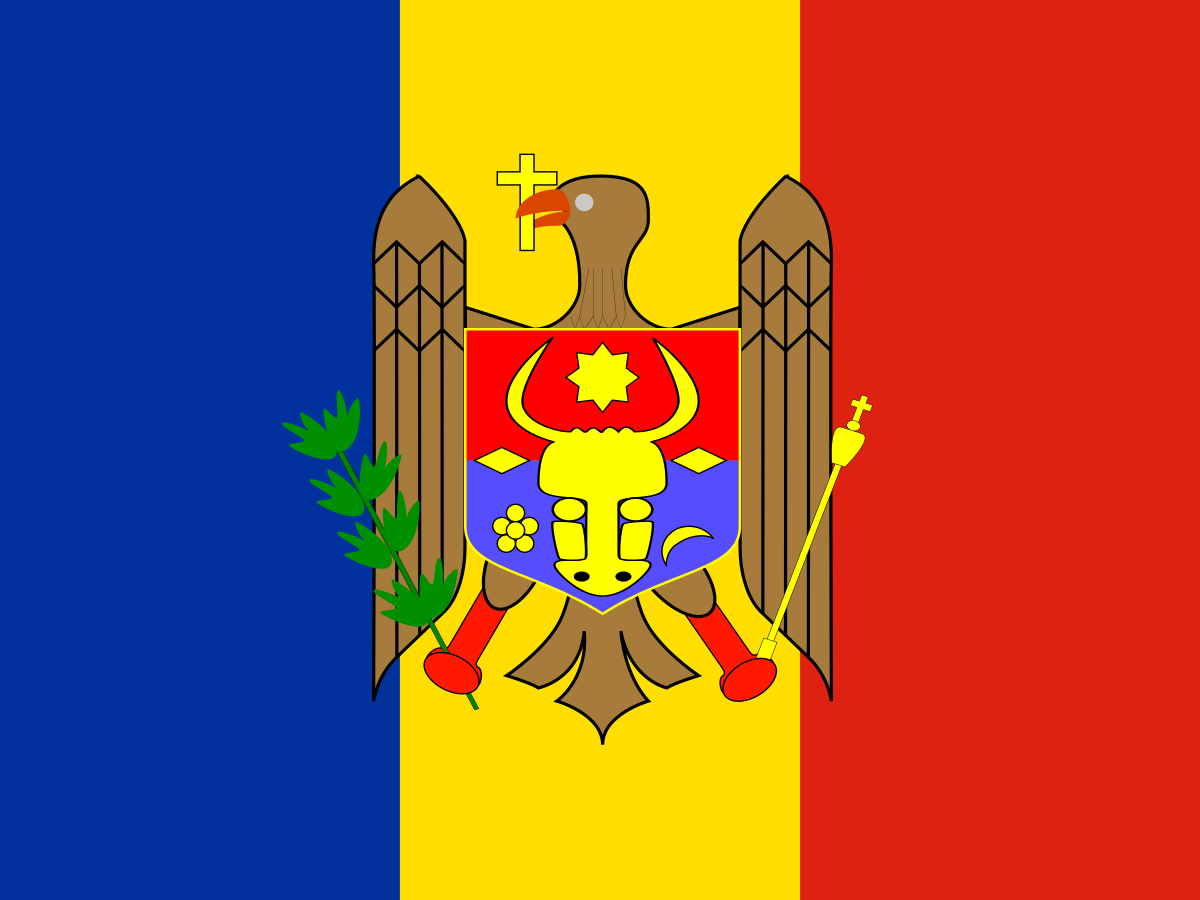
The flag of Moldova
Moldova's flag has three equal vertical bands of blue, yellow and red, with the national coat of arms in the centre of the yellow band.
The coat of arms features a golden eagle holding a cross in its beak and an olive branch and sceptre in its claws.
On its chest is a shield showing the traditional aurochs head associated with the historic Principality of Moldavia.
The tricolour reflects Moldova's close historical and cultural relationship with Romania while the coat of arms gives the flag a distinctly Moldovan identity.
The blue band
The blue band forms the hoist side of the flag. The blue, yellow and red combination is closely related to the Romanian tricolour and reflects shared historical and cultural connections.
The three colours are also strongly associated with the modern Moldovan national movement.
The yellow band
The yellow central band carries Moldova's national coat of arms.
The golden colour gives the centre of the flag a strong visual link with the eagle, shield and other elements of the state emblem.
The red band
The red band completes the national tricolour.
Together, the blue, yellow and red colours form a design that is immediately recognisable across the region and closely related to the Romanian flag.
The eagle
The central emblem shows a golden eagle holding a Christian cross in its beak. In one claw it holds an olive branch, representing peace, while the other holds a sceptre.
The eagle gives the flag a strong heraldic character and distinguishes Moldova's tricolour from Romania's flag, which does not normally display a coat of arms on its civil flag.
The aurochs head
The shield on the eagle's chest contains the head of an aurochs, a wild ancestor of modern cattle. Between its horns is an eight-pointed star, with a rose on one side and a crescent on the other.
The aurochs is one of the most important symbols of the historic Principality of Moldavia.
A short history of Moldova
Moldova's history is closely connected with the historic region of Moldavia. The medieval principality became an important state between larger powers including Poland-Lithuania, Hungary and the Ottoman Empire.
In the nineteenth and twentieth centuries the territory was divided between Russian, Romanian and Soviet rule before the modern Republic of Moldova became independent in 1991.
History timeline
Ancient era — Dacian and other peoplesThe wider region was inhabited by Dacian and other ancient peoples before becoming part of the Roman world and later experiencing successive migrations.
14th century — Principality of MoldaviaA medieval Principality of Moldavia emerged as a major political entity in the region.
15th century — Stephen the GreatStephen the Great ruled Moldavia and became one of the region's most celebrated medieval rulers.
16th century — Ottoman influenceMoldavia became increasingly dependent on the Ottoman Empire while retaining internal autonomy.
1812 — Bessarabia joins Russian EmpireAfter the Russo-Turkish War, the eastern part of historic Moldavia known as Bessarabia was annexed by the Russian Empire.
1859 — Moldavia and Wallachia uniteThe western part of Moldavia united with Wallachia under Alexandru Ioan Cuza, helping create the foundations of modern Romania.
1918 — Bessarabia joins RomaniaAfter the Russian Revolution, Bessarabia voted to unite with Romania.
1940 — Soviet annexationThe Soviet Union occupied and annexed Bessarabia, creating the Moldavian Soviet Socialist Republic.
1941–1944 — Romanian administration during WWIIRomanian forces, allied with Germany, retook Bessarabia from the Soviet Union during the Second World War before Soviet forces returned.
1944–1991 — Moldavian SSRMoldova remained part of the Soviet Union. Industrialisation, collectivisation and migration changed the country's economy and population.
1989 — Romanian becomes officialThe Moldavian SSR adopted language legislation recognising Moldovan/Romanian written in the Latin alphabet, an important step in the national revival.
1991 — IndependenceMoldova declared independence from the Soviet Union on 27 August 1991.
1992 — Transnistria conflictA short armed conflict broke out between Moldovan government forces and separatist forces in Transnistria. A ceasefire followed, but the political dispute remains unresolved.
2000s — European orientationMoldova increasingly developed political and economic links with the European Union while maintaining important relationships with neighbouring states.
2014 — Association Agreement with EUMoldova signed an Association Agreement with the European Union, strengthening economic and political ties.
2022 — EU candidate statusMoldova applied for EU membership following Russia's invasion of Ukraine and was granted candidate status later that year.
2024 — EU referendum and presidential electionMoldova held a referendum on constitutional support for EU integration while continuing its European integration process.
TodayMoldova is a parliamentary republic pursuing closer European integration while dealing with economic, demographic and security challenges.
Medieval Moldavia
The Principality of Moldavia emerged in the fourteenth century and covered territory much larger than the modern Republic of Moldova.
Its historic lands are now divided mainly between Moldova, Romania and Ukraine. The medieval state is central to Moldovan historical identity and explains the symbols used on the modern coat of arms.
Stephen the Great
Stephen the Great ruled Moldavia from 1457 to 1504 and is one of the country's most celebrated historical figures.
He fought several powerful neighbours and is remembered for strengthening the principality. He is also associated with numerous churches and monasteries across the region.
Moldavia and the Ottoman Empire
From the sixteenth century, Moldavia became a vassal state of the Ottoman Empire while retaining its own ruler and internal administration.
The principality remained strategically important because it sat between the Ottoman world and the states of Central and Eastern Europe.
Russian rule
In 1812, the Russian Empire annexed Bessarabia, the eastern part of historic Moldavia, after the Russo-Turkish War.
Russian administration brought major political and cultural changes and linked the region increasingly to the Russian Empire.
Union with Romania
In 1859, the western part of Moldavia united with Wallachia under Alexandru Ioan Cuza. The union developed into the modern Romanian state.
Bessarabia remained under Russian rule until the upheavals of the First World War and Russian Revolution.
Bessarabia and Romania
In 1918, Bessarabia's representative body voted to unite with Romania. The region remained part of Romania until the Soviet annexation of 1940.
This period is an important reason why language and cultural links between Moldova and Romania remain so strong today.
The Soviet period
Moldova became a Soviet republic after the Second World War. The Moldavian SSR underwent collectivisation, industrialisation and rapid urbanisation.
Russian became highly influential in public life, while Romanian/Moldovan remained an important part of cultural identity.
Language and identity
Language has been a major part of Moldova's modern identity debate. The country's official language is Romanian, while Russian and other languages remain widely spoken.
Moldovan and Romanian are essentially the same standard language, although the historical and political terminology used to describe it has varied.
Independence in 1991
Moldova declared independence from the Soviet Union on 27 August 1991.
The new state adopted national symbols drawing on the historic Moldavian tradition, including the blue-yellow-red tricolour and the eagle-and-aurochs coat of arms.
Transnistria
Transnistria is a narrow territory along Moldova's eastern border with Ukraine that has operated as a breakaway administration since the early 1990s.
The region is internationally recognised as part of Moldova, but the Moldovan government does not exercise full control there. Russian troops have also been stationed in the region.
Chișinău
Chișinău is Moldova's capital and largest city. It is the country's main political, economic, educational and cultural centre.
The city contains broad boulevards, parks, museums and a mixture of Soviet-era and modern architecture.
Moldova's geography
Moldova is a landlocked country of rolling hills, fertile plains and river valleys. The Dniester forms much of the eastern boundary, while the Prut marks the western border with Romania.
The country has no coastline, but its southern border lies close to the Danube.
The Dniester River
The Dniester is one of Moldova's most important rivers. It flows through or alongside Transnistria before reaching Ukraine and the Black Sea.
The river is important for water supplies, agriculture, ecosystems and hydroelectric generation.
Moldova's climate
Moldova has a temperate continental climate with warm summers and relatively cool winters.
The country's fertile soils and climate are well suited to vineyards, orchards, cereals and other agricultural products.
Moldova's countryside
Moldova is known for its rolling agricultural landscapes, orchards, vineyards and small villages.
Agriculture has historically played a major role in the economy and remains important to exports and rural communities.
Moldovan culture
Moldovan culture reflects a mixture of Romanian, Eastern European, Slavic and local traditions.
Music, folk costumes, village festivals, traditional crafts and Orthodox Christian traditions remain important parts of cultural life.
Moldovan food
Traditional Moldovan food includes mămăligă, plăcinte, sarmale and zeamă. Many dishes share similarities with Romanian and wider Eastern European cuisine.
Fresh vegetables, dairy products, maize, wheat and meat are common ingredients.
Wine in Moldova
Wine is one of Moldova's most famous products. The country's vineyards and underground wine cellars are a major part of its cultural and economic identity.
Moldova has a very long winemaking tradition, with favourable soils and a climate suited to grape cultivation.
Mileștii Mici
Mileștii Mici is famous for its enormous underground wine collection. Its network of tunnels stretches for well over 100 kilometres.
Wine bottles are stored in underground galleries where temperature and humidity are naturally stable.
Cricova
Cricova is another celebrated Moldovan underground wine cellar. Its extensive tunnels contain ageing rooms and wine collections.
The cellars have become an important tourist attraction and a symbol of Moldova's winemaking heritage.
Moldova's economy
Moldova's economy relies on agriculture, food processing, manufacturing, remittances, services and trade.
The country has increasingly sought to diversify its trade and strengthen economic links with the European Union.
Agriculture
Moldova's fertile land supports grapes, apples, cereals, sunflower, vegetables and other crops.
Agricultural products and processed foods are important exports, while rural employment remains significant.
European integration
Moldova has increasingly pursued closer relations with the European Union. It applied for EU membership in 2022 and was granted candidate status the same year.
European integration has become a major part of the country's foreign policy and political debate.
Moldova today
Modern Moldova is a small European parliamentary republic balancing its European aspirations with complex historical, economic and security relationships.
Its major challenges include population decline and emigration, economic development, energy security, corruption, and the unresolved Transnistrian situation.
Why is Moldova's flag interesting?
Moldova's flag looks very similar to Romania's because of their shared historical and linguistic connections, but the central eagle-and-aurochs coat of arms makes Moldova's flag instantly distinctive.
The emblem connects the modern republic directly to the medieval Principality of Moldavia.
Explore Moldova on FlagAtlas
Continue exploring Moldova and the world's flags with these FlagAtlas resources.