About Mongolia
Mongolia is a vast landlocked country in East and Central Asia, lying between Russia and China. Much of the country is made up of open grassland steppe, mountains and desert. Ulaanbaatar is the capital and by far the country's largest city.
Mongolia is famous for its nomadic traditions, horses, the Gobi Desert and the extraordinary history of the Mongol Empire founded by Genghis Khan.
CapitalUlaanbaatar
RegionEast/Central Asia
PopulationAbout 3.3 million
CurrencyMongolian tögrög
LanguageMongolian
Independence1921 / sovereignty restored 1990
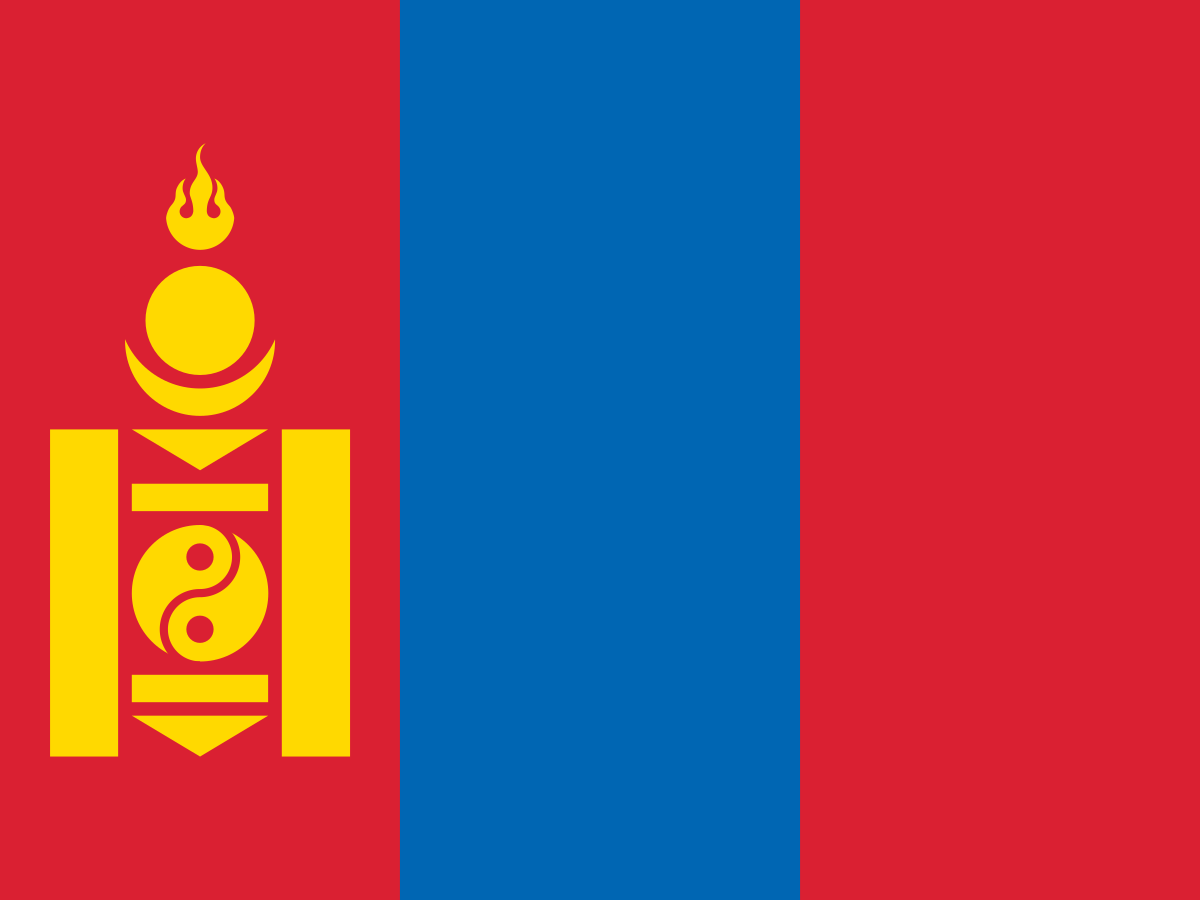
The flag of Mongolia
Mongolia's flag has three vertical bands of red, blue and red, with the golden Soyombo symbol on the hoist-side red band.
Blue represents Mongolia's eternal blue sky.
Red represents prosperity and progress. The Soyombo is an ancient national symbol containing imagery associated with fire, sun, moon, earth, water and the traditional Buddhist philosophical heritage of Mongolia.
The modern flag was adopted in 1992 after Mongolia's transition away from the communist system, with the old communist star removed from the Soyombo.
The red bands
The red bands represent prosperity and progress in the modern interpretation of Mongolia's flag.
The colour also creates a strong contrast with the blue central band and the golden Soyombo symbol.
The blue band
The central blue band represents Mongolia's eternal blue sky.
The sky has deep spiritual and cultural importance in Mongolian traditions. Mongolian identity has long been closely connected with the enormous open landscape and the sky above the steppe.
The Soyombo symbol
The Soyombo is one of Mongolia's most important national symbols. It contains several stylised elements arranged vertically.
The upper flame, sun and moon, geometric shapes and yin-yang-like symbol have developed layers of religious, philosophical and national meaning over time.
The Soyombo flame
At the top of the Soyombo is a flame with three tongues. The three flames are commonly associated with prosperity in the past, present and future.
Fire also has an important place in traditional Mongolian culture and symbolism.
The sun and moon
Below the flame are representations of the sun and crescent moon. They are commonly interpreted as symbols of the eternal nature of the Mongolian nation.
The imagery reflects Mongolia's long-standing relationship with the sky and celestial bodies.
The yin-yang symbol
The centre of the Soyombo contains a taijitu-like symbol representing complementary forces.
Its presence reflects the complex religious and philosophical influences that shaped Mongolian visual culture, including Buddhist traditions and earlier Central Asian beliefs.
A short history of Mongolia
Mongolia's history stretches from ancient steppe societies and nomadic confederations to the rise of the Mongol Empire, one of the largest contiguous land empires in history.
After centuries of division and changing imperial influence, Mongolia became closely linked to Qing China before becoming independent in the twentieth century and later establishing a democratic political system.
History timeline
Ancient era — Steppe culturesNomadic peoples inhabited and travelled across the Mongolian steppe for thousands of years, developing horse-based pastoral societies.
3rd century BC — Xiongnu EmpireThe Xiongnu formed a powerful steppe confederation that became one of the major powers of ancient Inner Asia.
6th–10th centuries — Turkic and other khanatesSuccessive Turkic and steppe states controlled or influenced parts of the region.
12th century — Temüjin risesTemüjin united rival Mongol tribes and built the political and military foundation for a new Mongol state.
1206 — Genghis KhanTemüjin was proclaimed Genghis Khan, or Chinggis Khaan, at a great assembly of Mongol nobles.
13th century — Mongol Empire expandsMongol armies conquered huge areas of Asia and Europe, creating the largest contiguous land empire in history.
1260s — Yuan dynastyKublai Khan established the Yuan dynasty in China, while different branches of the Mongol Empire ruled territories across Eurasia.
14th century — Yuan declinesThe Mongol Yuan dynasty in China collapsed in 1368, while other Mongol successor states continued across Inner Asia.
16th century — Buddhism expandsTibetan Buddhism became increasingly important among Mongolian rulers and communities.
17th century — Qing influenceMuch of Mongolia gradually came under the influence and control of the Qing Empire.
1911 — Bogd KhanateFollowing the fall of the Qing dynasty, Outer Mongolia declared independence and established the Bogd Khanate.
1921 — People's RevolutionMongolian revolutionaries, supported by Soviet Russia, defeated opposing forces and established a new political order.
1924 — Mongolian People's RepublicThe Mongolian People's Republic was proclaimed, becoming the world's second communist state after Soviet Russia.
1930s — Repression and purgesReligious institutions were heavily targeted and thousands of people were killed during political purges.
1945 — Independence recognisedA referendum confirmed support for Mongolian independence, and the country's status was increasingly recognised internationally.
1961 — United NationsMongolia joined the United Nations.
1990 — Democratic RevolutionMass peaceful demonstrations led to the end of one-party communist rule and the introduction of political and economic reforms.
1992 — New constitutionA democratic constitution established the modern parliamentary republic and the current national flag design.
21st century — Mining and developmentLarge mineral deposits became increasingly important to Mongolia's economy, particularly coal and copper.
TodayMongolia is a democratic, landlocked country balancing traditional nomadic culture with rapid urbanisation and a mineral-dependent modern economy.
The Mongol Empire
The Mongol Empire was founded by Genghis Khan in the early thirteenth century and expanded across an enormous area of Eurasia.
At its height it connected China, Central Asia, the Middle East and parts of Eastern Europe. The empire encouraged trade and movement across the vast territory, while its conquests also caused enormous destruction and loss of life.
Genghis Khan
Genghis Khan, born Temüjin, united the Mongol tribes and created a powerful military and political system.
He remains one of the most famous figures in world history and is a central figure in modern Mongolian national identity.
The Mongol military
Mongol armies were famous for their horse archers, mobility, discipline and sophisticated battlefield tactics.
Most soldiers could travel enormous distances on horseback, allowing Mongol forces to move much faster than many of their opponents.
Kublai Khan
Kublai Khan, grandson of Genghis Khan, established the Yuan dynasty in China and became emperor in 1271.
His reign connected Mongol imperial power with Chinese political and cultural traditions and brought Marco Polo and other foreign travellers into contact with the Mongol court.
Mongolia and the Qing Empire
From the seventeenth century, Mongolia increasingly came under the control of the Qing Empire.
Outer Mongolia remained distinct from China proper, but Qing administration and military influence shaped the region until the dynasty collapsed in 1911.
The Bogd Khanate
After the collapse of the Qing dynasty, Mongolia declared independence in 1911 under the spiritual and political leadership of the Bogd Khan.
The new state sought to preserve Mongolian independence while facing pressure from Russia, China and other regional powers.
The Mongolian People's Republic
In 1924, Mongolia became the Mongolian People's Republic. The country followed a Soviet-aligned communist system for much of the twentieth century.
Religious institutions were suppressed, while Soviet-style education, healthcare and industrial development transformed society.
The Democratic Revolution
In 1990, peaceful demonstrations and political pressure ended one-party communist rule. Mongolia introduced multiparty elections and moved toward a market economy.
The 1992 constitution established the modern democratic republic.
Ulaanbaatar
Ulaanbaatar is Mongolia's capital and largest city. It is home to a large share of the country's population and dominates political, economic and cultural life.
The city's rapid growth has brought major challenges, including traffic, air pollution and pressure on housing and infrastructure.
The Mongolian steppe
The steppe is one of Mongolia's defining landscapes: huge open grasslands stretching across the country.
Pastoral herders have traditionally moved with their livestock between seasonal grazing areas, making the steppe central to Mongolian culture and economy.
The Gobi Desert
The Gobi Desert covers large parts of southern Mongolia and northern China. It contains gravel plains, rocky landscapes, sand dunes and mountains.
The Gobi is also famous for dinosaur fossils and remains one of the world's great desert environments.
The Altai Mountains
The Mongolian Altai forms part of the country's western mountain systems. The region contains high peaks, glaciers, lakes and remote valleys.
It is also home to Kazakh communities famous for traditional eagle hunting.
Mongolia's climate
Mongolia has a strongly continental climate with long, extremely cold winters and short warm summers.
Rainfall is generally low, especially in the south, and the country is exposed to severe winter conditions known as dzud, which can cause mass livestock deaths.
Mongolian wildlife
Mongolia's vast landscapes support wildlife including snow leopards, wolves, saiga antelope, wild Bactrian camels, gazelles and Przewalski's horses.
Large protected areas help conserve species across the steppe and desert.
Przewalski's horse
The Przewalski's horse is one of Mongolia's most famous conservation success stories. The species disappeared from the wild in the twentieth century but has since been reintroduced.
It is considered the only surviving truly wild horse species.
The wild Bactrian camel
The wild Bactrian camel survives in the deserts of Mongolia and China and is one of the world's rarest large mammals.
It is exceptionally adapted to harsh desert conditions and can tolerate extreme temperatures and limited water.
Mongolian culture
Mongolian culture is strongly shaped by nomadic pastoralism, horses, Buddhism, wrestling, music and the vast landscape.
Traditional practices remain important even as more Mongolians live in towns and cities.
The ger
The traditional Mongolian ger, often called a yurt, is a portable round dwelling designed for life on the steppe.
Its structure can be dismantled and moved relatively easily, making it well suited to seasonal pastoral migration.
Naadam Festival
Naadam is Mongolia's most famous national festival. Its traditional competitions are wrestling, horse racing and archery.
The festival is closely associated with Mongolian history, identity and the country's warrior and pastoral traditions.
Mongolian wrestling
Mongolian khüükh wrestling is one of the three traditional Naadam sports. Wrestlers compete in distinctive costumes and use throws, trips and other techniques.
Winning a high-ranking title at Naadam is a major achievement.
Horse culture
Horses are central to Mongolian culture. Children often learn to ride from a young age, and horses remain important for herding, transport, racing and festivals.
Mongolia's relationship with horses is one of the most enduring features of its nomadic heritage.
Mongolian throat singing
Khöömii, or Mongolian throat singing, is a distinctive vocal tradition in which singers produce multiple tones and harmonics.
It is closely associated with the landscape and musical traditions of Inner Asia and has gained international recognition.
Mongolian food
Traditional Mongolian cuisine is strongly influenced by pastoral life and includes mutton, beef, dairy products, flour and noodles.
Popular foods include buuz dumplings, khuushuur and aaruul, a dried curd snack.
Mongolian Buddhism
Tibetan Buddhism became deeply influential in Mongolia from the sixteenth century onward. Monasteries became important religious and cultural centres.
Many monasteries were destroyed or suppressed during the communist period, but Buddhism experienced a major revival after 1990.
Mongolia's economy
Mongolia's modern economy is heavily influenced by mining, particularly coal, copper and gold.
Agriculture and livestock remain important, while tourism and services have grown as the country has opened further to international visitors.
Oyu Tolgoi
Oyu Tolgoi is one of Mongolia's largest mining projects and contains major copper and gold resources.
The mine is economically significant but has also generated debate about foreign investment, environmental impacts and the share of mineral wealth retained by Mongolia.
Livestock and herding
Mongolia has enormous numbers of livestock relative to its population. Herders traditionally keep sheep, goats, cattle, horses and camels.
Cashmere from Mongolian goats is an important export, while herding remains a major source of rural livelihoods.
Mongolia today
Modern Mongolia combines a strong nomadic heritage with a rapidly growing urban population and a resource-based economy.
The country faces challenges including air pollution in Ulaanbaatar, economic dependence on mining, harsh winters, climate change and the pressures of urbanisation.
Why is Mongolia's flag interesting?
Mongolia's flag is unusual because its central emblem is a highly detailed traditional national symbol rather than a simple coat of arms.
The Soyombo connects the modern republic with centuries of Mongolian religious, philosophical and national traditions.
Explore Mongolia on FlagAtlas
Continue exploring Mongolia and the world's flags with these FlagAtlas resources.