About Montenegro
Montenegro is a small mountainous country on the Adriatic coast of southeastern Europe. It borders Croatia, Bosnia and Herzegovina, Serbia, Kosovo and Albania. Podgorica is the capital, while Cetinje is the historic royal capital.
Montenegro is famous for rugged mountains, the Bay of Kotor, medieval towns, Adriatic beaches and a long history of balancing independence with the influence of larger neighbouring powers.
CapitalPodgorica
RegionBalkans / Adriatic
PopulationAbout 620,000
CurrencyEuro
Official languageMontenegrin
Independence3 June 2006
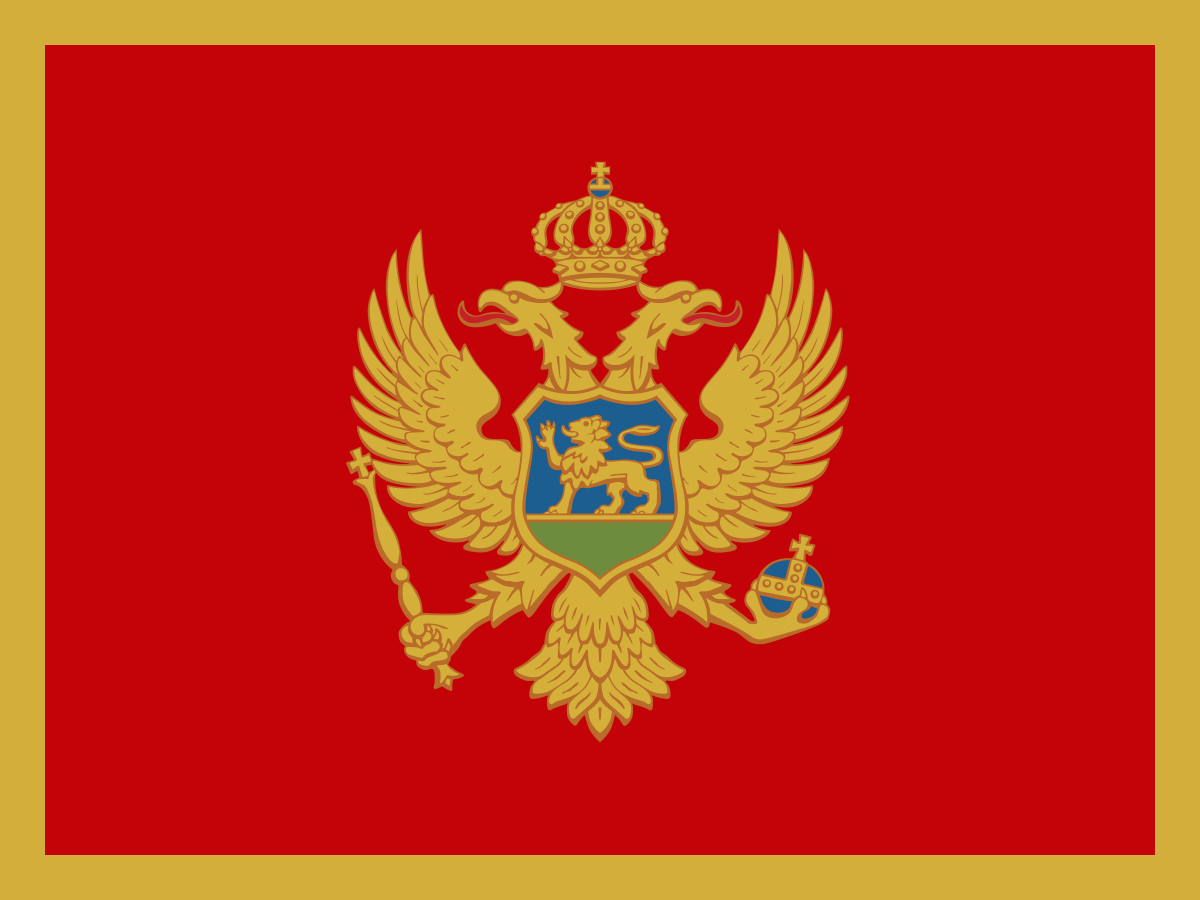
The flag of Montenegro
Montenegro's flag has a red field surrounded by a broad golden border, with the national coat of arms at the centre.
The coat of arms features a golden double-headed eagle carrying a shield.
The shield shows a golden lion passant and is associated with the country's historical rulers and Orthodox Christian heritage.
The modern flag was adopted in 2004, before Montenegro restored its independence in 2006. Its design deliberately recalls Montenegro's historic royal standards.
The red field
The red field is a historic colour associated with Montenegro and its royal standards.
It provides the strong background against which the golden border and detailed coat of arms are displayed.
The golden border
The golden border is one of the flag's most distinctive features. It recalls the ceremonial and royal character of historic Montenegrin standards.
The combination of red and gold gives the flag a deliberately heraldic appearance rather than the simpler tricolour design used during parts of the twentieth century.
The double-headed eagle
The central coat of arms shows a golden double-headed eagle. Double-headed eagles have a long history in Byzantine, Balkan and Orthodox Christian heraldry.
The eagle is a symbol of sovereignty and authority and is closely connected with Montenegro's historic dynastic traditions.
The lion shield
At the centre of the eagle is a shield bearing a golden lion passant on a blue-green field.
The lion is traditionally associated with state power, courage and the historical heritage of Montenegro.
The royal crown and sceptre
The eagle holds a sceptre and orb, while a crown appears above the shield. These symbols emphasise Montenegro's history as a principality and later kingdom.
The modern coat of arms therefore combines religious, dynastic and state symbolism.
A short history of Montenegro
Montenegro's history is shaped by its mountainous geography and its position between the Adriatic, the Ottoman Empire and other Balkan powers. The medieval state developed around the area of Zeta and later became known as Montenegro.
For centuries, local rulers maintained a high degree of independence despite repeated Ottoman pressure. Montenegro became internationally recognised as an independent state in 1878, later joined a South Slav state after the First World War, and restored independence in 2006.
History timeline
Ancient era — Illyrian and Roman landsThe territory of modern Montenegro was inhabited by Illyrian peoples and later incorporated into the Roman world.
Early Middle Ages — Slavic settlementSlavic communities settled across the western Balkans and formed new political and cultural societies.
10th–11th centuries — DukljaThe medieval state of Duklja emerged in the region and became an important early South Slavic polity.
12th–14th centuries — ZetaZeta became a major name for the medieval state in the region, ruled by several powerful dynasties.
15th century — Crnojević dynastyThe Crnojević family ruled Zeta and helped develop Cetinje as a political and cultural centre.
1496 — Ottoman influenceThe Ottoman Empire established control or influence over much of the surrounding region, while the mountainous core of Montenegro retained considerable autonomy.
16th–17th centuries — Prince-BishopsMontenegro was governed by prince-bishops, known as vladikas, who combined political and religious authority.
1697 — Petrović-Njegoš dynastyDanilo Petrović became the first hereditary ruler of the dynasty that would dominate Montenegro for much of the next two centuries.
1852 — Secular principalityDanilo II Petrović-Njegoš ended the tradition of theocratic rule and became Montenegro's secular prince.
1878 — Independence recognisedThe Congress of Berlin formally recognised Montenegro as an independent state.
1910 — Kingdom of MontenegroPrince Nikola became King Nikola I, transforming the principality into a kingdom.
1918 — Union with SerbiaAfter the First World War, Montenegro was incorporated into the Kingdom of Serbs, Croats and Slovenes, later known as Yugoslavia.
1945 — Socialist MontenegroMontenegro became one of the six constituent republics of socialist Yugoslavia.
1992 — Federal Republic of YugoslaviaMontenegro remained united with Serbia after the breakup of socialist Yugoslavia.
2003 — Serbia and MontenegroThe Federal Republic of Yugoslavia was replaced by the looser state union of Serbia and Montenegro.
2006 — Independence restoredFollowing a referendum, Montenegro declared independence on 3 June 2006.
2017 — NATO membershipMontenegro joined NATO, strengthening its integration with Western political and security institutions.
2018 — EU accession negotiationsMontenegro continued negotiations toward European Union membership.
TodayMontenegro is a parliamentary republic pursuing European integration and balancing tourism, environmental protection and economic development.
Medieval Duklja and Zeta
The early medieval states of Duklja and Zeta formed the political foundations of later Montenegro.
The region's rulers operated between larger powers and gradually developed distinctive institutions and traditions that became part of Montenegrin historical identity.
The Crnojević dynasty
The Crnojević dynasty ruled Zeta during the late medieval period. Ivan Crnojević is associated with establishing Cetinje as a political centre.
His son Đurađ Crnojević is remembered for establishing one of the first printing presses among the South Slavs at Cetinje in the late fifteenth century.
Cetinje
Cetinje is Montenegro's historic royal capital and remains an important cultural centre.
The town sits in a mountain basin and contains the former royal palace, monasteries and museums connected with Montenegro's political history.
The Petrović-Njegoš dynasty
The Petrović-Njegoš dynasty ruled Montenegro from the late seventeenth century until the monarchy ended in 1918.
Its rulers helped consolidate Montenegrin independence, resisted Ottoman expansion and transformed the country from a prince-bishopric into a modern secular principality and kingdom.
Petar II Petrović-Njegoš
Petar II Petrović-Njegoš was prince-bishop, poet and philosopher and is one of Montenegro's most important cultural figures.
His epic poem The Mountain Wreath became a major work of South Slavic literature and an important part of Montenegrin cultural identity.
King Nikola I
Nikola I ruled Montenegro first as prince and then as king from 1860 to 1918. His reign saw international recognition of Montenegro and considerable state modernisation.
He was forced into exile after the First World War when Montenegro was incorporated into the new South Slav state.
Montenegro and the Ottoman Empire
Montenegro spent centuries resisting Ottoman expansion. Its mountainous terrain made the region difficult to conquer and helped local forces maintain substantial autonomy.
Montenegrin victories became central to national historical memory, although relations with the Ottoman Empire also included periods of diplomacy and negotiation.
Independence in 1878
At the Congress of Berlin in 1878, the great European powers formally recognised Montenegro as an independent state.
The recognition significantly strengthened Montenegro's international position and confirmed territorial gains made during the preceding conflicts.
Montenegro and Yugoslavia
After the First World War, Montenegro became part of the new South Slav kingdom that developed into Yugoslavia.
After the Second World War it became one of six socialist republics within the Socialist Federal Republic of Yugoslavia.
The 2006 independence referendum
Montenegro held an independence referendum in May 2006. The result narrowly passed the required threshold for independence.
Montenegro declared independence on 3 June 2006 and was subsequently recognised internationally as a sovereign state.
Podgorica
Podgorica is Montenegro's modern capital and largest city. It is the country's main administrative, economic and transport centre.
The city was heavily damaged during the Second World War and subsequently rebuilt, giving it a mixture of older Balkan, socialist and modern architecture.
The Bay of Kotor
The Bay of Kotor is one of Montenegro's most spectacular landscapes. Its steep mountains rise dramatically from a winding Adriatic inlet.
The historic towns of Kotor, Perast and Herceg Novi attract visitors with medieval buildings, fortifications and maritime heritage.
Kotor
The medieval city of Kotor lies at the head of the Bay of Kotor and is surrounded by dramatic limestone mountains.
Its old town and defensive walls form part of a UNESCO World Heritage site and are among Montenegro's best-known landmarks.
Durmitor National Park
Durmitor National Park contains rugged mountains, deep valleys, forests and glacial lakes in northern Montenegro.
The park is a major destination for hiking, skiing, rafting and nature tourism and forms part of a UNESCO World Heritage site.
Montenegro's geography
Montenegro combines a short Adriatic coastline with dramatic mountain ranges. Much of the country is rugged and mountainous.
The contrast between coast, karst mountains, deep river canyons and inland lakes gives Montenegro an unusually diverse landscape for such a small country.
Montenegro's climate
Montenegro has a varied climate. The coast has a Mediterranean climate, while the interior and mountains experience cooler continental and alpine conditions.
Rainfall can be extremely high in the mountainous southwest, while the coast has hot, dry summers.
Lake Skadar
Lake Skadar, shared with Albania, is the largest lake in southern Europe. Its wetlands provide important habitat for birds and other wildlife.
The lake is particularly famous for its populations of pelicans and diverse freshwater and wetland ecosystems.
Montenegro's wildlife
Montenegro's mountains and forests support bears, wolves, chamois, wild boar, golden eagles and numerous other species.
Protected areas help preserve important habitats across the country's mountains, wetlands and coastline.
Montenegrin culture
Montenegrin culture reflects a mixture of South Slavic, Orthodox Christian, Adriatic and Balkan traditions.
Family, hospitality, traditional music, poetry and strong regional identities remain important parts of cultural life.
Montenegrin language
Montenegrin is the official language, while Serbian, Bosnian, Albanian and Croatian also have official or recognised status in various contexts.
The language situation reflects Montenegro's diverse population and its shared linguistic heritage with neighbouring South Slavic countries.
Montenegrin food
Montenegrin cuisine combines Mediterranean, Balkan and mountain traditions. Seafood is important along the coast, while smoked meats, cheese, potatoes and lamb are common inland.
Njeguški pršut and Njeguški cheese are among the country's best-known traditional foods.
Tourism
Tourism is one of Montenegro's most important economic sectors. Visitors are attracted by the Adriatic coast, historic towns, mountains, national parks and outdoor activities.
Coastal tourism is particularly important during the summer, while the mountains attract hikers, skiers and adventure travellers.
Montenegro's economy
Montenegro's economy relies heavily on tourism, services, construction, energy and trade.
The country uses the euro despite not being a member of the European Union, and it has pursued closer economic and political integration with Europe.
Montenegro and the European Union
Montenegro is a candidate for European Union membership and has been negotiating accession for many years.
EU integration is a major foreign-policy objective, alongside reforms concerning governance, the rule of law and the economy.
Montenegro today
Modern Montenegro is a small parliamentary republic with a population of around 620,000. It combines a growing tourism economy with a strong historical and cultural identity.
Its challenges include dependence on tourism, infrastructure, environmental pressures, demographic change and completing the reforms needed for EU membership.
Why is Montenegro's flag interesting?
Montenegro's flag stands out because it combines a bold red field and gold border with an elaborate medieval-style coat of arms.
Rather than simply representing geography or colours, the flag directly connects modern Montenegro with its royal and dynastic history.
Explore Montenegro on FlagAtlas
Continue exploring Montenegro and the world's flags with these FlagAtlas resources.