About Morocco
Morocco is a North African country on the Atlantic Ocean and Mediterranean Sea, separated from Europe by the Strait of Gibraltar. Its landscapes range from Atlantic and Mediterranean coasts to the Atlas Mountains and the Sahara Desert.
Rabat is the capital, while Casablanca is the largest city. Morocco has a rich history shaped by Amazigh peoples, Arab-Islamic dynasties, Mediterranean trade, European influence and its position between Africa and Europe.
CapitalRabat
RegionNorth Africa
PopulationAbout 37 million
CurrencyMoroccan dirham
LanguagesArabic & Amazigh
Independence2 March 1956
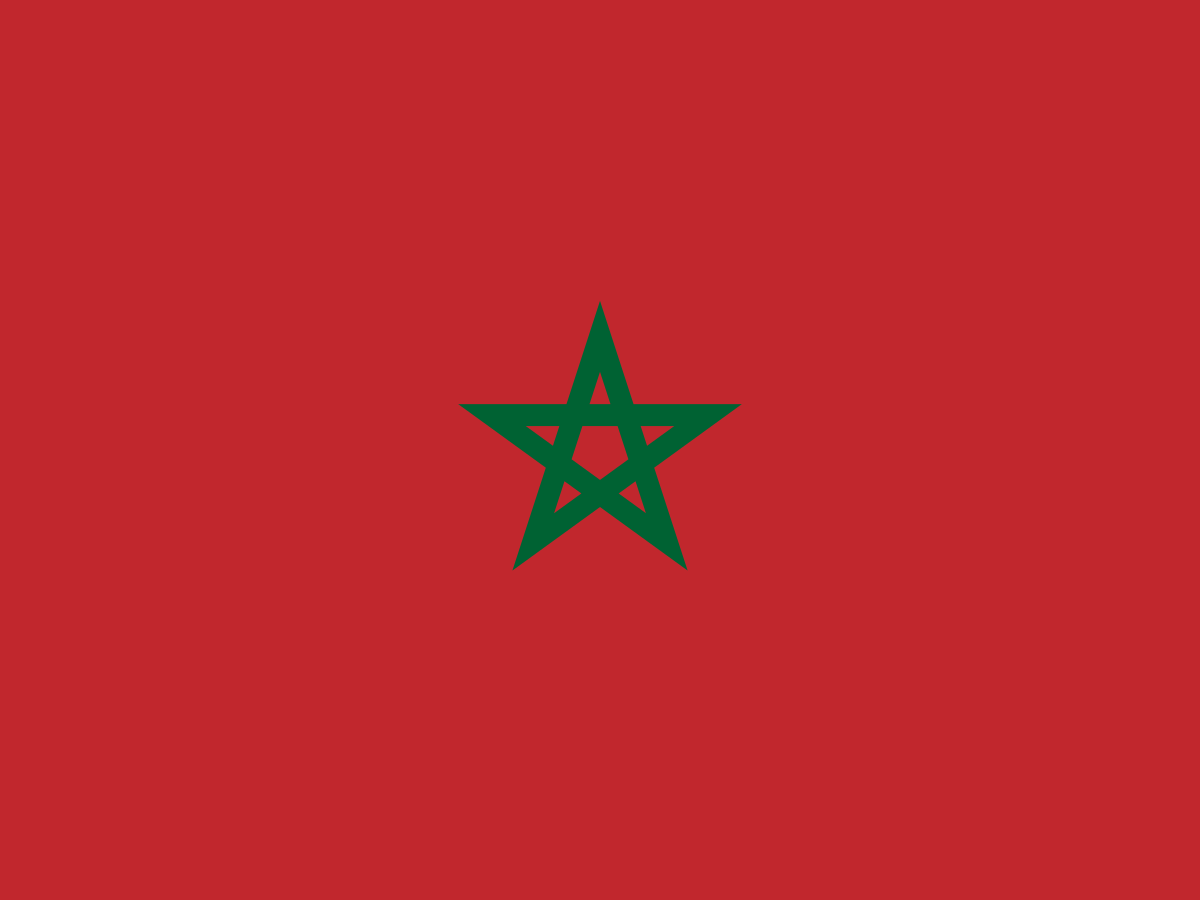
The flag of Morocco
Morocco's flag has a plain red field with a green five-pointed pentagram in the centre.
Red is strongly associated with the Alaouite dynasty and Moroccan sovereignty.
The green interlaced pentagram is a traditional Islamic geometric symbol often called the Seal of Solomon.
The current flag was adopted in 1915. The simple design is distinctive and strongly associated with Morocco's monarchy and Islamic heritage.
The red field
The red field is traditionally linked with the Alaouite dynasty, which has ruled Morocco since the seventeenth century.
Red has also been an important colour in Moroccan historical banners and royal symbolism.
The green pentagram
The central green pentagram is made from two overlapping triangles, creating a six-pointed star.
It is often called the Seal of Solomon or Seal of Sulayman. The symbol has a long history in the wider region and is associated with Islamic geometric and spiritual traditions.
Why is the star green?
Green has a particularly strong association with Islam and has long been used in Islamic art and symbolism.
On Morocco's flag, the green star contrasts sharply with the red background and gives the national design its instantly recognisable appearance.
The Alaouite dynasty
The Alaouite dynasty has ruled Morocco since the seventeenth century. The current king, Mohammed VI, is a member of the dynasty.
The dynasty's association with the red field is one of the reasons the colour has such a prominent place in Morocco's national symbolism.
A short history of Morocco
Morocco has one of North Africa's longest and richest recorded histories. Amazigh societies existed long before the arrival of Arab-Islamic rule, and the region later became part of several powerful Islamic states.
The Almoravids, Almohads, Marinids, Saadians and Alaouites each shaped Moroccan history. European powers increased their influence in the nineteenth and early twentieth centuries before Morocco regained independence in 1956.
History timeline
Ancient era — Amazigh societiesAmazigh peoples lived across North Africa for thousands of years and developed diverse kingdoms and communities.
1st century BC — Roman influenceParts of northern Morocco became part of the Roman world, including the province of Mauretania Tingitana.
7th–8th centuries — Arab conquestArab armies reached North Africa and Islam spread through the region. Amazigh communities became central to the new Islamic societies.
788 — Idrisid dynastyIdris I established the Idrisid dynasty, traditionally regarded as the first major independent Muslim dynasty in Morocco.
9th century — Fez developsFez grew into a major centre of learning, trade and Islamic culture.
859 — Al-Qarawiyyin foundedFatima al-Fihri founded the institution that became the University of al-Qarawiyyin in Fez.
11th century — Almoravid EmpireThe Almoravids built a powerful empire across Morocco, the western Sahara and parts of Iberia.
12th century — Almohad EmpireThe Almohads replaced the Almoravids and created another major North African and Iberian empire.
13th–15th centuries — Marinid dynastyThe Marinids ruled Morocco and developed Fez as a major intellectual and architectural centre.
16th century — Saadian dynastyThe Saadians strengthened Morocco and resisted Portuguese expansion along the Atlantic coast.
1578 — Battle of the Three KingsMoroccan forces defeated a Portuguese invasion, strengthening Moroccan independence and the Saadian state.
17th century — Alaouite dynastyThe Alaouites came to power and gradually reunified much of Morocco.
19th century — European pressureFrance, Spain and other European powers increased their economic and political influence in Morocco.
1912 — French protectorateThe Treaty of Fez established a French protectorate over most of Morocco, while Spain controlled zones in the north and south.
1921–1926 — Rif WarRifian forces under Abd el-Krim fought Spanish and later French forces in northern Morocco.
1944 — Independence movementThe Istiqlal Party presented a major independence manifesto calling for an end to the protectorate.
1956 — IndependenceMorocco regained independence from France and Spain, with Sultan Mohammed V becoming king.
1961 — Hassan II becomes kingHassan II succeeded Mohammed V and ruled for nearly four decades.
1975 — Green MarchMorocco organised a mass civilian march into the Western Sahara, a territory whose sovereignty remains disputed.
1999 — Mohammed VI becomes kingMohammed VI succeeded Hassan II and introduced a number of social, economic and political reforms.
2011 — Constitutional reformsMorocco adopted constitutional reforms during the wider Arab Spring period, strengthening the role of parliament and government while retaining the monarchy's central position.
TodayMorocco is a constitutional monarchy with a diversified economy, strong tourism industry and close political and economic relationships with Europe and Africa.
The Amazigh people
The Amazigh, often called Berbers, are the indigenous peoples of North Africa. Morocco is home to large Amazigh communities with distinct languages and cultural traditions.
Amazigh identity, music, crafts, architecture and languages are an important part of modern Moroccan culture.
The Idrisid dynasty
The Idrisid dynasty emerged in the late eighth century and established one of Morocco's earliest independent Islamic states.
Its rulers helped establish Fez as a major political and religious centre.
Fez
Fez is one of Morocco's most historic cities. Its medina contains narrow streets, markets, mosques, schools and traditional workshops.
Fez became a major centre of Islamic learning and scholarship and remains one of the country's most important cultural cities.
University of al-Qarawiyyin
The University of al-Qarawiyyin in Fez was founded in 859 AD by Fatima al-Fihri. It is widely recognised as one of the world's oldest continuously operating educational institutions.
Its long history makes Fez particularly important to Morocco's reputation as a centre of scholarship.
The Almoravids
The Almoravids created a powerful empire in the eleventh century, stretching across much of Morocco, the western Sahara and parts of Iberia.
They founded or greatly expanded Marrakech, which became one of the most important cities of the western Islamic world.
The Almohads
The Almohads replaced the Almoravids in the twelfth century and built another major empire across North Africa and Iberia.
Their period produced important architectural monuments and helped shape the distinctive Islamic architecture associated with Morocco.
The Marinids
The Marinid dynasty ruled Morocco from the thirteenth to fifteenth centuries. They developed Fez and sponsored religious schools known as madrasas.
Many of Morocco's famous medieval architectural features date from this period.
The Saadians
The Saadian dynasty ruled Morocco during the sixteenth and early seventeenth centuries. They resisted Portuguese expansion and strengthened Morocco's position along the Atlantic coast.
The famous Saadian Tombs in Marrakech date from this period.
The Alaouites
The Alaouite dynasty came to power in the seventeenth century and gradually reunified Morocco after a period of political fragmentation.
The dynasty remains on the Moroccan throne today, making it one of the world's longest-established ruling houses.
The French protectorate
In 1912, Morocco became a French protectorate. Spain controlled separate zones, while Tangier had a special international status.
French administration brought major changes to infrastructure, cities and the economy, but also generated growing nationalist resistance.
The Rif War
The Rif War of the 1920s was fought in northern Morocco. Rifian forces led by Abd el-Krim initially achieved major victories against Spanish forces before France joined the conflict.
The war became an important episode in Morocco's anti-colonial history.
Moroccan independence
Morocco regained independence in 1956 after the end of the French and Spanish protectorates.
Sultan Mohammed V returned from exile and became king, helping establish the institutions of the modern Moroccan state.
Hassan II
Hassan II became king in 1961 and ruled until 1999. His reign included major political tensions as well as economic and infrastructure development.
The monarchy remained the dominant political institution during his rule.
The Green March
In 1975, Morocco organised the Green March, sending large numbers of civilians towards the Western Sahara.
The status of Western Sahara remains disputed internationally, with Morocco administering most of the territory while the Polisario Front seeks independence.
Mohammed VI
Mohammed VI became king in 1999. His reign has included social reforms, infrastructure investment and efforts to expand Morocco's economic links with Africa and Europe.
Morocco has also developed major renewable-energy projects and transport infrastructure.
Rabat
Rabat is Morocco's capital and one of the country's major political and administrative centres.
The city contains the Royal Palace, government institutions, historic monuments and the famous Hassan Tower.
Marrakech
Marrakech is one of Morocco's most famous cities. Its historic medina, souks and red-coloured buildings have made it a major tourist destination.
The city was founded under the Almoravids and has repeatedly served as an important royal capital.
Casablanca
Casablanca is Morocco's largest city and its major commercial and economic centre.
The city is famous for the enormous Hassan II Mosque, which stands beside the Atlantic Ocean.
The Atlas Mountains
The Atlas Mountains cross Morocco from southwest to northeast. They include the High Atlas, Middle Atlas and Anti-Atlas ranges.
Mount Toubkal, in the High Atlas, is the highest mountain in Morocco and North Africa.
The Sahara
The Sahara Desert extends across southern Morocco. Morocco's desert landscapes include rocky plateaus, dry valleys and dramatic sand dunes.
Desert tourism, including camel excursions and overnight camps, is an important part of Morocco's visitor economy.
Morocco's climate
Morocco has a varied climate ranging from Mediterranean and Atlantic conditions to semi-arid and desert climates.
The Atlas Mountains create major differences in rainfall and temperature between regions, while the Atlantic Ocean moderates coastal areas.
Morocco's wildlife
Morocco's varied environments support species including Barbary macaques, fennec foxes, desert-adapted reptiles, birds of prey and many migratory birds.
Protected areas and national parks help conserve habitats from the mountains to the coast.
Moroccan culture
Moroccan culture combines Amazigh, Arab, Islamic, African, Mediterranean and European influences.
Architecture, music, crafts, food, festivals and traditional markets all reflect this layered history.
Moroccan Arabic and Amazigh languages
Morocco's official languages are Arabic and Amazigh. Moroccan Arabic, known as Darija, is widely used in everyday life, while French remains influential in business and education.
Amazigh languages are spoken by communities across the Atlas and other regions.
Moroccan food
Moroccan cuisine is famous for dishes such as tagine, couscous, pastilla, harira and mint tea.
Spices, preserved lemons, olives, dried fruit, vegetables and slow-cooked meats are common ingredients.
Moroccan architecture
Moroccan architecture is known for zellij tilework, carved plaster, courtyards, arches and geometric decoration.
Historic mosques, palaces, riads and madrasas demonstrate the influence of Islamic, Amazigh and Andalusian traditions.
Tourism
Tourism is a major part of Morocco's economy. Visitors come for Marrakech, Fez, the Atlas Mountains, Atlantic beaches, the Sahara and historic medinas.
Morocco's proximity to Europe and its diverse landscapes make it one of Africa's most visited destinations.
Morocco's economy
Morocco has a diversified economy based on services, tourism, agriculture, manufacturing, mining and trade.
Automotive manufacturing, aerospace, phosphate mining and renewable energy have become increasingly important alongside traditional agricultural exports.
Phosphate mining
Morocco possesses some of the world's largest known phosphate reserves. Phosphate mining and processing are important to the national economy.
Phosphates are essential to fertiliser production and therefore have major importance for global agriculture.
Renewable energy
Morocco has invested heavily in solar and wind power. The Noor solar complex near Ouarzazate became one of the country's best-known renewable-energy projects.
The country's strong sunshine and wind resources support efforts to reduce dependence on imported fossil fuels.
Morocco today
Modern Morocco is a constitutional monarchy with a young and increasingly urban population. It combines historic cities and traditional rural communities with modern industries, ports and infrastructure.
Key challenges include water scarcity, regional inequality, unemployment, environmental pressures and the effects of climate change.
Why is Morocco's flag interesting?
Morocco's flag is unusually simple but carries several layers of history: a red field linked to the Alaouite dynasty and a green geometric star connected with Islamic tradition.
It is a strong example of a national flag using colour and a single symbol to connect modern state identity with centuries of history.
Explore Morocco on FlagAtlas
Continue exploring Morocco and the world's flags with these FlagAtlas resources.