About Namibia
Namibia is a large, sparsely populated country in southwestern Africa on the Atlantic Ocean. It borders Angola, Zambia, Botswana and South Africa, and its coastline includes the dramatic Skeleton Coast.
Windhoek is the capital. Namibia is famous for the Namib Desert, enormous sand dunes, Etosha National Park, the Fish River Canyon and its exceptionally clear night skies.
CapitalWindhoek
RegionSouthern Africa
PopulationAbout 2.6 million
CurrencyNamibian dollar
Official languageEnglish
Independence21 March 1990
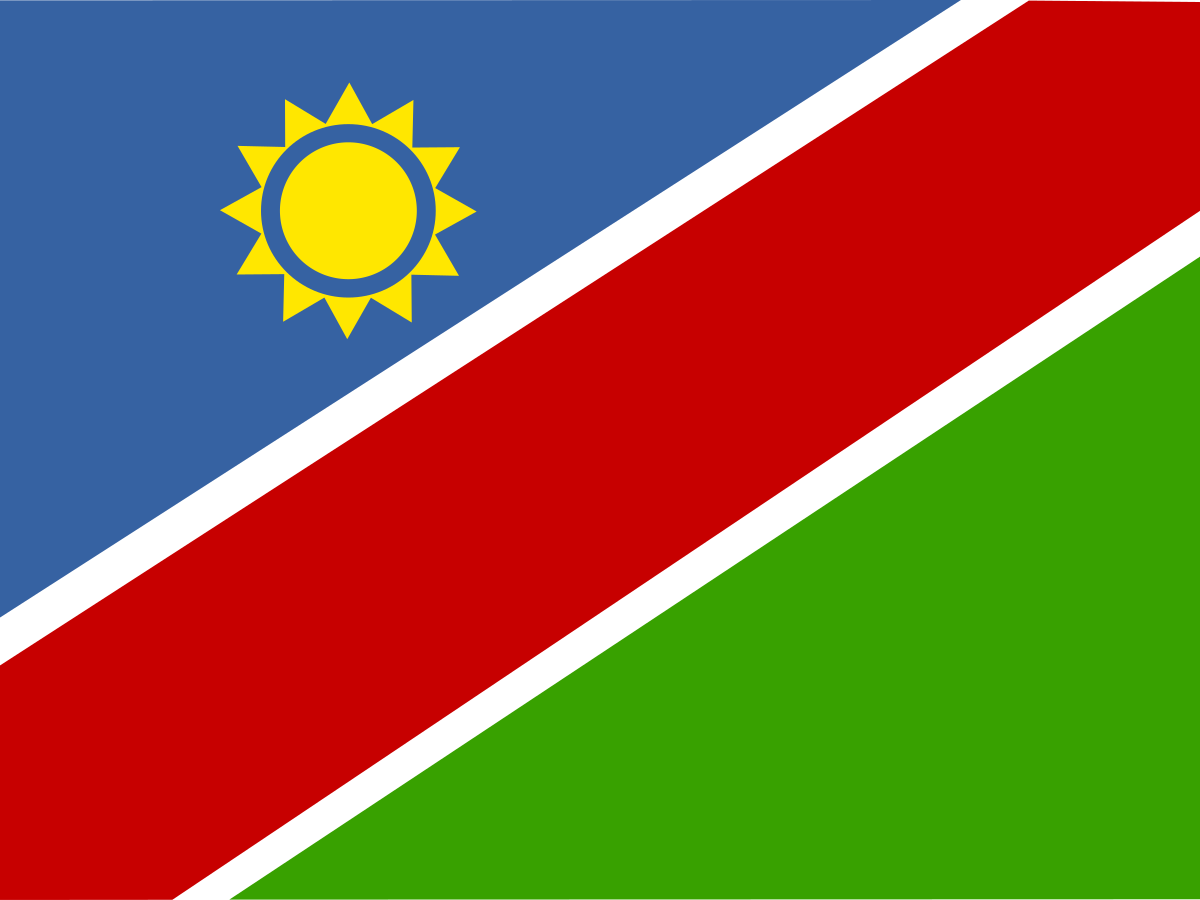
The flag of Namibia
Namibia's flag has a diagonal red band bordered by white, separating blue above from green below. A golden sun appears in the upper hoist corner.
The flag combines symbols of the country's natural environment and its people.
Blue represents the sky, rain and Atlantic Ocean; red represents the people and their determination; green represents vegetation and agricultural resources; white represents peace and unity; and the golden sun represents life and energy.
The flag was adopted when Namibia became independent on 21 March 1990. Its design was selected from a national competition.
The blue field
Blue symbolises the sky and the Atlantic Ocean. It is also associated with water and the importance of rain in Namibia's dry environment.
The large blue area at the top of the flag creates a strong contrast with the green lower field.
The red band
The red diagonal band represents the people of Namibia and their determination.
The diagonal arrangement gives the flag a distinctive appearance and helps connect the upper blue and lower green fields.
The green field
Green represents vegetation and agricultural resources.
Although Namibia is predominantly arid, agriculture and grazing remain important to many communities and rural livelihoods.
The white borders
The white borders around the red band represent peace and unity.
They also make the red diagonal stripe stand out clearly from the blue and green fields.
The golden sun
The golden sun represents life and energy. Its twelve triangular rays are one of the flag's most recognisable features.
The sun is placed in the upper hoist corner, where it appears against the blue sky.
A short history of Namibia
Namibia's history includes ancient hunter-gatherer and pastoral societies, powerful regional communities, German colonial rule, South African administration and a long independence struggle.
Namibia finally became independent in 1990 after decades of conflict and international pressure.
History timeline
Ancient era — San and Khoekhoe peoplesIndigenous hunter-gatherer and pastoral communities lived across the region for thousands of years.
1st millennium — Bantu-speaking migrationBantu-speaking communities, including ancestors of modern Ovambo and Herero peoples, expanded into parts of the region.
15th century — Portuguese explorersPortuguese sailors reached the Atlantic coast, although European settlement remained limited for centuries.
19th century — European missionary and trading activityMissionaries, traders and colonial interests increasingly entered the territory.
1884 — German South-West AfricaGermany declared a protectorate over much of present-day Namibia.
1904–1908 — Herero and Nama genocideGerman colonial forces carried out mass killings, expulsions and forced detention against Herero, Nama and other communities.
1915 — South African occupationSouth African forces occupied German South-West Africa during the First World War.
1920 — League of Nations mandateSouth Africa administered the territory under a League of Nations mandate after Germany's defeat.
1948 — Apartheid laws extendedSouth Africa increasingly imposed its apartheid system and policies of racial segregation on the territory.
1960 — SWAPO emergesThe South West Africa People's Organisation developed into the leading Namibian independence movement.
1966 — UN ends mandateThe United Nations formally ended South Africa's mandate over South West Africa, although South Africa continued to administer the territory.
1966 onward — Armed struggleSWAPO's armed wing, PLAN, began operations against South African forces.
1978 — UN Security Council Resolution 435A UN-backed plan was developed for Namibian independence and internationally supervised elections.
1988 — New York AccordsAngola, Cuba and South Africa agreed on a framework linked to Cuban troop withdrawal and Namibian independence.
1989 — Transition to independenceUNTAG supervised the transition, including Namibia's first democratic elections.
1990 — IndependenceNamibia became independent on 21 March 1990, with Sam Nujoma as its first president.
1994 — Walvis Bay transferredThe strategic port of Walvis Bay was transferred from South African control to Namibia.
2000s — Economic developmentMining, tourism, fisheries and services became increasingly important to Namibia's economy.
2010s–2020s — Resource explorationMajor discoveries and exploration for oil and gas increased expectations of future energy investment.
TodayNamibia is a stable multiparty democracy facing challenges including inequality, unemployment, drought and water scarcity.
The Herero and Nama genocide
Between 1904 and 1908, German colonial forces carried out a campaign of mass killing, expulsion and forced detention against the Herero and Nama peoples.
The atrocities are widely recognised as genocide and remain a central part of Namibia's history and its relationship with Germany.
German South-West Africa
Germany established German South-West Africa in the late nineteenth century. Colonial authorities seized land and imposed systems of forced labour and racial control.
The colonial period ended during the First World War when South African forces occupied the territory.
South African rule
After the First World War, South Africa administered Namibia under a League of Nations mandate. South African rule later became increasingly controversial as apartheid policies were imposed.
The independence movement grew stronger during the second half of the twentieth century.
SWAPO and independence
SWAPO became the leading force in Namibia's independence struggle. Its armed wing fought South African forces while the political movement pursued international recognition and diplomatic support.
SWAPO won the 1989 elections and formed the first government of independent Namibia.
Sam Nujoma
Sam Nujoma was a founding leader of SWAPO and became Namibia's first president after independence in 1990.
He served three terms and remains one of the central figures in modern Namibian history.
Namibia's ethnic diversity
Namibia is home to many communities including the Ovambo, Herero, Nama, Damara, Kavango, Caprivian and San peoples, among others.
Different groups have their own languages, traditions and historical experiences, contributing to Namibia's diverse cultural identity.
Windhoek
Windhoek is Namibia's capital and largest city. It sits in the central highlands and is the country's main political, commercial and transport centre.
The city contains German colonial-era buildings alongside modern African architecture and business districts.
The Namib Desert
The Namib Desert runs along Namibia's Atlantic coast and is considered one of the world's oldest deserts.
Its enormous dunes, fog, gravel plains and extreme aridity create some of the most distinctive landscapes in Africa.
Sossusvlei
Sossusvlei is famous for towering red-orange sand dunes and the stark white clay pan surrounded by ancient dead camel-thorn trees.
The area is part of the Namib-Naukluft National Park and is one of Namibia's most photographed landscapes.
The Skeleton Coast
The Skeleton Coast is Namibia's remote Atlantic coastline, famous for fog, shipwrecks, dunes and rugged desert scenery.
Cold offshore waters create frequent coastal fog, while the coastline supports seals, seabirds and other wildlife.
Etosha National Park
Etosha National Park is one of Africa's great wildlife destinations. Its huge salt pan dominates the landscape and attracts animals to waterholes around its edges.
Visitors can see elephants, lions, rhinos, giraffes, zebras and many antelope species.
Fish River Canyon
The Fish River Canyon is one of the world's largest canyon systems. It cuts through the arid landscape of southern Namibia.
The canyon is a major geological and tourist landmark and is especially spectacular at sunrise and sunset.
Namibia's climate
Namibia has an overwhelmingly arid or semi-arid climate. Rainfall is highly variable and generally decreases towards the coast.
The cold Benguela Current helps create the extremely dry conditions along the Atlantic coast, while summer thunderstorms provide much of the inland rainfall.
Fog in the Namib
The Namib Desert receives important moisture from coastal fog. Some plants and animals have evolved specialised ways to collect or use this moisture.
Fog is especially common where cold Atlantic air meets the warmer desert.
Namibia's wildlife
Namibia supports remarkable wildlife including desert elephants, black rhinos, cheetahs, lions, giraffes, seals and many antelope species.
It is one of the leading African countries for wildlife conservation on privately managed and communal land as well as in national parks.
Desert-adapted elephants
The desert elephants of northwest Namibia have adapted to exceptionally dry conditions and travel long distances between water sources.
They are not a separate species, but a population with behaviour and movement patterns shaped by the desert environment.
Namibian culture
Namibian culture reflects many African traditions alongside German, South African and other historical influences.
Music, dance, storytelling, beadwork, textiles and traditional ceremonies vary between communities.
Languages of Namibia
English is the official language, while Oshiwambo languages, Khoekhoegowab, Otjiherero, Afrikaans, German and other languages are widely used.
The country's multilingual character reflects its diverse population and colonial history.
Namibian food
Namibian cuisine includes meat, maize, millet, mahangu, seafood and game, alongside foods influenced by German and South African traditions.
Kapana, a popular street-food style of grilled beef, is especially associated with urban Namibia.
Tourism
Tourism is a major part of Namibia's economy. Visitors come for desert landscapes, wildlife, dunes, adventure activities and exceptionally dark skies.
The country's low population density and extensive conservation areas make it particularly attractive for safari and road-trip tourism.
Namibia's economy
Namibia's economy depends heavily on mining, fisheries, tourism, agriculture and services.
Diamonds, uranium, gold and other minerals are important exports. The country is also exploring new opportunities in oil, gas and green hydrogen.
Diamonds and uranium
Namibia is an important producer of diamonds and uranium. Diamond mining has historically been concentrated along the Atlantic coast and offshore areas, while uranium mining is significant around the central Namib.
Mining provides major export earnings but also makes the economy sensitive to global commodity prices.
Green hydrogen
Namibia has ambitious plans to develop green hydrogen using its abundant solar and wind resources.
The government hopes renewable-energy projects can create new export industries while supporting domestic economic development.
Namibia today
Modern Namibia is a stable constitutional democracy with one of Africa's lowest population densities. It has built a strong tourism and conservation reputation but continues to face high inequality and unemployment.
Drought, water scarcity and climate change are major long-term challenges, while new energy and mineral projects could significantly affect the economy.
Why is Namibia's flag interesting?
Namibia's flag is distinctive because the diagonal red band, white borders and golden sun create a dynamic design that combines national identity with natural symbolism.
The flag also represents a successful transition from colonial rule to independence and democratic statehood.
Explore Namibia on FlagAtlas
Continue exploring Namibia and the world's flags with these FlagAtlas resources.