About Nepal
Nepal is a landlocked country in South Asia between India and China. Much of the country is mountainous, and the Himalayas contain some of the world's highest peaks.
Kathmandu is the capital and the centre of Nepal's political and cultural life. Nepal is famous for Mount Everest, the Kathmandu Valley, Hindu and Buddhist heritage, trekking and extraordinary geographical diversity.
CapitalKathmandu
RegionSouth Asia
PopulationAbout 30 million
CurrencyNepalese rupee
Official languageNepali
Modern republicSince 2008
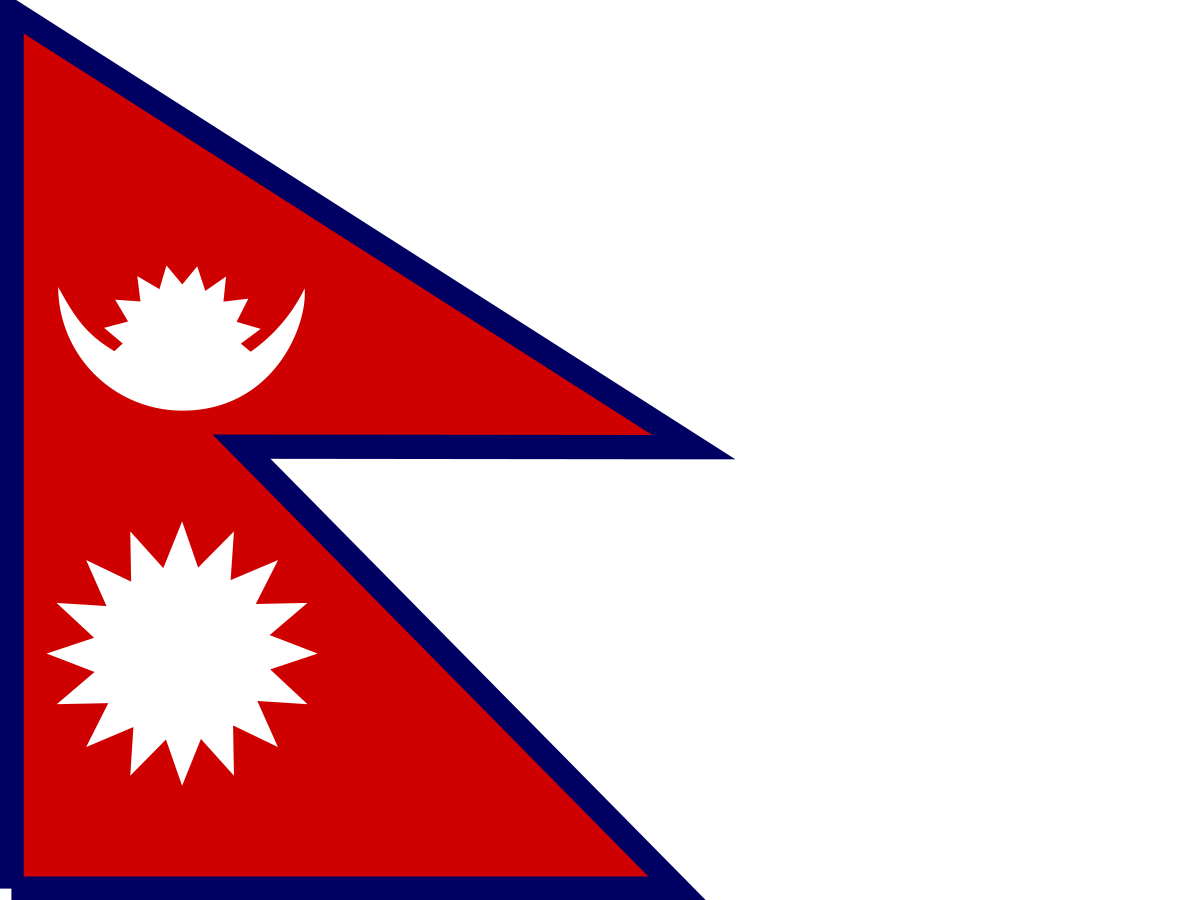
The flag of Nepal
Nepal has the only national flag in the world that is not rectangular. It consists of two stacked triangular pennons with a deep crimson field, blue borders and white symbols of the moon and sun.
The flag's shape is closely associated with the Himalayan and South Asian flag traditions of Nepal.
The crimson red is Nepal's national colour, the blue border is associated with peace and harmony, and the sun and moon represent permanence and endurance.
The current constitutional form of the flag was established in 1962, following the adoption of Nepal's new constitution.
The crimson red field
The crimson red is Nepal's national colour and is also associated with the country's national flower, the rhododendron.
The red field gives the flag its strong visual identity and contrasts with the blue border and white celestial symbols.
The blue border
The blue border represents peace and harmony.
It frames the two red pennons and provides a distinctive contrast with the white moon and sun.
The moon
The upper pennon contains a white crescent moon. It is traditionally associated with the cool Himalayan climate and the aspiration that Nepal will remain peaceful and enduring.
The moon also contributes to the flag's distinctive visual connection with celestial symbols.
The sun
The lower pennon contains a white stylised sun. The sun is associated with heat, energy and endurance.
Together, the moon and sun express the traditional idea that Nepal should endure for as long as these celestial bodies exist.
Why is Nepal's flag triangular?
Nepal's unusual shape is linked to traditional pennant forms used in South Asia and the Himalayan region. The two triangles are sometimes interpreted as representing the Himalayan mountains.
The design was preserved when the modern national flag was standardised, making Nepal instantly recognisable around the world.
A short history of Nepal
Nepal's history developed around the Kathmandu Valley and the Himalayan trade routes between the Indian subcontinent and Tibet. The region was home to powerful city-states and dynasties before Prithvi Narayan Shah unified much of the country in the eighteenth century.
Nepal later fought the British, established a hereditary Rana regime and eventually became a constitutional monarchy before transforming into a federal democratic republic in 2008.
History timeline
Ancient era — Himalayan and South Asian culturesThe region of modern Nepal was inhabited by diverse peoples and influenced by both the Indian subcontinent and Himalayan trade routes.
c. 6th century BC — Birth of Siddhartha GautamaSiddhartha Gautama, who became the Buddha, was born at Lumbini in the region of modern Nepal.
3rd century BC — Mauryan influenceEmperor Ashoka of the Mauryan Empire is traditionally associated with pilgrimage to Lumbini and the spread of Buddhism.
Licchavi periodThe Licchavi era saw the development of important political, artistic and religious traditions in the Kathmandu Valley.
12th–18th centuries — Malla periodMalla rulers developed the Kathmandu Valley's three great urban centres: Kathmandu, Patan and Bhaktapur.
15th century — Kathmandu Valley city cultureTrade, architecture, metalwork and religious art flourished in the valley's city-states.
1768–1769 — Unification of NepalPrithvi Narayan Shah conquered Kathmandu Valley and laid the foundations of the unified Kingdom of Nepal.
1814–1816 — Anglo-Nepalese WarNepal fought the British East India Company. The Treaty of Sugauli established the post-war frontier and reduced Nepal's territorial ambitions.
1846 — Rana regime beginsJung Bahadur Rana seized power and established a hereditary Rana prime-ministerial regime that dominated Nepal for more than a century.
1923 — Britain recognises Nepal's independenceThe United Kingdom formally recognised Nepal as an independent and sovereign state.
1950–1951 — End of Rana rulePolitical change restored the monarchy's active role and began Nepal's transition towards parliamentary government.
1955 — Nepal joins the United NationsNepal became a member of the United Nations and expanded its international diplomatic relationships.
1960 — Royal takeoverKing Mahendra dismissed the elected government and established the partyless Panchayat system.
1990 — Democratic movementMass protests led to the restoration of multiparty democracy and a constitutional monarchy.
1996 — Maoist insurgencyThe Communist Party of Nepal (Maoist) launched an armed rebellion that became a major national conflict.
2001 — Royal massacreKing Birendra and several members of the royal family were killed in a massacre at the royal palace. Gyanendra subsequently became king.
2005 — Direct royal ruleKing Gyanendra assumed direct political power, intensifying opposition to the monarchy.
2006 — Peace agreementThe Comprehensive Peace Accord ended the armed conflict and opened the way for a new political settlement.
2008 — Republic declaredNepal abolished its monarchy and became a federal democratic republic.
2015 — New constitutionNepal adopted a new constitution establishing a federal democratic republican system.
2015 — EarthquakeA devastating earthquake struck central Nepal, causing major loss of life and extensive damage, including to historic heritage sites.
TodayNepal is a federal democratic republic whose economy relies heavily on services, tourism, agriculture and remittances.
Lumbini and the Buddha
Lumbini in southern Nepal is traditionally recognised as the birthplace of Siddhartha Gautama, the Buddha.
The sacred site attracts Buddhist pilgrims from around the world and is one of Nepal's most important religious and cultural landmarks.
The Kathmandu Valley
The Kathmandu Valley has been a major centre of Himalayan civilisation for centuries. Its historic cities include Kathmandu, Patan and Bhaktapur.
The valley is famous for temples, stupas, palaces, courtyards, wood carving and metalwork shaped by Hindu and Buddhist traditions.
The Malla kings
The Malla dynasty played a major role in developing the Kathmandu Valley's urban and artistic culture.
Although the valley was politically divided between rival city-states, competition between the rulers encouraged extraordinary temple and palace construction.
Prithvi Narayan Shah
Prithvi Narayan Shah, king of Gorkha, conquered the Kathmandu Valley in the eighteenth century and created the foundations of modern Nepal.
His campaigns brought many Himalayan territories together under one expanding kingdom.
The Anglo-Nepalese War
The Anglo-Nepalese War of 1814–1816 was fought between Nepal and the British East India Company.
Nepal retained its independence, but the Treaty of Sugauli reduced its territory and established much of the basis of its later borders.
The Gurkhas
Nepal's Gurkha soldiers became internationally famous for their service in the British and Indian armies and other military forces.
Their reputation for courage and discipline developed through a long history of military service and remains an important part of Nepal's international identity.
The Rana regime
The Rana regime began in 1846 when Jung Bahadur Rana established hereditary control of the prime ministership.
The Ranas dominated Nepal's political system while the monarchy's practical authority was greatly reduced. The regime ended in the early 1950s.
The 1990 democratic movement
The 1990 People's Movement forced King Birendra to restore multiparty democracy.
A new constitutional monarchy was established, beginning a period of parliamentary politics that later gave way to the Maoist conflict and another major political transformation.
The Maoist conflict
Nepal's Maoist insurgency lasted from 1996 to 2006 and caused thousands of deaths and widespread disruption.
The conflict ended with a peace agreement that opened the way for elections, a new constitution and the eventual abolition of the monarchy.
The 2001 royal massacre
In June 2001, King Birendra and several members of the royal family were killed at Narayanhiti Palace.
The tragedy profoundly affected Nepal's political future and was followed by the accession of King Gyanendra.
The 2008 republic
Nepal's monarchy was formally abolished in 2008 after elections to a Constituent Assembly.
The country became a federal democratic republic, marking the end of a monarchy with centuries of history.
Kathmandu
Kathmandu is Nepal's capital and largest urban centre. It sits in the Kathmandu Valley and is the country's main political, economic and cultural hub.
The city combines ancient temples and courtyards with modern offices, businesses and dense urban development.
Mount Everest
Mount Everest, known in Nepal as Sagarmatha, is the world's highest mountain above sea level.
The mountain stands on the Nepal–China border and is one of the world's most famous symbols of the Himalayas and Nepal.
The Himalayas
The Himalayas dominate northern Nepal and contain many of the world's highest peaks.
Mountain environments range from subtropical foothills to permanent snow and ice, creating enormous biodiversity and challenging conditions for transport and settlement.
Pokhara
Pokhara is a major tourist city beside Phewa Lake and is known for spectacular views of the Annapurna range.
It is one of Nepal's main bases for trekking, mountaineering, paragliding and other outdoor activities.
Chitwan National Park
Chitwan National Park protects forests, grasslands and wetlands in southern Nepal.
It is famous for one-horned rhinoceroses, Bengal tigers, elephants, crocodiles and many bird species.
Nepal's climate
Nepal has an extremely varied climate because of its huge differences in altitude. The country ranges from subtropical lowlands to alpine and Himalayan conditions.
The summer monsoon brings most of the country's rainfall, while high mountain areas remain cold and snow-covered for much of the year.
The 2015 earthquake
A major earthquake struck Nepal on 25 April 2015, followed by further damaging tremors.
Thousands of people died and historic buildings, villages and infrastructure were badly damaged, including important heritage sites in the Kathmandu Valley.
Nepal's wildlife
Nepal supports remarkable wildlife including Bengal tigers, one-horned rhinoceroses, red pandas, snow leopards, Himalayan black bears and wild elephants.
The country's national parks and conservation areas protect habitats ranging from tropical forests to high Himalayan landscapes.
Hinduism and Buddhism
Nepal has a strong religious heritage shaped especially by Hinduism and Buddhism.
Temples, monasteries, shrines and festivals often reflect interaction between the two traditions, particularly in the Kathmandu Valley.
Nepali culture
Nepali culture is highly diverse, reflecting Himalayan, South Asian, Tibetan and indigenous traditions.
Music, dance, festivals, architecture, crafts and food vary between ethnic communities and geographical regions.
Nepali language
Nepali is the official language and is written mainly in the Devanagari script.
Nepal is multilingual, with many other languages spoken by communities across the Terai, hills and mountains.
Nepali food
Nepali cuisine includes dal bhat, momo dumplings, thukpa, sel roti and a wide range of regional dishes.
Rice, lentils, vegetables, spices and pickles are common ingredients, while Tibetan and Himalayan influences are especially visible in mountain cuisine.
Tourism
Tourism is one of Nepal's most important industries. Visitors come for trekking, mountaineering, pilgrimage, wildlife and cultural tourism.
The Everest region, Annapurna, Pokhara, Chitwan and the Kathmandu Valley are among the country's best-known destinations.
Nepal's economy
Nepal's economy relies on services, agriculture, tourism, manufacturing and remittances.
Millions of Nepalese work abroad, making remittances a major source of household income and foreign exchange.
Hydropower
Nepal has enormous potential for hydroelectric power because of its steep mountain rivers.
Hydropower investment has expanded, although geography, infrastructure and financing make large projects challenging.
Nepal today
Modern Nepal is a young federal republic balancing rapid urbanisation with a predominantly rural population and challenging mountain geography.
Major issues include infrastructure, employment, migration, disaster resilience, climate change and protecting the country's exceptional natural and cultural heritage.
Why is Nepal's flag interesting?
Nepal's flag is the only current national flag that is not rectangular. Its two triangular pennons, blue border and white moon and sun make it instantly recognisable.
It is also unusual because its design combines national colour, celestial symbolism and a shape rooted in Nepal's historic flag traditions.
Explore Nepal on FlagAtlas
Continue exploring Nepal and the world's flags with these FlagAtlas resources.