About New Zealand
New Zealand is an island country in the southwestern Pacific Ocean, made up mainly of the North Island and South Island plus many smaller islands. It is known for dramatic mountains, coastlines, forests, Māori culture and a distinctive history of settlement and self-government.
Wellington is the capital, while Auckland is the largest city. New Zealand is geographically remote but has strong historical, cultural and economic links with the wider Pacific, Australia and the United Kingdom.
CapitalWellington
Largest cityAuckland
PopulationAbout 5.3 million
CurrencyNew Zealand dollar
Official languagesEnglish, Māori, NZ Sign Language
RegionOceania
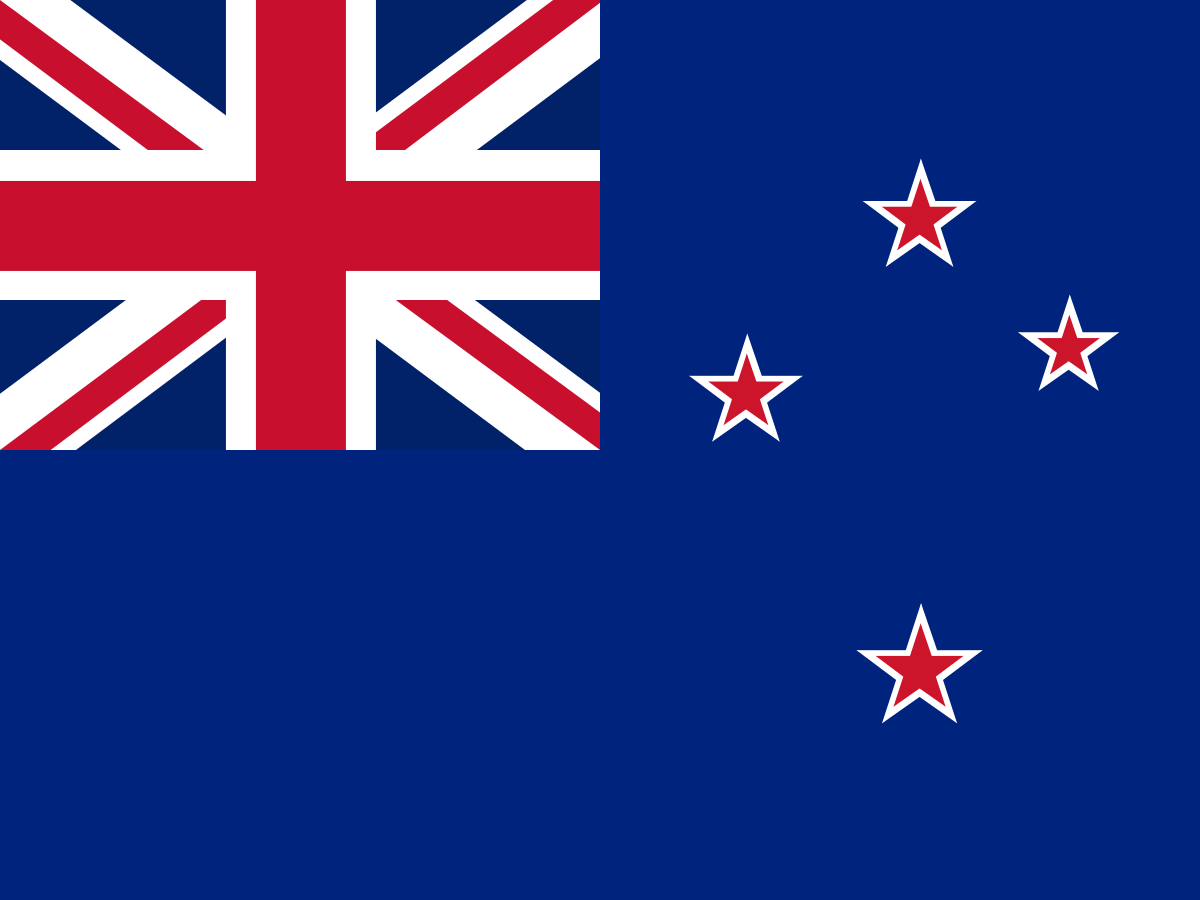
The flag of New Zealand
New Zealand's flag is a blue ensign featuring the Union Jack in the upper hoist corner and four red stars with white borders representing the Southern Cross.
The flag reflects both New Zealand's British constitutional history and its location in the South Pacific.
The Union Jack represents historical links with Britain, while the Southern Cross identifies New Zealand's position in the southern hemisphere.
The current flag was officially adopted in 1902, although closely related designs had been used before then.
The Union Jack
The Union Jack represents New Zealand's historical relationship with the United Kingdom and its development as a British colony and later self-governing dominion.
Its presence also links the New Zealand flag with several other flags historically based on the British Blue Ensign.
The Southern Cross
The four red stars represent the Southern Cross constellation, a prominent feature of the southern night sky.
The stars are shown in a stylised form and help distinguish New Zealand's flag from the Australian flag, which also features the Southern Cross but has five stars.
Why are the stars red?
The Southern Cross stars are red with white borders. The red colour gives them a strong visual contrast against the blue field and connects them with the wider colour scheme of the flag.
The stars are positioned to represent the distinctive Southern Cross pattern rather than simply being decorative.
A short history of New Zealand
New Zealand was settled by Polynesian ancestors of the Māori people centuries before European arrival. European exploration began in the seventeenth century, followed by increasing British involvement and colonisation.
The Treaty of Waitangi was signed in 1840, becoming a foundational document in New Zealand's constitutional history. The country later developed responsible government, became increasingly independent and eventually adopted its current constitutional arrangements.
History timeline
c. 1250–1300 — Polynesian settlementPolynesian voyagers settled Aotearoa New Zealand, developing distinct Māori societies and traditions.
1642 — Abel TasmanDutch explorer Abel Tasman became the first known European to sight New Zealand, although he did not establish a permanent settlement.
1769 — James CookBritish navigator James Cook charted much of New Zealand's coastline, opening the way for increased European exploration and contact.
Late 18th–early 19th centuries — Growing contactEuropean traders, missionaries and whalers increasingly visited New Zealand. Māori communities adapted to new technologies, trade and changing political relationships.
1835 — Declaration of IndependenceSome northern Māori chiefs signed the Declaration of Independence of the United Tribes of New Zealand.
1840 — Treaty of WaitangiRepresentatives of the British Crown and many Māori chiefs signed the Treaty of Waitangi, a foundational document of modern New Zealand.
1840s–1870s — New Zealand WarsArmed conflicts occurred between the Crown and various Māori groups, involving disputes over sovereignty, land and government authority.
1852 — New Zealand Constitution ActBritain established a framework for representative government and elected institutions.
1856 — Responsible governmentNew Zealand's elected government gained responsible control over domestic affairs.
1860s–1880s — European settlement and expansionLarge-scale immigration and land settlement transformed New Zealand's population, economy and landscape.
1893 — Women's suffrageNew Zealand became the first self-governing country in the world where women gained the right to vote in national elections.
1901 — New Zealand remains outside Australian federationNew Zealand chose not to join the newly created Commonwealth of Australia.
1907 — Dominion statusNew Zealand became a dominion within the British Empire, reflecting its growing self-government.
1914–1918 — First World WarNew Zealand forces fought as part of the British Empire, with the Gallipoli campaign becoming a defining national memory.
1931 — Statute of WestminsterThe statute recognised greater legislative independence for the dominions, although New Zealand did not fully adopt it until 1947.
1939–1945 — Second World WarNew Zealand again fought alongside Britain and the Allies, contributing forces in Europe, North Africa, the Pacific and elsewhere.
1947 — Full legislative independenceNew Zealand formally adopted the Statute of Westminster, confirming its legislative independence from the UK.
1950s–1970s — Social and economic changeNew Zealand became increasingly urbanised while expanding its welfare state, manufacturing and international relationships.
1984–1987 — Constitutional reformMajor reforms strengthened the principle of parliamentary government and clarified the relationship between ministers, Parliament and the Crown.
1987 — Nuclear-free policyNew Zealand's nuclear-free policy became a major part of its foreign and defence identity.
1990s–2000s — Treaty settlementsThe Crown increasingly negotiated historical Treaty of Waitangi settlements with Māori iwi and hapū.
2011 — Christchurch earthquakeA devastating earthquake struck Christchurch, killing 185 people and causing extensive damage.
2019 — Christchurch mosque attacksA terrorist attack on two Christchurch mosques killed 51 people and led to major national debate about extremism and firearms law.
2020 — COVID-19 responseNew Zealand initially pursued strict border controls and public-health measures during the COVID-19 pandemic.
TodayNew Zealand is a parliamentary constitutional monarchy and a highly developed Pacific democracy.
Māori people
The Māori are the tangata whenua, or Indigenous people, of Aotearoa New Zealand. Their ancestors arrived through Polynesian voyaging traditions and developed distinctive languages, social structures, art and spiritual traditions.
Māori culture is central to modern New Zealand identity, with te reo Māori, kapa haka, carving, weaving and whakapapa all playing important roles.
The Treaty of Waitangi
The Treaty of Waitangi was signed in 1840 between representatives of the British Crown and many Māori chiefs.
The English and Māori texts contain important differences in wording and interpretation. Treaty principles and the historical relationship between Māori and the Crown remain central to New Zealand's politics and public life.
The New Zealand Wars
The New Zealand Wars were a series of nineteenth-century conflicts involving the Crown, colonial forces and Māori groups.
Disputes over land, sovereignty and government authority were major causes. Large areas of Māori land were subsequently confiscated or otherwise transferred from Māori ownership.
Māori culture today
Māori culture is visible throughout New Zealand in language, place names, performing arts, visual arts, sport and public ceremonies.
The national rugby team, government institutions and schools frequently incorporate Māori cultural elements, while te reo Māori has experienced significant revitalisation.
Women and the vote
In 1893, New Zealand became the first self-governing country in which women gained the right to vote in national elections.
The achievement followed a long campaign led by suffragists including Kate Sheppard and became an important milestone in the international history of women's political rights.
The Gallipoli campaign
New Zealand troops fought at Gallipoli in 1915 alongside Australian forces and other Allied troops.
The campaign ended in military failure but became an important part of New Zealand's national remembrance and the development of the ANZAC tradition.
New Zealand in World War II
New Zealand contributed substantial military forces during the Second World War, serving in North Africa, Italy, Greece, the Pacific and other theatres.
The war strengthened New Zealand's sense of national identity while maintaining close links with Australia, Britain and the United States.
Nuclear-free New Zealand
New Zealand adopted a strong nuclear-free policy in the 1980s, particularly in relation to nuclear-powered or nuclear-armed ships entering its waters.
The policy created tensions with the United States but became a lasting part of New Zealand's independent foreign-policy identity.
Wellington
Wellington is the capital of New Zealand and sits at the southern end of the North Island around a large natural harbour.
It is the country's political centre and is known for Parliament, museums, film production, arts and a lively waterfront.
Auckland
Auckland is New Zealand's largest city and major commercial centre. It is built around two harbours and a landscape of volcanic cones.
The city has a highly diverse population and is an important gateway to the Pacific and wider world.
The South Island
The South Island is famous for the Southern Alps, dramatic fjords, glaciers and large areas of sparsely populated wilderness.
Christchurch, Dunedin, Queenstown and Invercargill are among its major centres.
Fiordland and Milford Sound
Fiordland National Park contains spectacular mountains, rainforests, lakes and deep glacial fjords. Milford Sound is one of the country's most famous natural landmarks.
Heavy rainfall and rugged terrain have helped preserve large areas of wilderness.
Mount Cook / Aoraki
Aoraki / Mount Cook is the highest mountain in New Zealand, rising to 3,724 metres.
It is part of the Southern Alps and is a major destination for mountaineering, hiking and scenic tourism.
New Zealand's climate
New Zealand has a generally temperate maritime climate, but conditions vary considerably with latitude, altitude and exposure to prevailing winds.
The west coast of the South Island is among the wettest inhabited areas on Earth, while eastern regions are considerably drier.
Earthquakes and volcanoes
New Zealand lies along the boundary between the Pacific and Australian tectonic plates, making earthquakes and volcanic activity important natural hazards.
The North Island contains active volcanic zones, while earthquakes have shaped cities including Christchurch and Wellington.
New Zealand wildlife
New Zealand's isolation produced unusual wildlife, including many flightless birds. Important species include the kiwi, kea, tūī, takahē and yellow-eyed penguin.
Introduced mammals such as rats, stoats and possums have had major impacts on native species, making conservation a national priority.
The kiwi
The kiwi is a flightless nocturnal bird and one of New Zealand's best-known national symbols.
New Zealanders themselves are often informally called 'Kiwis' after the bird.
New Zealand culture
New Zealand culture combines Māori heritage, Polynesian influences, British traditions and a modern Pacific identity.
Film, music, literature, outdoor recreation and sport are important parts of contemporary culture.
The Māori language
Te reo Māori is one of New Zealand's official languages and has undergone significant revitalisation after a period of decline.
Māori words and place names are increasingly common in public life, education and media.
New Zealand food
New Zealand food includes lamb, seafood, meat pies, pavlova, hangi and a wide range of Pacific and Asian-influenced dishes.
Māori hangi involves cooking food in an earth oven and remains an important traditional and cultural practice.
Rugby and sport
Rugby union is one of New Zealand's most important sports. The national men's team, the All Blacks, is internationally famous.
Netball, cricket, football, sailing, rowing and many outdoor sports are also widely enjoyed.
New Zealand's economy
New Zealand has a highly developed economy based on services, agriculture, food processing, tourism, manufacturing and technology.
Dairy products, meat, wine, fruit and other agricultural exports are particularly important, while tourism contributes substantially to employment and foreign earnings.
Dairy farming
New Zealand is a major exporter of dairy products, particularly milk powder, butter and cheese.
Dairy farming is concentrated in regions with suitable rainfall and pasture, especially parts of the North Island and South Island.
Tourism
Tourism is a major part of New Zealand's economy. Visitors come for mountains, national parks, adventure sports, Māori culture, wine regions and film locations.
Queenstown, Rotorua, Milford Sound, the Bay of Islands and the central North Island are among the best-known destinations.
The Lord of the Rings
New Zealand became globally associated with The Lord of the Rings and other major film productions after director Peter Jackson filmed much of the trilogy across the country.
Film tourism has helped draw international visitors to landscapes used as Middle-earth locations.
New Zealand today
Modern New Zealand is a prosperous Pacific democracy with a strong environmental identity, close links with Australia and an increasingly prominent place in the wider Pacific.
Key challenges include housing affordability, infrastructure, climate change, biodiversity loss, natural hazards and maintaining a constructive relationship between Māori and the Crown.
Why is New Zealand's flag interesting?
New Zealand's flag is interesting because it combines a British-derived Union Jack with the Southern Cross, reflecting both historical connections and the country's location in the South Pacific.
The flag has also been the subject of national debate, with a referendum in 2015–2016 considering an alternative design, although the existing flag was retained.
Explore New Zealand on FlagAtlas
Continue exploring New Zealand and the world's flags with these FlagAtlas resources.