About Nicaragua
Nicaragua is the largest country in Central America, bordered by Honduras to the north and Costa Rica to the south, with coastlines on both the Pacific Ocean and Caribbean Sea.
The country is known for volcanoes, tropical forests, colonial cities, large freshwater lakes and a long history shaped by Indigenous peoples, Spanish colonialism, foreign intervention and political revolution.
CapitalManagua
RegionCentral America
PopulationAbout 6.7 million
CurrencyCórdoba
Official languageSpanish
Income groupLower-middle income
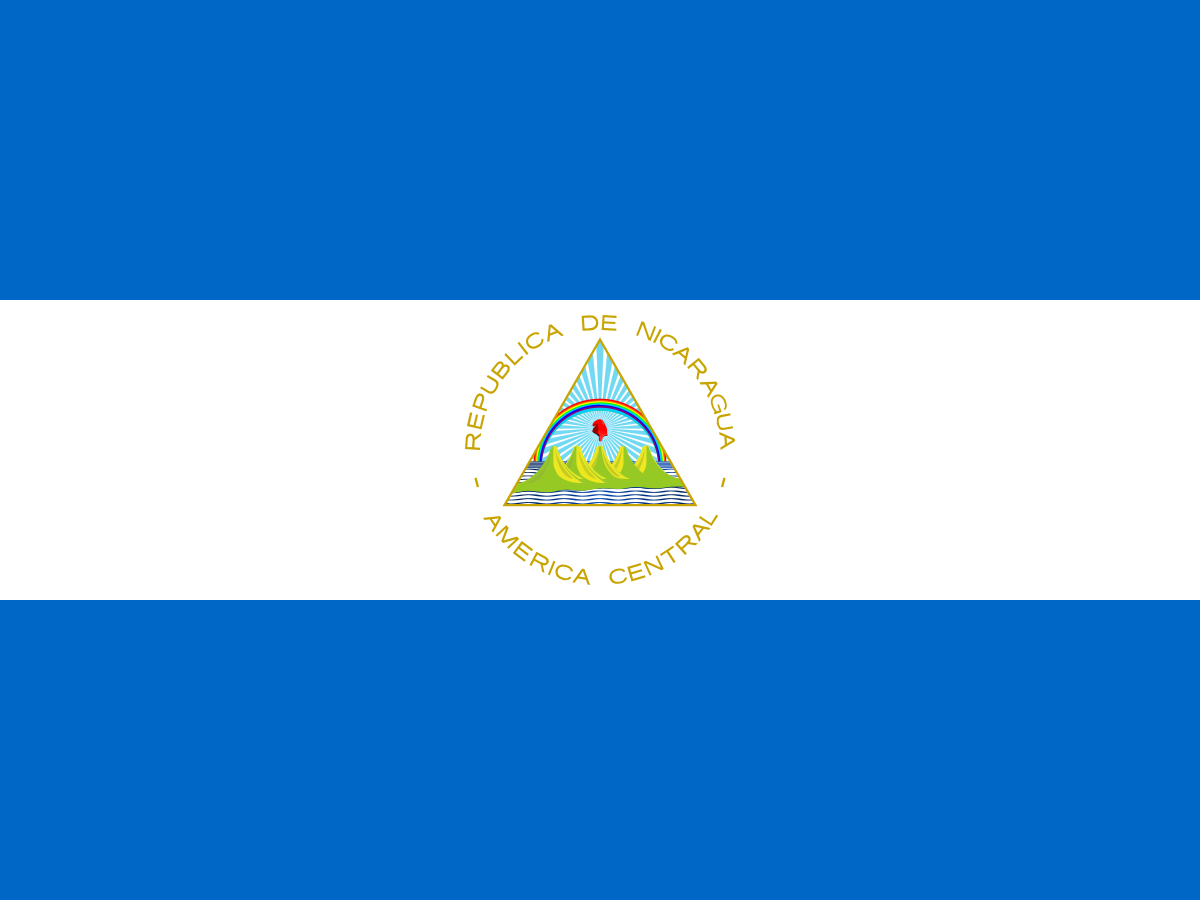
The flag of Nicaragua
Nicaragua's flag consists of three horizontal bands: blue, white and blue, with the national coat of arms centred in the white band.
The design is closely related to the historic flag of the Federal Republic of Central America.
The blue and white colours connect Nicaragua with the wider Central American unionist tradition.
The coat of arms contains a triangle, volcanoes, a sea, a rainbow and the words REPÚBLICA DE NICARAGUA — AMÉRICA CENTRAL.
The blue bands
The blue bands are associated with the Central American federation tradition and the country's position between the Pacific Ocean and Caribbean Sea.
Modern explanations commonly connect the colours with Nicaragua's surrounding waters and ideals of Central American unity.
The white band
The central white band provides the background for the coat of arms.
White is commonly associated with peace and purity, while the central position makes the emblem the main focus of the national flag.
The coat of arms
Nicaragua's coat of arms is one of the most detailed features on any Central American national flag. Its central triangle contains five volcanoes, water, a rainbow and a Phrygian cap.
The five volcanoes represent the original five member states of the Federal Republic of Central America.
The five volcanoes
The five volcanoes represent the five former members of the Federal Republic of Central America: Guatemala, El Salvador, Honduras, Nicaragua and Costa Rica.
The symbol therefore links the modern Nicaraguan state with a period when much of Central America was politically united.
The rainbow and Phrygian cap
The rainbow and Phrygian cap are symbols associated with hope, peace and liberty within the national emblem.
The emblem's imagery reflects nineteenth-century republican and Central American political traditions.
A short history of Nicaragua
Nicaragua's history stretches from ancient Indigenous societies to Spanish colonisation, independence, civil wars, foreign intervention and twentieth-century revolution.
The Sandinista Revolution of 1979 overthrew the Somoza dictatorship and profoundly changed Nicaragua's political and economic system.
History timeline
Before European arrival — Indigenous societiesThe territory was inhabited by diverse Indigenous peoples including communities speaking languages from several different language families.
1502 — Christopher Columbus reaches the Caribbean coastColumbus reached the Caribbean coast during his fourth voyage, beginning a new phase of European contact.
1520s — Spanish conquestSpanish expeditions conquered much of the region and established colonial settlements.
1524 — León and Granada foundedSpanish colonial cities including León and Granada became important political and commercial centres.
16th–18th centuries — Spanish colonial ruleNicaragua became part of the Spanish colonial system, with agriculture, trade and Catholic institutions reshaping society.
Caribbean coast — British and Indigenous influenceThe Caribbean side developed a distinct history involving Indigenous peoples, Afro-Caribbean communities and British influence.
1821 — Independence from SpainCentral America declared independence from Spanish rule.
1823 — Federal Republic of Central AmericaNicaragua joined Guatemala, El Salvador, Honduras and Costa Rica in a Central American federation.
1838 — Nicaragua becomes independentThe federation broke apart and Nicaragua became an independent republic.
1850s — William WalkerAmerican adventurer William Walker seized power in Nicaragua and declared himself president before being expelled and later executed.
Late 19th–early 20th centuries — Liberal reformsPolitical and economic reforms encouraged export agriculture, infrastructure development and stronger links with international markets.
1909 onward — US interventionPolitical instability and foreign economic interests contributed to repeated United States intervention in Nicaragua.
1912–1933 — US military presenceUS Marines were deployed for long periods amid civil conflict and political instability.
1927–1933 — Sandino's resistanceAugusto César Sandino led an armed resistance against US forces and the Nicaraguan government.
1934 — Sandino assassinatedSandino was assassinated after negotiations with the government. The National Guard later became the dominant armed institution.
1936–1979 — Somoza dynastyThe Somoza family dominated Nicaragua's political system for more than four decades.
1972 — Managua earthquakeA devastating earthquake destroyed much of central Managua and killed thousands of people.
1978–1979 — RevolutionThe Sandinista National Liberation Front gained momentum during a nationwide uprising against the Somoza regime.
1979 — Somoza regime fallsAnastasio Somoza Debayle fled the country and the Sandinistas took power.
1980s — Contra WarThe Sandinista government fought Contra forces backed by the United States, causing major loss of life and economic disruption.
1984 — ElectionsNicaragua held elections in which the Sandinistas won, although the political environment remained highly contested.
1990 — Sandinistas lose electionVioleta Barrios de Chamorro won the presidency, beginning a major political transition.
1990s — Democratic transitionNicaragua moved towards a multiparty political system and market-oriented economic policies.
2007 — Daniel Ortega returns to presidencyDaniel Ortega returned to the presidency after winning the 2006 election.
2018 — Protests and political crisisLarge protests over social-security reforms developed into a wider political crisis involving allegations of serious human-rights abuses.
2021 — Contested electionDaniel Ortega won another presidential term amid international criticism over the treatment of political opponents and restrictions on the opposition.
TodayNicaragua remains a politically contentious Central American republic with an economy based on agriculture, services, manufacturing, remittances and tourism.
Indigenous Nicaragua
Before European colonisation, Nicaragua was home to diverse Indigenous peoples including Nahuat-speaking, Matagalpa, Miskito, Sumo/Mayangna and Rama communities.
The Caribbean coast developed differently from the Pacific and central regions, preserving distinctive Indigenous and Afro-Caribbean cultures.
Spanish colonial Nicaragua
Spanish colonisation began in the sixteenth century. León and Granada became important colonial centres.
Spanish rule brought Catholicism, new agricultural systems and devastating population losses from warfare and introduced diseases.
Independence and Central America
Nicaragua became independent from Spain in 1821 and initially joined the Federal Republic of Central America.
The federation collapsed during the 1830s, after which Nicaragua developed as an independent republic.
William Walker
In the 1850s, American adventurer William Walker intervened in Nicaragua's civil conflict and briefly became president.
His attempt to establish a personal regime alarmed neighbouring Central American states. He was defeated and later executed in Honduras.
US intervention
The United States intervened repeatedly in Nicaragua during the early twentieth century. US Marines were stationed there for long periods.
Opposition to foreign intervention helped strengthen nationalist movements, including the resistance led by Augusto César Sandino.
Augusto César Sandino
Augusto César Sandino led a guerrilla campaign against US military intervention and the Nicaraguan government during the late 1920s and early 1930s.
Although assassinated in 1934, Sandino later became the symbolic namesake of the Sandinista National Liberation Front.
The Somoza dynasty
The Somoza family dominated Nicaragua from the 1930s until 1979 through control of the National Guard and the political system.
Opposition grew over corruption, repression, inequality and the family's concentration of wealth and power.
The 1972 Managua earthquake
A powerful earthquake struck Managua on 23 December 1972, killing thousands and destroying much of the city centre.
The disaster became a major national tragedy and contributed to growing criticism of the Somoza government's handling of relief and reconstruction.
The Sandinista Revolution
The Sandinista Revolution culminated in 1979 when the Somoza regime collapsed.
The new government introduced major social programmes including literacy and health initiatives, while also moving Nicaragua towards a socialist-oriented political and economic system.
The Contra War
During the 1980s, Nicaragua became a Cold War battleground. The Sandinista government fought the Contras, who received substantial support from the United States.
The conflict caused tens of thousands of deaths and severe economic damage.
The 1990 election
In 1990, Violeta Barrios de Chamorro defeated the Sandinista candidate Daniel Ortega.
The peaceful transfer of power marked an important turning point after a decade of war and political upheaval.
Nicaragua's politics today
Nicaragua has experienced increasing political concentration under Daniel Ortega and his government. International organisations and governments have raised concerns about political freedoms, opposition arrests and human rights.
The political situation has become one of the most significant issues shaping Nicaragua's relationship with other countries.
Managua
Managua is Nicaragua's capital and largest city. It sits on the southwestern shore of Lake Managua.
The city was heavily damaged by the 1931 and 1972 earthquakes, which helped shape its unusual low-density urban layout.
Lake Nicaragua
Lake Nicaragua is one of the largest freshwater lakes in Central America and is one of Nicaragua's defining geographical features.
It is connected to the Caribbean Sea by the San Juan River and contains numerous islands, including the volcanic Ometepe Island.
Lake Nicaragua's sharks
Lake Nicaragua became famous for reports of bull sharks living in its freshwater environment. Bull sharks are capable of moving between salt and fresh water.
The lake's connection to the Caribbean helps explain how marine animals could reach an inland freshwater environment.
Ometepe Island
Ometepe Island lies in Lake Nicaragua and is formed by two volcanoes, Concepción and Maderas.
The island is known for its volcanic landscapes, forests, beaches and archaeological heritage.
Volcanoes
Nicaragua contains numerous volcanoes and is part of the Central American volcanic arc.
Volcanoes such as Masaya, Momotombo, Concepción and San Cristóbal are important geological and tourist landmarks.
Masaya Volcano
Masaya Volcano is one of Nicaragua's most accessible active volcanic areas and has a long history of eruptions.
Its landscapes and volcanic activity make it one of the country's best-known natural attractions.
Nicaragua's climate
Nicaragua has a predominantly tropical climate, with distinct wet and dry seasons in many areas.
The Caribbean side is generally wetter than the Pacific side, while mountainous areas are cooler than the lowlands.
Rainforests and biodiversity
Nicaragua contains tropical forests, wetlands, mangroves, coral reefs and other important ecosystems.
Wildlife includes monkeys, jaguars, sloths, sea turtles, colourful birds and many reptiles and amphibians.
Corn Islands
The Corn Islands lie in the Caribbean Sea and are known for beaches, coral reefs, diving and Afro-Caribbean culture.
Big Corn Island and Little Corn Island are among Nicaragua's most distinctive Caribbean destinations.
León
León is one of Nicaragua's historic cities and was an important centre of colonial administration, education and politics.
Its cathedral, colonial architecture and nearby volcanic landscapes make it a major cultural and tourist destination.
Granada
Granada is one of the oldest colonial cities in Central America and is famous for colourful buildings, churches and its location near Lake Nicaragua.
The city's colonial architecture reflects centuries of Spanish influence.
Nicaraguan culture
Nicaraguan culture combines Indigenous, Spanish, African and wider Central American influences.
Music, dance, religious festivals, poetry, baseball and local traditions vary between the Pacific, central highlands and Caribbean coast.
Nicaragua's languages
Spanish is the official and most widely spoken language. On the Caribbean coast, Indigenous languages such as Miskito, Mayangna and Rama are also spoken, alongside English-based Creole varieties.
This linguistic diversity reflects Nicaragua's different historical and cultural regions.
Nicaraguan food
Nicaraguan cuisine includes gallo pinto, nacatamales, vigorón, quesillo, plantains and fresh seafood.
Corn, beans, rice, plantains and meat are common ingredients, while Caribbean cuisine has additional African and Indigenous influences.
Baseball
Baseball is one of Nicaragua's most popular sports and has a particularly strong following.
The country has produced professional players who have competed in Major League Baseball, including Dennis Martínez.
Nicaragua's economy
Nicaragua's economy depends on agriculture, manufacturing, services, remittances and tourism.
Major exports include coffee, beef, gold, sugar, seafood and other agricultural products.
Coffee
Coffee is an important Nicaraguan export and is grown mainly in the country's cooler highland regions.
Beans from areas such as Matagalpa, Jinotega and Nueva Segovia are recognised for their quality and form an important part of rural livelihoods.
Tourism
Tourism in Nicaragua is based on volcanoes, colonial cities, lakes, beaches, wildlife and adventure activities.
Granada, León, Ometepe, the Corn Islands and volcanic parks are among the country's best-known destinations.
Nicaragua today
Modern Nicaragua is a lower-middle-income Central American country with considerable natural resources and cultural diversity.
Its major challenges include poverty, political tensions, climate-related risks, natural disasters and balancing economic development with environmental protection.
Why is Nicaragua's flag interesting?
Nicaragua's flag is particularly interesting because its coat of arms preserves the memory of the Federal Republic of Central America through the five volcanoes.
The rainbow, triangle, Phrygian cap and surrounding text turn an otherwise simple blue-white-blue tricolour into a detailed historical symbol.
Explore Nicaragua on FlagAtlas
Continue exploring Nicaragua and the world's flags with these FlagAtlas resources.