About Oman
Oman is a country on the southeastern corner of the Arabian Peninsula, overlooking the Arabian Sea and the Gulf of Oman. It also includes the strategically important Musandam Peninsula and several islands.
Oman has a long maritime history, distinctive Islamic and Arab traditions, dramatic mountains and deserts, and a modern economy built around energy, trade, tourism and services. Muscat is the capital and largest metropolitan centre.
CapitalMuscat
ContinentAsia
PopulationAbout 4.5 million
CurrencyOmani rial
Official languageArabic
RegionArabian Peninsula
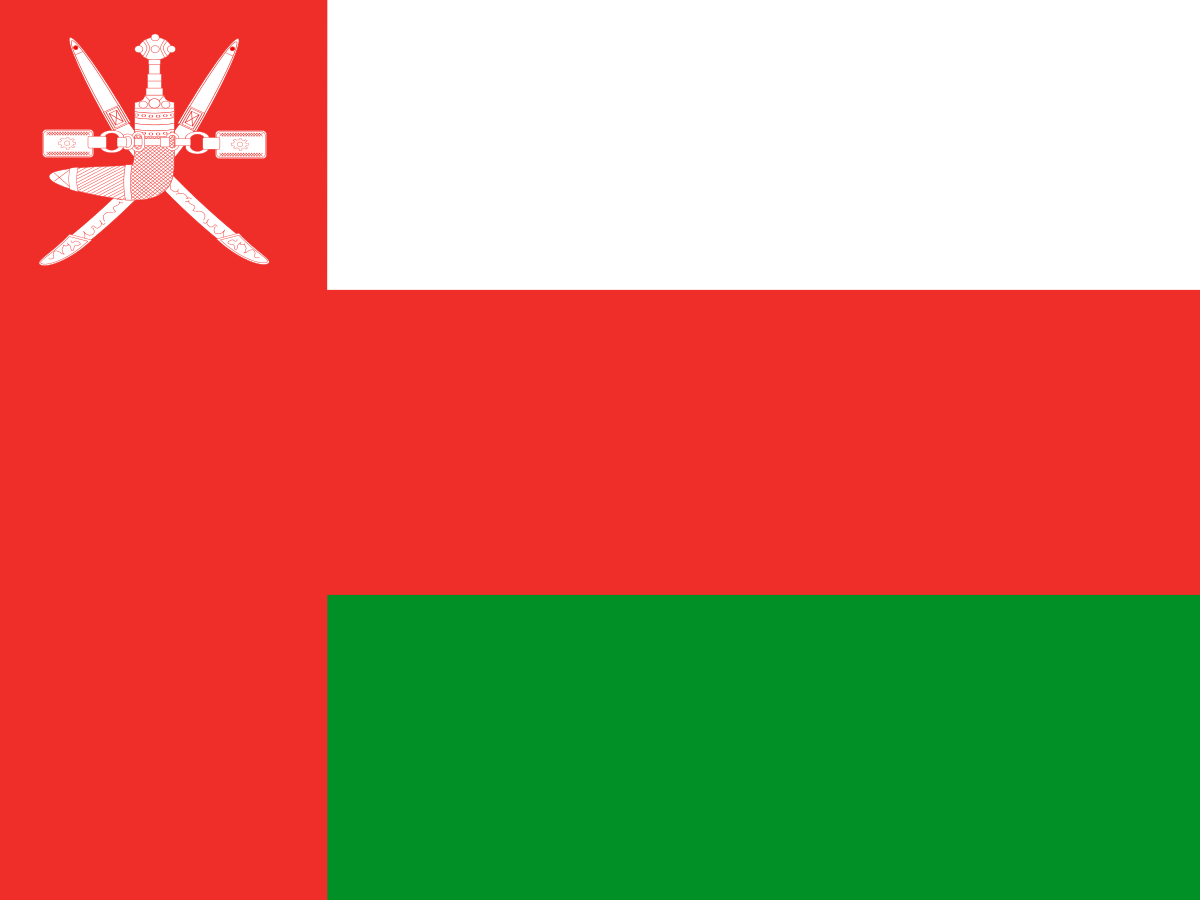
The flag of Oman
Oman's flag has a white, red and green design with a vertical red panel at the hoist. The national emblem of two crossed swords, a khanjar and its belt appears in the upper part of the hoist panel.
The current national flag was adopted in 1970 and modified in 1975.
The colours have long-standing associations with Omani history, peace, prosperity and the country's landscape.
The distinctive emblem makes the Omani flag immediately recognisable among the flags of the Arab world.
The red on the flag
Red is a traditional Omani colour and has been associated with the ruling Al Bu Said dynasty as well as the country's historic identity.
It dominates the vertical hoist panel and also forms the central horizontal stripe.
The white on the flag
White is commonly associated with peace and is also linked to the Imamate tradition in Omani history.
It forms the upper horizontal stripe of the national flag.
The green on the flag
Green is associated with fertility, agriculture and Oman's green mountain regions, particularly the Al Hajar Mountains.
It forms the lower horizontal stripe and provides a strong contrast with the red and white.
The national emblem
Oman's emblem shows a khanjar dagger and crossed swords within a decorative belt.
The khanjar is a traditional curved Omani dagger worn as part of ceremonial dress and is an important national cultural symbol.
The khanjar
The khanjar is a distinctive curved dagger traditionally worn by Omani men on formal occasions.
Its elaborate silverwork, hilt and belt are associated with Omani craftsmanship and national identity. The khanjar appears prominently in Oman's coat of arms.
A short history of Oman
Oman has one of the oldest continuously distinctive political and cultural traditions in the Arabian Peninsula. Its location made it a major centre of Indian Ocean trade, connecting Arabia with East Africa, India and beyond.
The country was influenced by Islam from the seventh century, developed powerful maritime networks, experienced Portuguese occupation of Muscat, and later expanded its influence along the East African coast.
History timeline
Ancient period — Magan and maritime tradeThe territory of Oman was associated with ancient copper production and maritime trade linking southern Arabia with Mesopotamia and the wider Indian Ocean world.
7th century — Islam reaches OmanOman became one of the early regions of Arabia to accept Islam, while retaining distinctive Ibadi religious traditions.
8th–9th centuries — Ibadi imamate traditionOman developed a political tradition in which religiously chosen imams could govern the country, alongside powerful local and tribal authorities.
11th–15th centuries — Indian Ocean tradeOmani merchants participated in extensive maritime trade networks linking Arabia, East Africa, India and the Persian Gulf.
1507 — Portuguese capture of MuscatPortuguese forces captured Muscat as part of their attempt to control the Indian Ocean trade routes.
1650 — Oman expels the PortugueseOmani forces expelled the Portuguese from Muscat, beginning a period of greater Omani maritime power.
17th–18th centuries — Omani maritime expansionOman developed a powerful navy and expanded its influence along the East African coast and western Indian Ocean.
1744 — Ahmad bin Said begins Al Bu Said dynastyAhmad bin Said Al Bu Said founded the dynasty that continues to rule Oman today.
Late 18th century — Muscat becomes a major trading centreOmani influence grew through maritime commerce, particularly with East Africa and the Indian Ocean.
1798 — British-Omani relationship developsBritain established close strategic relations with Oman as European powers competed for influence in the Indian Ocean.
19th century — Zanzibar and East AfricaOmani rulers became closely associated with Zanzibar, which became an important centre of Omani political and commercial influence.
1832 — Capital moved to ZanzibarSultan Said bin Sultan made Zanzibar his principal seat while maintaining authority over Omani territories.
1856 — Omani and Zanzibar realms separatedAfter Said bin Sultan's death, his sons inherited separate realms, ending the political unity of Oman and Zanzibar.
Late 19th–early 20th centuries — Internal divisionsOman experienced recurring tensions between the coastal sultanate and inland imamate communities.
1950s — Jebel Akhdar WarConflict between the Sultan's forces and forces supporting the inland Imamate ended with the Sultanate establishing control over the interior.
1970 — Qaboos takes powerSultan Qaboos bin Said replaced his father, Said bin Taimur, and began a major programme of modernisation.
1970 — Modern flag introducedThe present red, white and green flag was introduced after Sultan Qaboos came to power.
1975 — Dhofar Rebellion endsThe long-running insurgency in southern Oman was defeated with the assistance of Omani and allied forces.
1975 — Flag modifiedThe national flag was modified to its present proportions and arrangement.
1981 — Gulf Cooperation Council foundedOman became one of the six founding members of the Gulf Cooperation Council.
1996 — Basic Law introducedOman adopted its Basic Law, setting out the framework of the modern state and succession.
2000s — Economic diversificationOman increased investment in tourism, ports, logistics, manufacturing, fisheries and other sectors alongside oil and gas.
2011 — Protests and reformsOman experienced demonstrations during the Arab Spring period. The government responded with economic measures and some political and administrative reforms.
2020 — Sultan Qaboos diesSultan Qaboos died after almost 50 years on the throne. His cousin Haitham bin Tariq became Sultan.
2021 — New Basic LawA new Basic Law strengthened the framework for succession and updated the structure of government.
TodayOman is a hereditary monarchy pursuing economic diversification while maintaining its distinctive foreign policy and cultural traditions.
Ancient Oman
Oman has a long archaeological history. Ancient sources associate parts of the region with Magan, a land known for copper and maritime trade.
Oman's position between the Arabian Peninsula, the Persian Gulf and the Indian Ocean allowed it to participate in trade networks thousands of years ago.
The arrival of Islam
Oman accepted Islam in the 7th century during the lifetime of the Prophet Muhammad.
Oman developed a distinctive Ibadi Islamic tradition, which remains an important part of the country's religious and cultural identity.
The Ibadi tradition
Oman is one of the world's principal centres of Ibadi Islam.
Ibadi communities developed a distinctive political tradition around the institution of the imam. Oman today is governed by a hereditary sultan rather than an elected religious imam.
The Portuguese in Oman
Portuguese forces captured Muscat in 1507 as Portugal sought to control Indian Ocean trade routes.
Oman eventually expelled the Portuguese in 1650. The victory helped establish Oman's reputation as a major maritime power.
Oman's maritime empire
During the seventeenth and eighteenth centuries, Oman developed an influential maritime network stretching across the Arabian Sea and East Africa.
Omani rulers controlled or influenced ports including Mombasa and Zanzibar and became major participants in Indian Ocean commerce.
Zanzibar and East Africa
Oman had deep historical connections with Zanzibar and the East African coast. Sultan Said bin Sultan moved his main court to Zanzibar in the nineteenth century.
Omani influence helped shape the architecture, language, trade and culture of Zanzibar and other coastal communities.
The Al Bu Said dynasty
The Al Bu Said dynasty has ruled Oman since 1744, when Ahmad bin Said Al Bu Said became ruler.
The dynasty remains the ruling house under Sultan Haitham bin Tariq.
Sultan Qaboos
Sultan Qaboos bin Said ruled Oman from 1970 until his death in 2020. His reign transformed the country through investment in roads, schools, hospitals, electricity, telecommunications and modern government.
He also pursued a foreign policy that often positioned Oman as a diplomatic bridge between regional and international powers.
Sultan Haitham
Sultan Haitham bin Tariq became ruler in January 2020 following the death of Sultan Qaboos.
His government has continued economic diversification and implemented reforms under Oman's long-term development strategy, Vision 2040.
The Dhofar Rebellion
The Dhofar Rebellion was an armed insurgency in southern Oman that began in the 1960s.
The conflict ended in the 1970s after Sultan Qaboos's government expanded development and military operations in the region, with assistance from allied countries.
Oman's mountains
The Al Hajar Mountains dominate northern Oman and include some of the highest peaks in the Arabian Peninsula.
Jebel Shams, at roughly 3,000 metres, is the country's highest mountain area. Mountain villages, wadis and terraced farms create landscapes very different from the surrounding desert.
Wadis
Oman's wadis are valleys and river channels that can carry water after rainfall. Some contain permanent pools, vegetation and traditional settlements.
Wadis are important for agriculture and tourism but can become dangerous during sudden heavy rainfall and flash floods.
The Empty Quarter
Parts of western Oman reach into the vast Rub' al Khali, or Empty Quarter, one of the world's largest sand deserts.
The desert contains enormous dunes and extremely arid landscapes stretching across several Arabian Peninsula countries.
Oman's coastline
Oman has a long coastline facing the Arabian Sea and Gulf of Oman, with rugged cliffs, sandy beaches, fishing villages and important ports.
The country's position near the Strait of Hormuz gives it major strategic importance for global shipping and energy trade.
Musandam
The Musandam Peninsula is an Omani territory separated from most of the country by the United Arab Emirates.
Its dramatic fjord-like coastal inlets, known as khors, have earned it the nickname 'Norway of Arabia'. The peninsula overlooks the Strait of Hormuz.
The Strait of Hormuz
The Strait of Hormuz is one of the world's most important maritime chokepoints, linking the Persian Gulf with the Gulf of Oman and Arabian Sea.
Oman's Musandam Peninsula lies beside the strait, giving the country an important strategic position.
Oman's climate
Oman is predominantly hot and arid, with very high summer temperatures across much of the country.
The Al Hajar Mountains are cooler, while Dhofar in the south experiences the seasonal khareef monsoon, which turns parts of the region green during summer.
Khareef season
The khareef is the southwest monsoon that affects southern Oman, particularly Dhofar, during summer.
Mist, light rain and cooler conditions transform the normally dry landscape around Salalah into green grasslands and lush vegetation.
Omani wildlife
Oman's varied landscapes support Arabian oryx, Arabian tahr, leopards, sea turtles, dolphins and many migratory birds.
The country has protected areas and marine reserves aimed at conserving wildlife and fragile desert and coastal ecosystems.
Sea turtles
Oman is an important nesting area for green turtles and other sea turtle species.
Ras al Jinz in the Ash Sharqiyah region is particularly famous for turtle nesting and conservation programmes.
Omani culture
Omani culture combines Arab, Islamic, African, Indian Ocean and tribal influences. Traditional dress, architecture, music, poetry, hospitality and seafaring remain important.
The country's long maritime history gives Omani culture a particularly strong connection with East Africa and the wider Indian Ocean.
Omani language
Arabic is Oman's official language. English is widely used in business, tourism and education.
Several regional Arabic dialects are spoken, while communities with South Asian and African heritage also use additional languages.
Omani food
Traditional Omani cuisine includes shuwa, majboos, harees, mashuai, dates, halwa and kahwa.
Seafood, rice, meat, spices and dates feature heavily, reflecting both Arabian traditions and Oman's historic trading connections.
Omani frankincense
Oman has been famous for frankincense for thousands of years. The resin comes from Boswellia trees that grow particularly well in Dhofar.
The ancient frankincense trade connected southern Oman with markets across Arabia, the Mediterranean and Asia. The Land of Frankincense sites are UNESCO World Heritage locations.
The economy
Oman's economy has historically relied heavily on oil and natural gas, but the government is working to diversify through logistics, tourism, fisheries, manufacturing, mining and renewable energy.
Oman's strategic ports and position near major shipping routes also support ambitions to become a regional logistics hub.
Oil and gas
Petroleum production became central to Oman's modern economy during the twentieth century.
Oil revenues helped finance the rapid development of infrastructure and public services after 1970, while current policy seeks to reduce dependence on hydrocarbons.
Ports and trade
Oman has invested heavily in modern ports including Duqm, Salalah and Sohar.
Their locations outside the Persian Gulf and close to major Indian Ocean routes give Oman opportunities to expand shipping, logistics and industrial activity.
Tourism
Oman's tourism appeal includes Muscat, mountain villages, wadis, deserts, forts, beaches, diving sites and Salalah's khareef season.
The country has developed tourism while generally maintaining a more conservative and culturally distinctive atmosphere than some other Gulf destinations.
Oman and the Gulf
Oman is a founding member of the Gulf Cooperation Council but has often maintained a distinctive foreign policy.
It has historically kept dialogue open with countries that have difficult relations with one another, helping Oman play a role in regional diplomacy.
Oman today
Modern Oman is a hereditary sultanate that has undergone enormous development since 1970. The country combines modern infrastructure with strong cultural traditions and a distinctive diplomatic approach.
Its major challenges include economic diversification, employment for a young population, water scarcity and managing the long-term transition beyond oil and gas.
Why is Oman's flag interesting?
Oman's flag is distinctive because it combines a red vertical panel and national emblem with horizontal white and green bands.
The khanjar and crossed swords connect the flag directly to Omani heritage, while the colours reflect traditions, peace and the country's landscapes.
Explore Oman on FlagAtlas
Continue exploring Oman and the world's flags with these FlagAtlas resources.