About Papua New Guinea
Papua New Guinea is a vast and culturally diverse country in the south-western Pacific. It occupies the eastern half of the island of New Guinea, along with numerous offshore islands.
It is one of the world's most linguistically and culturally diverse countries, with hundreds of distinct languages and traditions. Port Moresby is the capital.
CapitalPort Moresby
RegionMelanesia
PopulationAbout 10 million
CurrencyKina
Official languagesEnglish, Tok Pisin, Hiri Motu
Independence1975
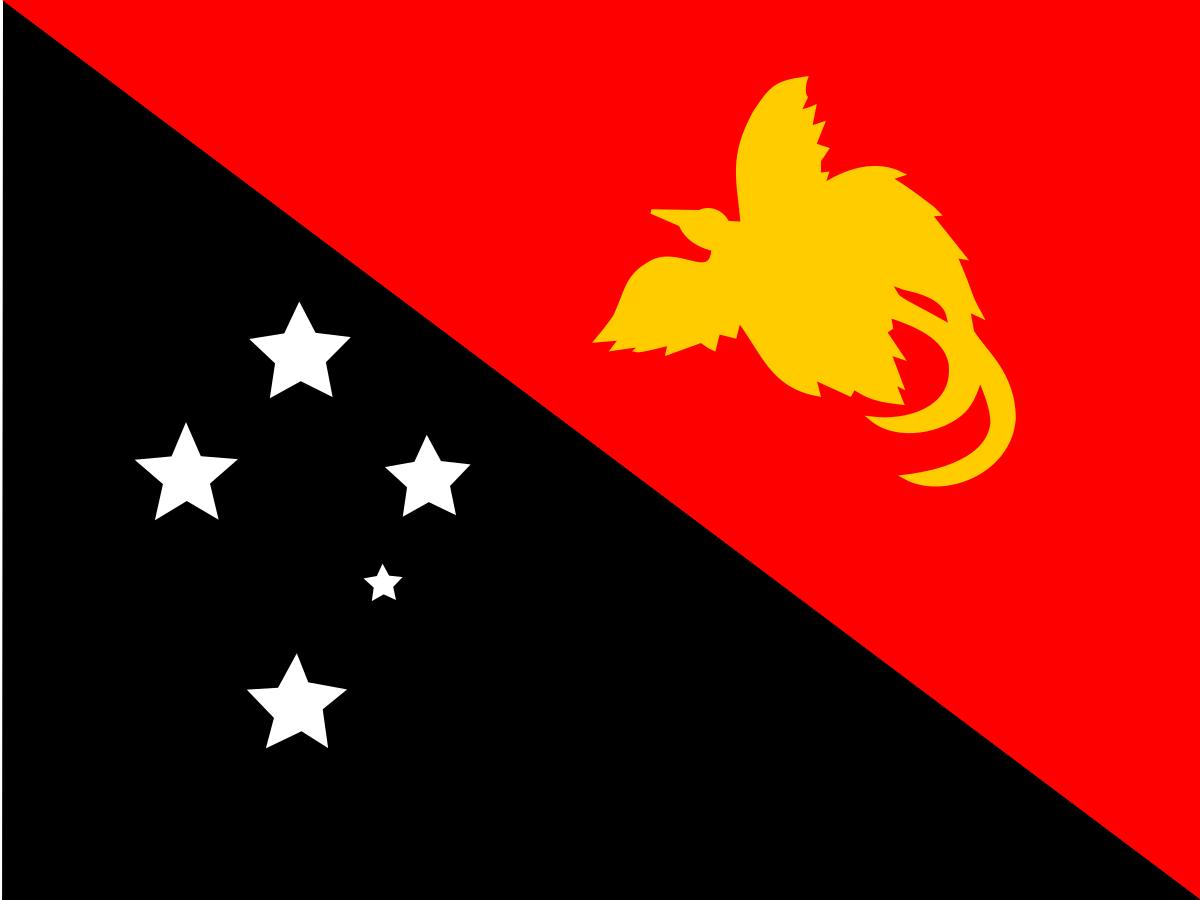
The flag of Papua New Guinea
Papua New Guinea's flag is divided diagonally into black and red. A yellow Southern Cross appears on the black half, while a yellow bird-of-paradise appears on the red half.
The flag was adopted in 1971.
Its design combines important national symbols with colours associated with Papua New Guinea's traditional culture and history.
The black field
The black field carries the Southern Cross. Black is one of the traditional colours found in Papua New Guinean art and cultural traditions.
The red field
The red field carries the bird-of-paradise. Red is also a traditional colour in Papua New Guinea and appears widely in ceremonial decoration, body art and traditional designs.
The Southern Cross
The Southern Cross is a constellation that can be seen clearly in the southern sky. It also appears on the flags of Australia, New Zealand, Samoa and other southern-hemisphere countries.
On Papua New Guinea's flag, the stars are arranged in a form representing the constellation.
The bird-of-paradise
The bird-of-paradise is one of Papua New Guinea's best-known national symbols. The country is home to many species of these remarkable birds, famous for their elaborate feathers and courtship displays.
The bird on the flag represents the country's distinctive wildlife and cultural identity.
A short history of Papua New Guinea
Papua New Guinea has a human history stretching back tens of thousands of years. Its communities developed sophisticated farming systems, trade networks, languages and artistic traditions long before European contact.
The territory was divided between German and British administration, later Australia, before becoming an independent state in 1975.
History timeline
c. 50,000 years ago — Early human settlementPeople reached New Guinea during the early settlement of Sahul, the ancient landmass that also included Australia.
c. 7,000–5,000 BCE — Early agricultureCommunities in the New Guinea highlands developed important forms of agriculture, including sophisticated drainage and cultivation systems.
Thousands of years ago — Papuan and Austronesian cultures developNew Guinea became home to a huge variety of languages and cultures. Later Austronesian migrations added new populations and maritime traditions, especially in coastal and island areas.
16th century — European contactEuropean navigators began charting parts of New Guinea and nearby islands.
1884 — German New GuineaGermany established control over the north-eastern part of the island and nearby islands, creating German New Guinea.
1884 — British New GuineaBritain established a protectorate over the south-eastern part of New Guinea, which was later transferred to Australian administration.
1906 — Territory of PapuaAustralian administration replaced British control in the south-east, creating the Territory of Papua.
1914 — Australia takes German New GuineaAustralian forces occupied German New Guinea during the First World War.
1921 — League of Nations mandateAustralia formally administered the former German territory under a League of Nations mandate.
1930s — Highlands explored by EuropeansEuropean expeditions entered parts of the previously little-known highlands, encountering large and highly organised Indigenous communities.
1942–1945 — Second World WarNew Guinea became a major Pacific War battlefield. Australian, American and local forces fought Japanese troops in campaigns including Kokoda.
1949 — Territory of Papua and New GuineaThe Australian-administered territories of Papua and New Guinea were formally united under one administration.
1960s–1970s — Self-government developsPolitical institutions expanded and Papua New Guineans gained increasing control over their own government.
1971 — Modern flag adoptedThe present black-and-red flag with the Southern Cross and bird-of-paradise was adopted.
1973 — Internal self-governmentPapua New Guinea achieved internal self-government while remaining constitutionally linked to Australia.
16 September 1975 — IndependencePapua New Guinea became an independent sovereign state, with Michael Somare as its first prime minister.
1975–1990s — Bougainville conflictA major conflict developed over the Panguna mine and demands for greater autonomy and independence on Bougainville.
2001 — Bougainville Peace AgreementA peace agreement established a framework for autonomy and a future referendum on Bougainville's political status.
2019 — Bougainville referendumVoters overwhelmingly supported greater independence from Papua New Guinea in a non-binding referendum.
2020s — Independence discussions continueNegotiations over Bougainville's future relationship with Papua New Guinea continue within the country's constitutional framework.
TodayPapua New Guinea remains a sovereign Pacific nation balancing rapid economic development with enormous cultural, environmental and geographical diversity.
Papua New Guinea's geography
Papua New Guinea occupies the eastern half of the island of New Guinea and includes the Bismarck Archipelago, New Britain, New Ireland, Bougainville and many smaller islands.
The landscape ranges from tropical lowlands and coral reefs to some of the highest mountains in Oceania.
The highlands
The New Guinea Highlands contain rugged mountains, deep valleys and fertile agricultural areas. Communities have lived in the highlands for thousands of years and developed intensive forms of farming suited to the terrain.
Mount Wilhelm
Mount Wilhelm is Papua New Guinea's highest mountain at 4,509 metres. It lies in the Bismarck Range and is one of the country's best-known natural landmarks.
The Sepik River
The Sepik River is one of the largest rivers in the Pacific region. Its huge floodplain supports forests, wetlands and many communities with strong river-based cultural traditions.
Climate
Papua New Guinea has a predominantly tropical climate, but altitude creates enormous variation. The highlands can be cool while lowland and coastal areas are hot and humid.
Rainfall is generally high, although seasonal patterns differ across the country.
Papua New Guinea's wildlife
Papua New Guinea is one of the world's great biodiversity hotspots. Its forests support birds-of-paradise, tree kangaroos, cassowaries, echidnas, parrots, crocodiles and countless insects and plants.
Many species are found nowhere else on Earth.
Birds-of-paradise
Papua New Guinea is famous for its birds-of-paradise, whose extraordinary feathers and courtship displays have fascinated naturalists for centuries.
More than a dozen genera and many species occur across New Guinea and nearby islands.
The cassowary
The southern cassowary is a large, flightless rainforest bird found in Papua New Guinea and northern Australia. It is important for forest ecology because it disperses the seeds of many large-fruited plants.
Tree kangaroos
Papua New Guinea is home to several species of tree kangaroo. Unlike Australia's better-known ground-dwelling kangaroos, these marsupials have adapted to life in rainforest trees.
Coral reefs
Papua New Guinea lies within the Coral Triangle, one of the richest marine biodiversity regions on Earth. Its reefs support huge numbers of fish, corals, turtles and other marine species.
Papua New Guinean culture
Papua New Guinea has extraordinary cultural diversity, with hundreds of distinct peoples, traditions and languages.
Traditional music, dance, carving, weaving, body decoration and ceremonial gatherings remain important in many communities.
Languages
Papua New Guinea is often described as the world's most linguistically diverse country. It has more than 800 living languages.
English, Tok Pisin and Hiri Motu are official languages. Tok Pisin is widely used as a lingua franca between communities.
Goroka and Mount Hagen festivals
The Goroka Show and Mount Hagen Cultural Show bring together performers from many communities. Elaborate feather headdresses, body paint, singing and dancing showcase Papua New Guinea's cultural diversity.
Traditional dress and decoration
Traditional decoration varies enormously between regions and peoples. Feathers, shells, fibres, clay, pigments and woven materials are used in ceremonial dress and body decoration.
These are expressions of identity rather than simply costumes.
The sing-sing
A sing-sing is a gathering involving traditional music, singing and dancing. Different communities perform distinctive styles and ceremonial displays, making these events an important expression of cultural identity.
Papua New Guinean food
Traditional diets vary by region but commonly include sweet potato, taro, cassava, sago, bananas, greens, fish and pork.
In the highlands, sweet potato is particularly important, while sago is a staple in many lowland areas.
The economy
Papua New Guinea's economy combines agriculture, mining, petroleum and gas, forestry, fisheries and services.
Natural resources generate substantial export income, while many people continue to depend directly on subsistence and small-scale agriculture.
Natural resources
Papua New Guinea has significant deposits of gold, copper, nickel, oil and natural gas. Resource projects can provide major revenues but also raise environmental, land-rights and community concerns.
Agriculture
Agriculture is central to everyday life and rural employment. Important crops include coffee, cocoa, palm oil, copra, sweet potato and vegetables.
Port Moresby
Port Moresby is Papua New Guinea's capital and largest city. It is the country's political and administrative centre and sits on the Gulf of Papua coast.
The Kokoda Track
The Kokoda Track crosses the rugged Owen Stanley Range and became famous during the Second World War. Australian and Papuan forces fought Japanese troops in a brutal 1942 campaign.
Today it is an important historical site and challenging trekking route.
Second World War in New Guinea
Papua New Guinea was a major battlefield in the Pacific War. The Kokoda campaign, Milne Bay, Buna-Gona and the campaigns around Lae and Salamaua were among the major operations.
Local Papuan carriers played an important role supporting Allied troops.
Bougainville
Bougainville is an autonomous region of Papua New Guinea. A long conflict over the Panguna copper mine and demands for independence ended with the Bougainville Peace Agreement.
A 2019 referendum produced an overwhelming vote for independence, but the final constitutional process remains unresolved.
Why is Papua New Guinea's flag interesting?
Papua New Guinea's flag combines two very different but equally important symbols: the Southern Cross connects the country to the southern Pacific, while the bird-of-paradise represents its unique wildlife and culture.
The diagonal division makes the flag particularly distinctive among national flags.
Explore Papua New Guinea on FlagAtlas
Continue exploring Papua New Guinea and the world's flags with these FlagAtlas resources.