About the Philippines
The Philippines is an archipelago in Southeast Asia made up of thousands of islands. It lies between the South China Sea and the western Pacific and has a rich mixture of Indigenous, Austronesian, Spanish, American, Chinese and other cultural influences.
Manila is the capital, while Quezon City is one of the country's largest cities. The Philippines is one of the world's most populous island nations.
CapitalManila
RegionSoutheast Asia
PopulationAbout 113 million
CurrencyPhilippine peso
Official languagesFilipino & English
Independence1946
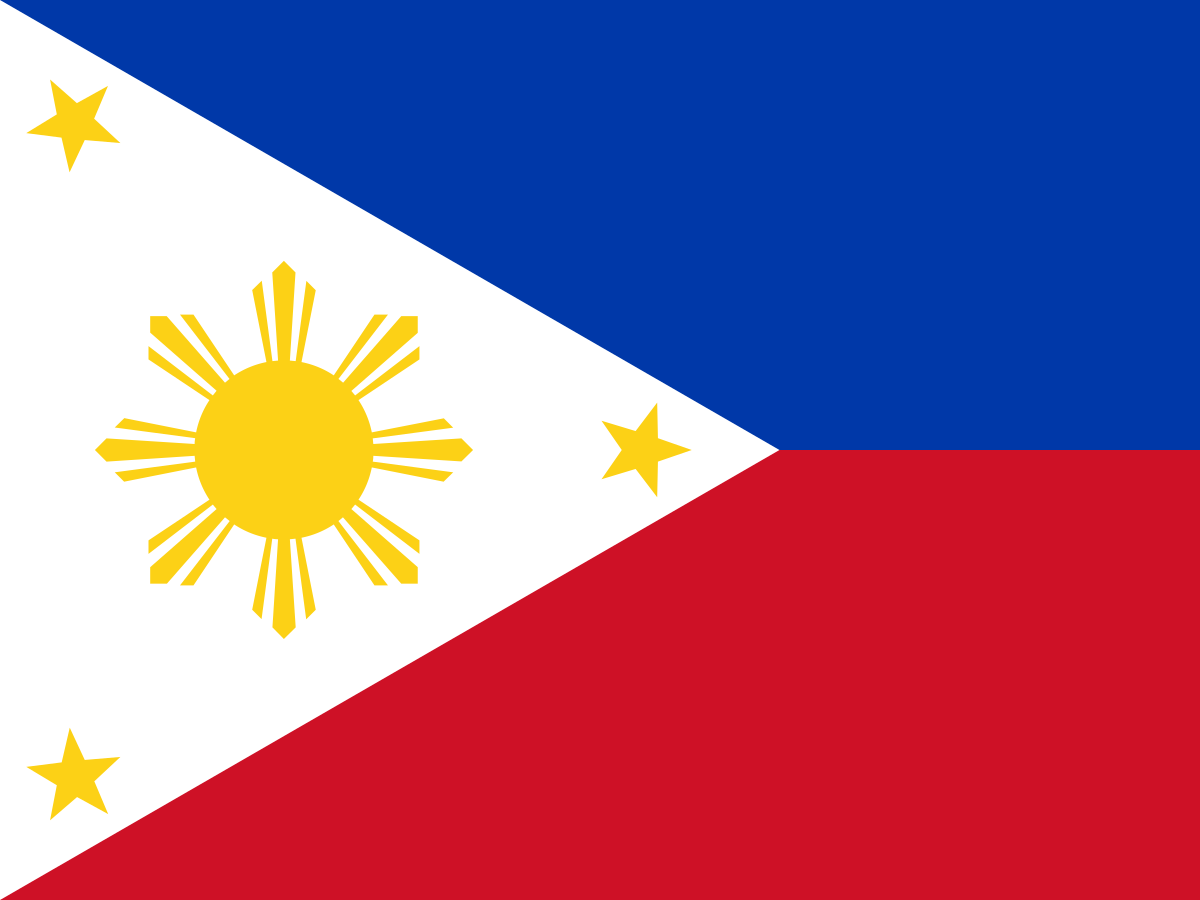
The flag of the Philippines
The Philippine flag has a distinctive design of blue and red horizontal fields, a white triangle at the hoist, a golden sun and three golden stars.
One unusual feature is that the flag can be displayed with the red field above the blue field during wartime.
The present flag was adopted in 1898 and formally retained after independence.
The symbols draw heavily on the country's revolutionary history and its three major island groups.
The blue field
The blue field traditionally represents peace, truth and justice. It occupies the upper half of the flag in normal peacetime display.
The red field
The red field represents patriotism and valour. In wartime protocol, the red field is displayed above the blue field, making the Philippine flag one of the few national flags whose orientation changes with national circumstances.
The white triangle
The white equilateral triangle represents equality and fraternity. It also reflects the revolutionary Katipunan movement, whose ideals influenced the design of the flag.
The golden sun
The eight-rayed golden sun represents the first eight provinces that rose in revolt against Spanish colonial rule during the Philippine Revolution.
The three stars
The three golden five-pointed stars represent the country's three major island groups: Luzon, Visayas and Mindanao.
The Katipunan
The Katipunan was a secret revolutionary organisation founded in 1892 that played a major role in the struggle against Spanish colonial rule. Its symbolism influenced the Philippine flag and national identity.
A short history of the Philippines
The Philippines has a long history of Austronesian migration, maritime trade and Indigenous societies. Spanish colonisation began in the 16th century, followed by more than three centuries of Spanish rule. The country later came under American administration and was occupied by Japan during the Second World War before achieving full independence in 1946.
History timeline
Thousands of years ago — Early settlementAncestors of today's Indigenous peoples lived across the islands, developing diverse societies adapted to coastal, forest and mountain environments.
c. 2200 BCE onward — Austronesian migrationsAustronesian-speaking peoples reached the Philippine archipelago as part of wider migrations across Island Southeast Asia and the Pacific.
10th century — Laguna Copperplate InscriptionThe Laguna Copperplate Inscription provides important evidence of writing, trade and political connections in the region before Spanish colonisation.
14th–15th centuries — Regional tradePhilippine communities traded with neighbouring societies including China, Borneo, Java and other parts of Southeast Asia.
1521 — Magellan reaches the PhilippinesFerdinand Magellan's expedition arrived in the islands. Magellan was killed at the Battle of Mactan.
1565 — Spanish colonisation beginsMiguel López de Legazpi established a permanent Spanish settlement, beginning a long period of Spanish colonial rule.
1571 — Manila becomes colonial centreManila was established as the centre of Spanish administration and became a major link in the trans-Pacific trade route.
1565–1815 — Manila–Acapulco Galleon TradeSpanish galleons connected Manila with Acapulco in New Spain, creating a major trade network across the Pacific.
1892 — Katipunan foundedAndrés Bonifacio and others founded the Katipunan, a secret organisation dedicated to independence from Spain.
1896 — Philippine RevolutionThe revolution against Spanish rule began and spread across parts of the archipelago.
12 June 1898 — Independence declaredEmilio Aguinaldo declared Philippine independence from Spain at Kawit, Cavite, and the new flag was formally presented.
1898 — Spanish rule endsSpain ceded the Philippines to the United States following the Spanish-American War.
1899–1902 — Philippine-American WarFilipino forces fought the United States after the collapse of Spanish rule. Resistance continued in various forms for several years.
1935 — Commonwealth establishedThe Philippine Commonwealth was created as a transitional government before planned independence.
1942–1945 — Japanese occupationThe Philippines was occupied by Japan during the Second World War. Major fighting returned during the Allied campaign to liberate the islands.
4 July 1946 — Full independenceThe Philippines became an independent republic and the United States formally recognised its sovereignty.
1965–1986 — Marcos eraFerdinand Marcos governed the Philippines, declaring martial law in 1972 and ruling under increasingly authoritarian conditions.
1986 — People Power RevolutionMass demonstrations helped remove Marcos and led to the restoration of democratic government under Corazon Aquino.
TodayThe Philippines is a democratic republic with a large, young population, a major overseas workforce and a diverse economy based on services, manufacturing, agriculture and remittances.
Luzon
Luzon is the largest and most populous island group and includes Manila. It contains major mountain ranges, fertile plains and important volcanoes including Mount Pinatubo and Mayon.
The Visayas
The Visayas are a central group of islands known for beaches, coral reefs, historic communities and diverse regional cultures. Cebu, Panay, Negros, Samar and Leyte are among the major islands.
Mindanao
Mindanao is the second-largest island and contains a wide variety of landscapes and cultures. It is home to many Indigenous and Muslim communities as well as major agricultural areas.
The geography of the Philippines
The Philippines is an archipelago of more than 7,000 islands, with a total coastline among the longest in the world. Its landscapes include mountains, volcanoes, tropical forests, rice terraces, beaches, mangroves and coral reefs.
Volcanoes
The Philippines lies on the Pacific Ring of Fire and has many active and potentially active volcanoes. Mayon is famous for its near-symmetrical cone, while Mount Pinatubo produced one of the largest volcanic eruptions of the 20th century in 1991.
Rice terraces
The Banaue Rice Terraces and other terraces in the Cordillera region are remarkable examples of traditional highland agriculture. Some have been cultivated for centuries by Indigenous communities.
Climate and typhoons
The Philippines has a predominantly tropical maritime climate. It is frequently affected by tropical cyclones, especially during the western Pacific typhoon season.
Typhoons can bring destructive winds, flooding and landslides, making disaster preparedness an important national issue.
Marine biodiversity
The Philippines lies within the Coral Triangle, one of the world's richest marine biodiversity regions. Coral reefs, seagrass beds and mangroves support huge numbers of fish and other marine species.
Philippine wildlife
The islands contain many endemic species, including the Philippine eagle, tamaraw, Philippine tarsier and several unique reptiles and mammals.
The Philippine eagle
The Philippine eagle is one of the world's largest forest eagles and is endemic to the Philippines. It is a national symbol and is critically endangered because of habitat loss and other threats.
The Philippine tarsier
The Philippine tarsier is a tiny primate with enormous eyes. It is mainly nocturnal and is found in forest habitats on several Philippine islands.
The tamaraw
The tamaraw is a small wild buffalo found only on Mindoro. It is critically endangered and is an important symbol of Philippine wildlife conservation.
Filipino culture
Philippine culture combines Indigenous Austronesian traditions with centuries of Spanish influence and later American influence, alongside Chinese, Islamic and other Asian connections.
Music, dance, family traditions, festivals and food vary greatly from island to island.
Languages
The Philippines is linguistically diverse. Filipino and English are the official languages, while numerous regional languages are widely spoken, including Cebuano, Ilocano, Hiligaynon and Waray.
Festivals
Philippine festivals are often called fiestas and can combine religious traditions, local history, music, dance and elaborate costumes. Sinulog in Cebu and Ati-Atihan in Aklan are among the best known.
Filipino food
Philippine cuisine includes dishes such as adobo, sinigang, lechon, pancit, kare-kare and lumpia. Rice is a staple and flavours often combine salty, sour, sweet and savoury elements.
Adobo
Adobo is one of the Philippines' best-known dishes. Meat or other ingredients are commonly cooked with vinegar, soy sauce, garlic and other seasonings, although recipes vary significantly between families and regions.
Basketball
Basketball is hugely popular in the Philippines and is deeply embedded in everyday culture. Local leagues, school competitions and professional teams attract large audiences.
The economy
The Philippine economy has major services, manufacturing, agriculture and overseas-worker sectors. Business-process outsourcing, electronics manufacturing, tourism and remittances are particularly important.
Overseas Filipino workers
Millions of Filipinos work abroad and send money home. These remittances are an important source of household income and foreign currency for the Philippine economy.
Manila
Manila is the national capital and a historic centre of government, commerce and culture. The wider Metro Manila area is a huge urban region containing many cities and municipalities.
Intramuros
Intramuros is the historic walled district of Manila. Built during the Spanish colonial period, it contains churches, fortifications and other surviving reminders of the city's colonial past.
Second World War
The Philippines was a major Pacific theatre during the Second World War. The Bataan Death March, Battle of Leyte Gulf and liberation of Manila are among the best-known events of the campaign.
The People Power Revolution
The People Power Revolution of 1986 brought millions of people onto the streets of Metro Manila. The movement helped end Ferdinand Marcos's rule and restored democratic government.
Why is the Philippines flag interesting?
The Philippine flag is unusually rich in symbolism. Its sun represents the first eight provinces to rebel against Spain, its three stars represent Luzon, Visayas and Mindanao, and its colours reflect ideals associated with the revolution.
Most unusually, the flag changes orientation in wartime, with the red field placed above the blue.
Explore the Philippines on FlagAtlas
Continue exploring the Philippines and the world's flags with these FlagAtlas resources.