About Portugal
Portugal is a country on the western edge of the Iberian Peninsula in Europe. It faces the Atlantic Ocean and includes the autonomous island regions of Madeira and the Azores.
Lisbon is the capital and largest city. Portugal is famous for its maritime history, explorers, distinctive architecture, azulejo tiles, fado music, wine and strong Atlantic culture.
CapitalLisbon
RegionSouthern Europe
PopulationAbout 10.5 million
CurrencyEuro
Official languagePortuguese
RepublicSince 1910
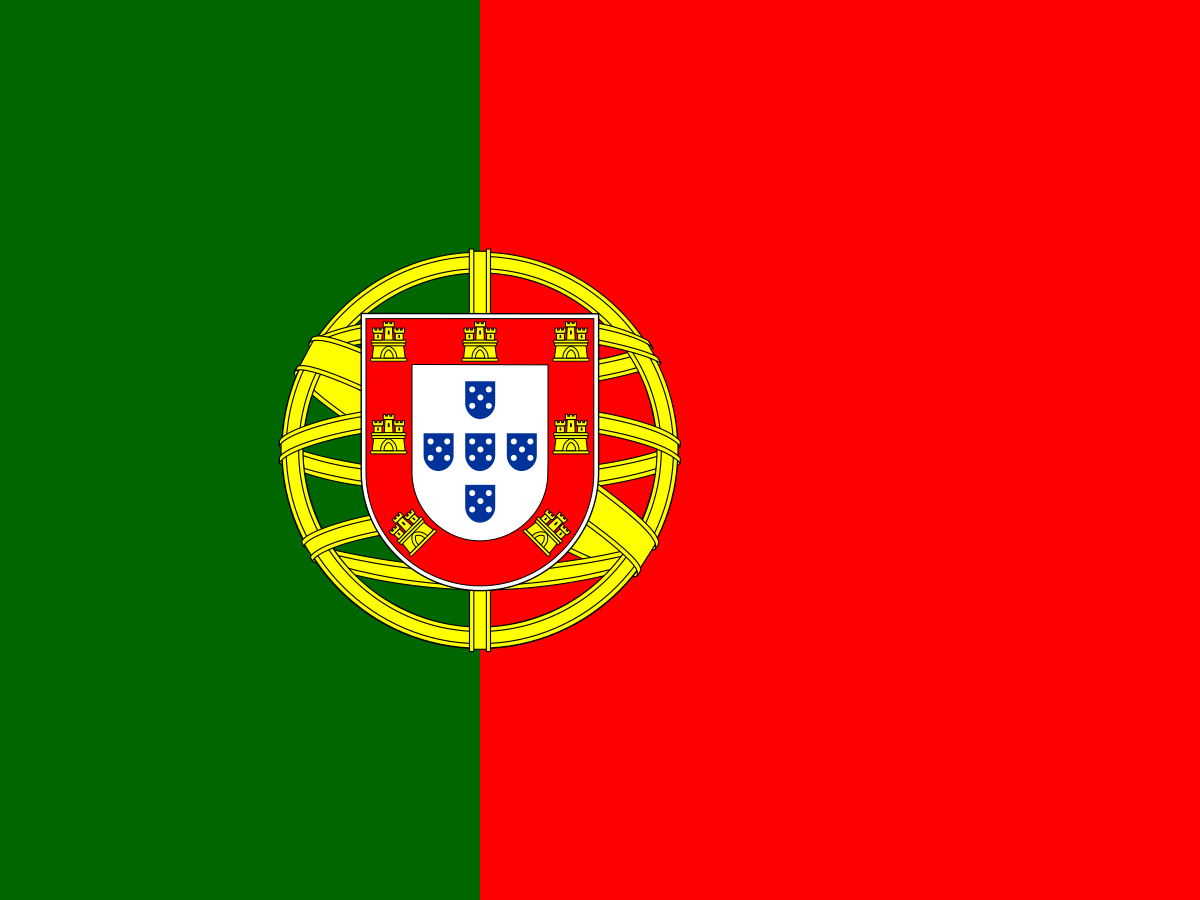
The flag of Portugal
Portugal's flag is divided vertically into a larger green section at the hoist and a smaller red section at the fly. The national coat of arms sits across the boundary between the two colours.
The design was adopted after the republican revolution of 1910 and replaced the blue-and-white royal flag.
The flag deliberately broke with the colours of the Portuguese monarchy.
Green is associated with the republican movement and hope, while red is strongly associated with the revolution and the sacrifices made in Portugal's history.
The green field
The green section is commonly associated with hope and became an important colour of the Portuguese republican movement. It also helped distinguish the new republican flag from the former royal colours.
The red field
The red field is associated with courage, sacrifice and the republican revolution of 1910. It also echoes older Portuguese military and national traditions.
The armillary sphere
The golden armillary sphere is one of Portugal's most recognisable symbols. It represents navigation, astronomy and Portugal's historic role in ocean exploration during the Age of Discoveries.
The Portuguese shield
The central Portuguese shield contains several layers of national symbolism, including the five blue shields and the red border with seven castles.
The five quinas
The five small blue shields, known as the quinas, form a cross-like arrangement inside the Portuguese shield. Traditional explanations connect them with the five wounds of Christ and the founding legends surrounding Afonso Henriques.
The seven castles
The seven golden castles around the red border are traditionally linked with the medieval Portuguese kingdom and its expansion during the Christian Reconquista. Their precise historical symbolism developed over time.
A short history of Portugal
Portugal developed from medieval Christian kingdoms in the western Iberian Peninsula into an independent kingdom and later a major maritime power. Portuguese navigators established trading routes and colonies across Africa, Asia and the Americas, creating a global empire.
The country later experienced political instability, a republic, dictatorship under the Estado Novo and the peaceful Carnation Revolution of 1974.
History timeline
1139 — Kingdom of Portugal traditionally foundedAfonso Henriques is traditionally regarded as the first king of Portugal, although the process of Portuguese independence developed over several decades.
1143 — Recognition of Portuguese independenceThe Treaty of Zamora helped establish Portugal's political independence from León.
1147 — Capture of LisbonPortuguese forces, supported by northern European crusaders, captured Lisbon from Muslim rule.
1249 — Algarve incorporatedPortuguese conquest reached the Algarve, broadly completing the kingdom's mainland territorial expansion.
1385 — Battle of AljubarrotaPortuguese forces defeated Castilian forces, securing Portuguese independence and the Avis dynasty.
1415 — Conquest of CeutaPortugal captured Ceuta in North Africa, an event often regarded as the beginning of the Portuguese overseas expansion.
1488 — Bartolomeu Dias rounds the CapeDias became the first known European navigator to round the southern tip of Africa, opening the route towards the Indian Ocean.
1498 — Vasco da Gama reaches IndiaVasco da Gama sailed from Portugal around Africa to reach India, creating a direct sea route between Europe and South Asia.
1500 — Portuguese arrival in BrazilPedro Álvares Cabral reached the coast of Brazil during a voyage to India, beginning centuries of Portuguese colonial rule there.
1580 — Iberian UnionPortugal came under the same monarch as Spain after a succession crisis, beginning a period of dynastic union.
1640 — Restoration of independenceThe Portuguese Restoration War began, eventually ending the Iberian Union and restoring an independent Portuguese monarchy.
1755 — Lisbon earthquakeA devastating earthquake, followed by tsunami and fires, destroyed much of Lisbon. The city was rebuilt under the leadership of the Marquis of Pombal.
1807–1811 — French invasionsNapoleonic forces invaded Portugal, and the Portuguese royal court moved to Brazil. British and Portuguese forces fought the French in the Peninsular War.
1822 — Brazil becomes independentBrazil declared independence from Portugal, marking a major change in the Portuguese overseas empire.
1910 — Republican RevolutionThe monarchy was overthrown and the First Portuguese Republic was established. The modern green-and-red flag was adopted.
1933 — Estado NovoAntónio de Oliveira Salazar established the authoritarian Estado Novo regime, which lasted for decades.
1961–1974 — Colonial WarsPortugal fought prolonged wars against independence movements in Angola, Mozambique and Portuguese Guinea.
25 April 1974 — Carnation RevolutionA largely peaceful military coup overthrew the Estado Novo. Red carnations became a symbol of the revolution.
1974–1975 — DecolonisationPortugal rapidly granted independence to most of its remaining African colonies.
1986 — European Community membershipPortugal joined what was then the European Economic Community, later becoming part of the European Union.
1999 — Macau handoverPortugal transferred sovereignty over Macau to China, ending its last major overseas colonial possession.
TodayPortugal is a parliamentary republic, EU member and NATO member with a modern service-based economy and a large tourism industry.
The Age of Discoveries
Portugal played a major role in the Age of Discoveries from the 15th century onwards. Portuguese sailors explored the Atlantic and African coasts, reached the Indian Ocean and established trading posts and colonies across several continents.
Prince Henry the Navigator
Prince Henry the Navigator was a Portuguese royal figure associated with the early stages of Portuguese maritime expansion. His court supported navigation, cartography and voyages along the Atlantic coast of Africa.
Vasco da Gama
Vasco da Gama became the first known European to reach India by sailing around the Cape of Good Hope. His voyage opened an important sea route for Portuguese trade with Asia.
Ferdinand Magellan
Ferdinand Magellan was born in Portugal but sailed for Spain. His expedition began the first voyage around the world, although Magellan himself died in the Philippines before it was completed.
Portugal and Brazil
Brazil was Portugal's largest and most important colony. Portuguese language and culture remain central to Brazil today, making Portuguese the most widely spoken language in South America.
The geography of Portugal
Portugal has a varied mainland landscape with Atlantic beaches, river valleys, rolling plains, forests and mountains. The northern and central regions are generally more mountainous, while the south includes the warmer Alentejo and Algarve regions.
The Azores
The Azores are a Portuguese archipelago in the North Atlantic made up of nine main volcanic islands. They are known for dramatic landscapes, crater lakes, green pastures and marine biodiversity.
Madeira
Madeira is a Portuguese island group off the northwest coast of Africa. Its mountainous terrain, subtropical climate and distinctive levada irrigation channels make it a major tourist destination.
The Douro Valley
The Douro Valley is famous for vineyards and wine production. Its steep terraced hillsides have been shaped by centuries of agriculture and are closely associated with Port wine.
Climate
Portugal has a generally Mediterranean-influenced climate, although conditions vary. The north tends to be cooler and wetter, while southern Portugal is warmer and drier. Atlantic influence moderates temperatures along the coast.
Portuguese wildlife
Portugal's wildlife includes Iberian wolves, wild boar, Iberian lynx, golden eagles, storks, dolphins and many coastal and migratory bird species.
The Iberian lynx
The Iberian lynx is one of the world's most endangered cat species and is native to the Iberian Peninsula. Conservation efforts in Portugal and Spain have helped its population recover from extremely low levels.
Portuguese culture
Portuguese culture reflects the country's Atlantic location, Catholic traditions, maritime history and regional diversity. Architecture, music, food, festivals and decorative arts all have strong regional identities.
Fado
Fado is Portugal's best-known traditional musical genre. Often characterised by expressive singing and themes of longing, loss and fate, it developed particularly strongly in Lisbon and Coimbra.
Azulejos
Azulejos are painted ceramic tiles found throughout Portugal. They decorate churches, railway stations, houses and public buildings and have become one of the country's most recognisable visual traditions.
Portuguese food
Portuguese cuisine makes extensive use of fish, seafood, olive oil, bread, potatoes and spices. Popular dishes include bacalhau, caldo verde, sardines, francesinha and pastéis de nata.
Bacalhau
Bacalhau, or salted cod, is one of Portugal's most iconic foods. Portuguese cuisine has an enormous number of recipes for preparing it, and it has a long connection with the country's maritime history.
Pastéis de nata
Pastéis de nata are small Portuguese custard tarts with flaky pastry and a caramelised top. They originated in the Lisbon area and have become famous around the world.
Portuguese wine
Portugal produces many distinctive wines. Port is strongly associated with the Douro Valley, while Madeira wine is produced on Madeira and Vinho Verde comes mainly from the northwestern mainland.
Lisbon
Lisbon is Portugal's capital and largest city. It sits on the Tagus estuary and is famous for its hills, trams, tiled buildings, waterfront and historic neighbourhoods such as Alfama.
Porto
Porto is Portugal's second-largest city and a major centre of commerce and wine. The historic centre lies along the Douro River and is closely associated with Port wine production.
The 1755 Lisbon earthquake
The 1755 Lisbon earthquake was one of the most destructive natural disasters in European history. Much of Lisbon was destroyed by the earthquake, tsunami and subsequent fires, and the city was rebuilt with a new planned street layout.
The Carnation Revolution
The Carnation Revolution of 25 April 1974 ended the Estado Novo dictatorship. Soldiers placed red carnations in their rifles, giving the peaceful revolution its famous name and symbol.
The economy
Portugal has a diversified economy based heavily on services, tourism, manufacturing, agriculture, technology and exports. Major industries include textiles, footwear, automotive components, cork and renewable energy.
Cork
Portugal is the world's leading producer of cork. Cork oak forests are particularly important in the Alentejo and support industries producing wine stoppers, flooring, fashion goods and other products.
Portugal and the European Union
Portugal joined the European Economic Community in 1986 and is now an EU member using the euro. European integration has played a major role in infrastructure investment and economic development.
Why is Portugal's flag interesting?
Portugal's flag is unusually easy to recognise because of its off-centre division between green and red and the detailed national emblem at the boundary. The armillary sphere is particularly distinctive, directly connecting the modern flag with Portugal's maritime history.
It is also an important example of a national flag deliberately redesigned after a revolution to replace the colours of a monarchy.
Explore Portugal on FlagAtlas
Continue exploring Portugal and the world's flags with these FlagAtlas resources.