Europe
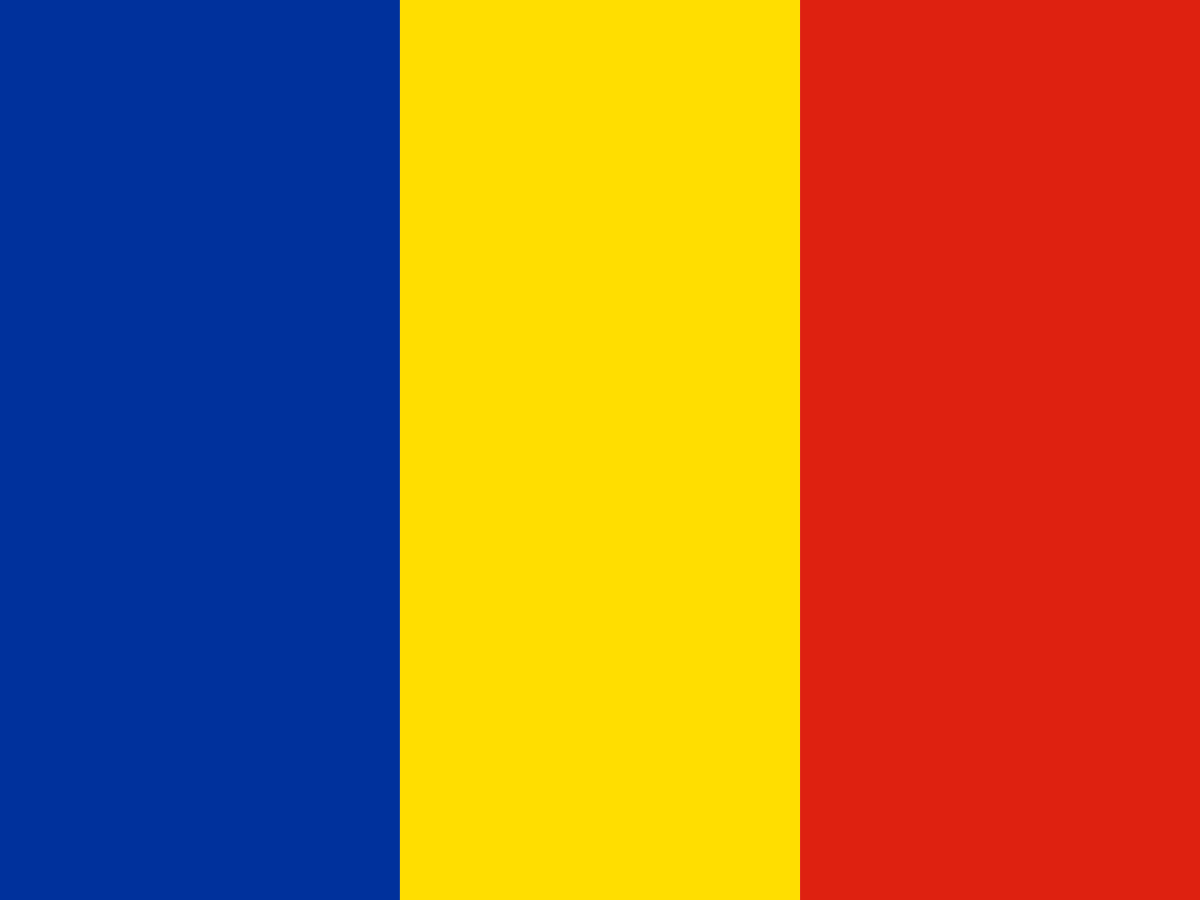
Romania Flag
Blue represents liberty, yellow symbolises justice, and red stands for fraternity — inspired by the French Revolution.
Capital
Bucharest
Continent
Europe
Population
19.0 million
Development indicators
GDP per capita
$16,700
USD per year (approx. 2023)
Human Development Index
0.821
Very High development
World Bank income classification
Upper-Middle Income (UMIC)
UMIC
🌡️ Climate: Temperate continental
Flag symbolism
Blue represents liberty, yellow symbolises justice, and red stands for fraternity — inspired by the French Revolution.
tricolore
Did you know?
Romania's flag is almost identical to Chad's — the only difference is a tiny shade variation in the blue.
Test your knowledge
Think you know your world flags? Try the FlagAtlas daily challenge, speed quiz, or explore all Europe flags.
📚 Revising for GCSE Geography? Visit our free revision page →
About Romania
Romania is a country in south-eastern Europe, located on the western shore of the Black Sea. It borders Hungary, Serbia, Bulgaria, Ukraine and Moldova.
Romania is known for the Carpathian Mountains, the Danube Delta, medieval towns, castles and a long history shaped by Dacian, Roman, Ottoman, Habsburg and modern European influences.
CapitalBucharest
RegionEastern Europe
PopulationAbout 19 million
CurrencyRomanian leu
Official languageRomanian
EU memberSince 2007
The Romania flag
Romania's national flag is a vertical blue, yellow and red tricolour. The colours run from the hoist to the fly in that order.
The modern design has its roots in the revolutionary and national movements of the 19th century and has been an important symbol of Romanian national identity.
Blue
The blue stripe is commonly associated with liberty in Romanian flag symbolism. Blue also has a long association with Romanian national identity and the historical region of Wallachia.
Yellow
The central yellow stripe is traditionally associated with justice and is also linked with the wealth and fields of the country.
Red
The red stripe is traditionally associated with fraternity and the sacrifices made in the struggle for national independence.
The Romanian tricolour
Romania's tricolour was formally adopted during the 1848 revolution, although the exact shades, orientation and official arrangements have changed at different points in the country's history.
Romania and Chad
Romania's flag is famously very similar to the flag of Chad. Both use vertical blue, yellow and red stripes. The colours and official specifications differ slightly, but the two flags can be difficult to distinguish when viewed from a distance.
A short history of Romania
Romania's history combines ancient Dacian civilisation, Roman conquest, medieval principalities and centuries of influence from neighbouring empires. The modern Romanian state emerged through the union of historic principalities in the 19th century.
Romania became a kingdom in 1881, expanded after the First World War, experienced communist rule after the Second World War and became a democratic republic after the 1989 revolution.
History timeline
Ancient period — DaciansThe territory of modern Romania was home to the Dacians, a group of peoples who developed powerful kingdoms in the Carpathian region.
106 AD — Roman conquestEmperor Trajan conquered Dacia after a series of wars. The Roman province became an important part of the empire and influenced the development of the Romanian language.
3rd century — Roman withdrawalRoman administration withdrew from Dacia, although Roman cultural and linguistic influence remained important in the region.
Middle Ages — Principalities developWallachia, Moldavia and Transylvania developed as distinct political regions, influenced by neighbouring powers including Hungary and the Ottoman Empire.
1456–1462 — Vlad IIIVlad III of Wallachia became one of Romania's best-known medieval rulers. His historical reputation later helped inspire the fictional Dracula legend.
1600 — Michael the BraveMichael the Brave briefly brought Wallachia, Moldavia and Transylvania under one ruler, becoming an important symbol of later Romanian national unity.
1821 — Tudor Vladimirescu revoltA major uprising in Wallachia contributed to the weakening of Phanariote rule and helped set the stage for later political change.
1848 — Romanian revolutionRevolutionary movements spread across the Romanian principalities. The blue, yellow and red tricolour became associated with the national movement.
1859 — Union of Moldavia and WallachiaAlexandru Ioan Cuza was elected ruler of both Moldavia and Wallachia, creating the basis of the modern Romanian state.
1866 — Carol IPrince Carol became ruler of Romania, beginning a long period of constitutional monarchy and modernisation.
1877 — IndependenceRomania declared independence from the Ottoman Empire during the Russo-Turkish War.
1881 — Kingdom of RomaniaRomania became a kingdom and Carol I was crowned king.
1916–1918 — First World WarRomania entered the First World War in 1916. The conflict caused heavy losses but was followed by major territorial changes.
1918 — Great UnionTransylvania, Bukovina and Bessarabia joined the Romanian state in the events remembered as the Great Union.
1940 — Territorial lossesRomania lost significant territories during the upheavals of the Second World War and subsequently became closely aligned with Nazi Germany.
1947 — Communist republicKing Michael I was forced to abdicate and Romania became a communist republic under Soviet influence.
1965 — Nicolae CeaușescuCeaușescu became leader of the Romanian Communist Party and developed an increasingly authoritarian regime.
1989 — RevolutionMass protests and a violent uprising brought down Ceaușescu's government. Ceaușescu and his wife Elena were executed on 25 December 1989.
1990s — Democratic transitionRomania moved towards a multiparty democratic system and a market economy.
2004 — NATORomania joined NATO, strengthening its integration with Western European and North American institutions.
2007 — European UnionRomania joined the European Union together with Bulgaria on 1 January 2007.
TodayRomania is a democratic European republic and an EU and NATO member with a diverse economy spanning manufacturing, services, technology, agriculture and energy.
Bucharest
Bucharest is Romania's capital and largest city. It is an important centre for government, business, universities, culture and technology and is sometimes nicknamed the “Little Paris” because of historical French architectural influence.
The Carpathian Mountains
The Carpathian Mountains form a great arc through Romania and contain some of Europe's most extensive remaining wilderness areas. They support forests, alpine landscapes and large populations of bears, wolves and lynx.
The Danube
The Danube River forms part of Romania's southern border before reaching the Black Sea. It is one of Europe's major waterways and has played an important role in trade, transport and settlement.
The Danube Delta
The Danube Delta is one of Europe's most important wetlands. Its channels, lakes and reed beds support huge numbers of birds, fish and other wildlife and it is recognised as a UNESCO World Heritage Site.
Black Sea coast
Romania has a Black Sea coastline with beaches, ports and resorts. Constanța is the country's major Black Sea port and one of its oldest continuously inhabited cities.
Climate
Romania has a mainly temperate continental climate, with warm summers, cold winters and noticeable seasonal differences. Mountain areas are cooler and receive more snow, while the Black Sea coast has a more moderate maritime influence.
Wildlife
Romania has some of Europe's most significant populations of brown bears, grey wolves, Eurasian lynx and wild European bison. Its forests and wetlands also support many bird species.
European bison
The European bison, or wisent, has been reintroduced to parts of the Romanian Carpathians after disappearing from the country in the wild. Conservation projects have helped establish growing herds.
Romanian culture
Romanian culture reflects a mixture of Latin, Balkan, Central European and Eastern European influences. Folk music, traditional crafts, dance, literature and regional festivals remain important parts of cultural life.
Romanian language
Romanian is a Romance language, descended largely from the Latin spoken in the Roman province of Dacia and neighbouring areas. It is therefore related to Italian, French, Spanish and Portuguese, although it has also absorbed vocabulary from surrounding languages.
Romanian food
Romanian cuisine includes dishes such as sarmale, mămăligă, ciorbă and mici. Food traditions vary considerably between regions and reflect Balkan, Central European and Ottoman influences.
Sarmale
Sarmale are cabbage or vine leaves stuffed with a mixture usually based on minced meat and rice. They are widely eaten at celebrations and family gatherings.
Castles and medieval towns
Romania is famous for castles and historic towns in Transylvania and other regions. Bran Castle is particularly famous internationally because of its association with the Dracula story, although its historical connection to Vlad III is much more limited than popular culture suggests.
Vlad the Impaler and Dracula
Vlad III, also known as Vlad the Impaler, was a 15th-century ruler of Wallachia. Bram Stoker's fictional Count Dracula was not a direct biography of Vlad, but the historical ruler helped contribute to the character's later reputation.
The economy
Romania has a diversified economy including manufacturing, automotive production, information technology, agriculture, energy and services. Its large domestic market makes it one of the more significant economies in south-eastern Europe.
Technology and IT
Romania has developed a strong information technology and software sector, with major technology centres in Bucharest, Cluj-Napoca, Iași and Timișoara.
Romania and Europe
Romania is a member of the European Union, NATO and the United Nations. Its location on the Black Sea also gives it strategic importance at the eastern edge of the EU and NATO.
Why is Romania's flag interesting?
Romania's flag is simple but historically important: the blue-yellow-red tricolour became a powerful symbol during the 1848 revolutionary movement and was later carried through the creation of the modern Romanian state.
It is also one of the world's best-known near-identical flag pairs because of its similarity to Chad.
Explore Romania on FlagAtlas
Continue exploring Romania and the world's flags with these FlagAtlas resources.