About São Tomé and Príncipe
São Tomé and Príncipe is a small island country in the Gulf of Guinea, off the west coast of Central Africa. It consists mainly of the islands of São Tomé and Príncipe, together with smaller islands and islets.
The country is known for volcanic mountains, tropical rainforest, cocoa plantations, beaches and a distinctive Portuguese-African culture.
CapitalSão Tomé
RegionCentral Africa
PopulationAbout 230,000
CurrencyDobra (STN)
Official languagePortuguese
Independence1975
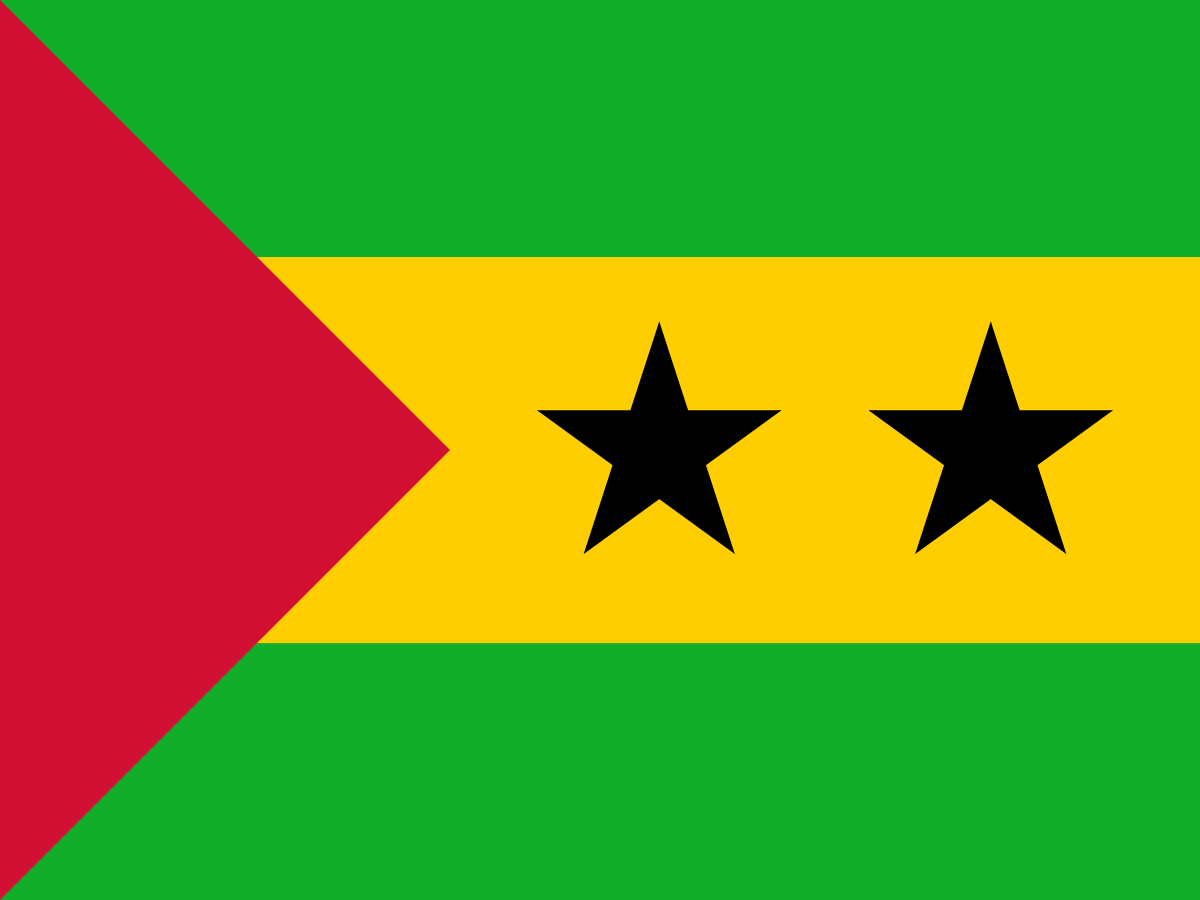
The São Tomé and Príncipe flag
The national flag has three horizontal sections: a broad green band at the top and bottom, a yellow central band and a red triangle at the hoist. Two black five-pointed stars sit in the yellow band.
The design uses Pan-African colours and the two stars represent the country's two principal islands, São Tomé and Príncipe.
Green
The green bands represent the country's lush vegetation and tropical landscape. São Tomé and Príncipe has exceptionally rich plant life because of its warm, wet island climate.
Yellow
The yellow band represents the country's tropical sunshine and is part of the wider Pan-African colour tradition used by many African states.
Red
The red triangle represents the struggle for independence and the sacrifices made in the country's liberation movement.
The two black stars
The two black five-pointed stars represent the two principal islands of the country: São Tomé and Príncipe. They are one of the flag's most distinctive features.
Pan-African colours
The combination of green, yellow and red places the flag within the Pan-African colour tradition. These colours became particularly important to African independence movements during the 20th century.
A short history
São Tomé and Príncipe was uninhabited when Portuguese explorers reached the islands in the late 15th century. The Portuguese established settlements and developed plantations, particularly for sugar and later cocoa.
Colonial rule continued for centuries before the independence movement gained strength. The islands became independent from Portugal on 12 July 1975.
History timeline
1470s — Portuguese arrivalPortuguese navigators reached the islands, which were uninhabited at the time.
Late 15th century — Settlement beginsThe Portuguese established settlements and brought enslaved people from mainland Africa and elsewhere to work on plantations.
16th century — Sugar plantationsSão Tomé became an important centre of sugar production, relying heavily on enslaved labour.
16th–17th centuries — Plantation societyThe islands developed a complex society shaped by Portuguese colonisation, African communities and the plantation economy.
19th century — Cocoa and coffeeCocoa and coffee became major plantation crops, transforming the colonial economy.
20th century — Colonial ruleSão Tomé and Príncipe remained a Portuguese colony while plantation agriculture continued to dominate the economy.
1960 — Independence movementThe Committee for the Liberation of São Tomé and Príncipe emerged and later became the MLSTP.
1974 — Portuguese RevolutionThe fall of Portugal's Estado Novo government accelerated decolonisation across Portuguese Africa.
12 July 1975 — IndependenceSão Tomé and Príncipe became an independent state under President Manuel Pinto da Costa.
1990 — New constitutionA new constitution introduced a multi-party political system.
1991 — First multi-party electionsSão Tomé and Príncipe held its first multi-party elections after the transition to democratic politics.
2003 — Coup attemptA military coup briefly removed the government, but constitutional rule was restored after negotiations.
TodaySão Tomé and Príncipe is a democratic island republic whose economy depends on services, agriculture, tourism and international support.
São Tomé island
São Tomé is the larger and more populous of the two principal islands. It contains the capital and much of the country's population, agriculture and infrastructure.
Príncipe island
Príncipe is smaller and more sparsely populated. Its forests, beaches and biodiversity are major attractions, and much of the island forms part of a UNESCO Biosphere Reserve.
Capital São Tomé
The capital, São Tomé, is located on the northeast coast of the main island. It is the country's political, commercial and cultural centre and contains Portuguese colonial architecture, markets and waterfront areas.
Pico de São Tomé
Pico de São Tomé is the highest point in the country, rising to about 2,024 metres. The volcanic peak is surrounded by dense tropical forest and forms part of the island's dramatic mountainous interior.
Volcanic islands
Both principal islands are of volcanic origin. Their steep mountains and fertile volcanic soils have helped create ideal conditions for rainforest and plantation agriculture.
Climate
São Tomé and Príncipe has a tropical climate with warm temperatures throughout the year. Rainfall varies significantly between locations, with some northern areas much drier than the mountainous south and southwest.
Rainforest
The islands contain some of the most important remaining rainforest habitats in the Gulf of Guinea. Their isolation has contributed to high levels of endemic biodiversity.
Wildlife
São Tomé and Príncipe is famous for its birds. Several species are endemic, meaning they are found naturally nowhere else in the world. Conservation is therefore a major national priority.
Birds of São Tomé and Príncipe
The islands support remarkable birds including the São Tomé giant sunbird, São Tomé grosbeak and Newton's fiscal. The São Tomé grosbeak is particularly notable because it is one of the world's rarest birds.
Marine life
The surrounding Atlantic waters support sea turtles, dolphins, whales, tropical fish and coral communities. Marine conservation is important both for biodiversity and for sustainable tourism and fishing.
The economy
The economy is based on services, agriculture, fishing and tourism. Cocoa remains one of the country's best-known agricultural products, while the government has increasingly promoted tourism and sustainable development.
Cocoa
Cocoa plantations became central to the colonial economy during the 19th and early 20th centuries. Today, São Tomé and Príncipe is known for high-quality cocoa and has increasingly promoted small-scale and organic production.
Coffee
Coffee is another traditional crop. Although less important than cocoa, it remains part of the country's agricultural heritage and contributes to rural livelihoods.
Tourism
Tourism is built around rainforest, beaches, volcanic scenery, wildlife, diving and colonial heritage. Príncipe in particular has become associated with conservation-focused and high-end eco-tourism.
Culture
São Tomé and Príncipe has a distinctive culture shaped by Portuguese, Central African and island traditions. Music, dance, food and religious festivals combine influences from different communities.
Language
Portuguese is the official language. Several Portuguese-based creole languages are also spoken, including Forro, Angolar and Principense, reflecting the islands' complex history.
Music and dance
Traditional musical styles include ússua, socopé and danço-congo. Music and dance are especially important during community celebrations and festivals.
Food
Sãotoméan cuisine makes extensive use of fish, seafood, plantains, breadfruit, cassava, coconut and tropical fruit. Calulu, a traditional stew made with fish or meat and leafy vegetables, is one of the country's best-known dishes.
Cocoa and chocolate
The country's cocoa heritage has helped create a growing reputation for speciality chocolate. Small producers and tourism businesses increasingly connect chocolate with the islands' plantation history and agricultural identity.
Biodiversity hotspot
The islands are part of the biologically rich Gulf of Guinea. Their isolation has encouraged evolution of species found nowhere else, making habitat protection particularly important.
Príncipe Biosphere Reserve
The island of Príncipe and surrounding marine areas form a UNESCO Biosphere Reserve, recognising the importance of its ecosystems and the goal of balancing conservation with sustainable development.
Independence
São Tomé and Príncipe became independent from Portugal on 12 July 1975. Independence followed the Portuguese Revolution of 1974 and the rapid decolonisation of Portuguese territories in Africa.
Political system
São Tomé and Príncipe is a semi-presidential democratic republic. The president is head of state and the prime minister leads the government, with political power divided between the presidency, government and elected National Assembly.
Why is the flag interesting?
The São Tomé and Príncipe flag combines a strong Pan-African colour scheme with two stars representing the country's two main islands. The red triangle adds a clear historical reference to the struggle for independence.
Explore São Tomé and Príncipe on FlagAtlas
Keep exploring flags and educational resources without relying on unconfirmed country-specific links.