About San Marino
San Marino is a tiny independent republic completely surrounded by Italy. It is one of the world's smallest sovereign states and is famous for its exceptionally long republican tradition.
The capital is San Marino, a historic hilltop city on Monte Titano. The country's medieval centre and fortifications are among its most important attractions.
CapitalSan Marino
RegionSouthern Europe
PopulationAbout 34,000
CurrencyEuro (€)
Official languageItalian
Traditional foundation301 AD
The San Marino flag
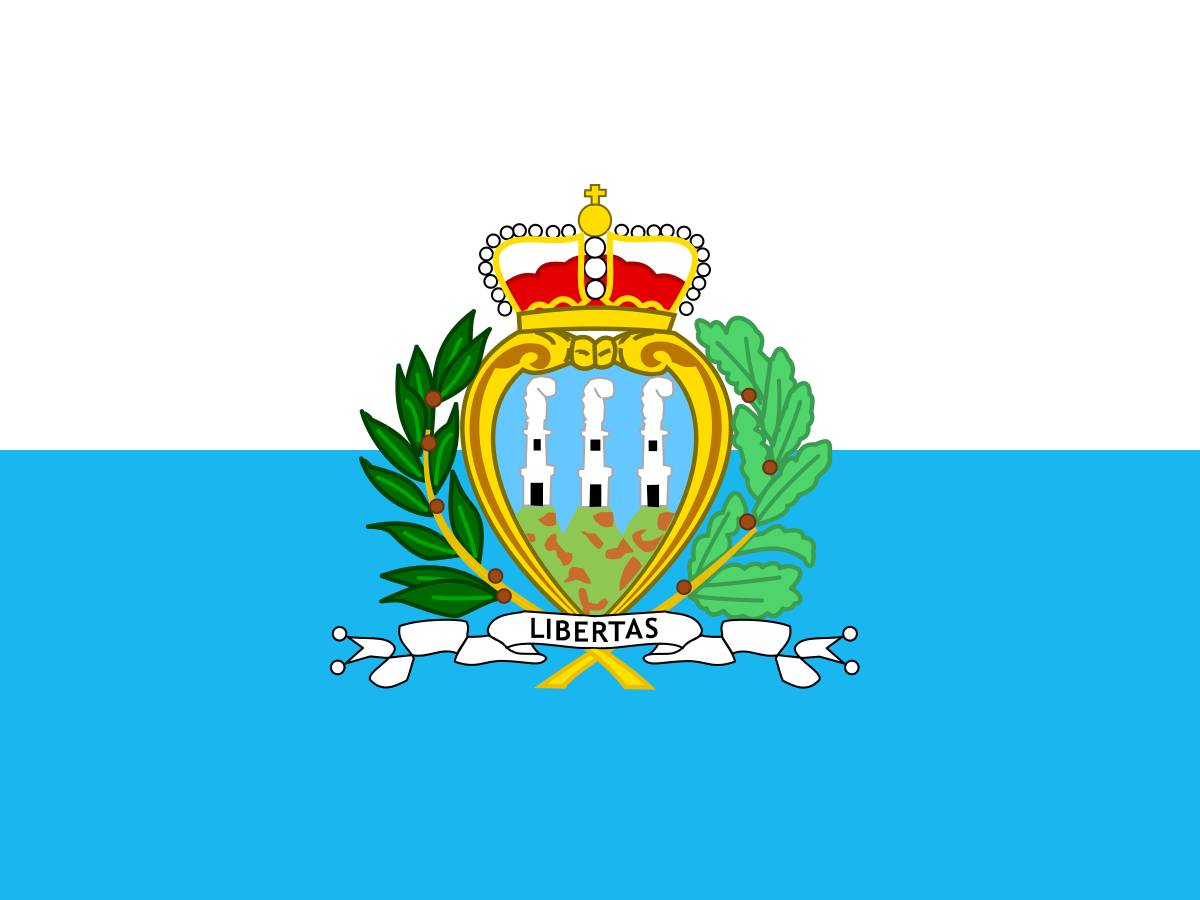
San Marino's flag has two equal horizontal bands: white above light blue. The state flag places the national coat of arms in the centre, while the civil version omits the arms.
The coat of arms shows the three towers of San Marino on Monte Titano, with a crown above and oak and laurel branches around the shield.
White
The white half is traditionally associated with peace and purity, complementing the blue of the country's flag.
Light blue
The light blue half represents the sky and is strongly associated with San Marino's identity and its long tradition of freedom.
The coat of arms
The central coat of arms contains a shield showing the three towers of San Marino — Guaita, Cesta and Montale — on Monte Titano. The shield is surrounded by a wreath of oak and laurel and topped by a crown.
The three towers
The three towers are the most recognisable symbols of San Marino. Guaita, Cesta and Montale stand along Monte Titano and are reminders of the republic's medieval defensive system.
The motto — Libertas
The coat of arms bears the Latin word “Libertas”, meaning “Liberty”. The motto reflects the importance of independence and self-government in San Marino's national identity.
The crown
The crown above the shield represents the sovereignty of the republic. San Marino is a republic, not a monarchy, so the crown is a heraldic symbol of sovereign authority rather than a royal throne.
A short history
San Marino traditionally traces its foundation to 301 AD, when Marinus, a Christian stonemason from the island of Rab, is said to have established a religious community on Monte Titano.
While the traditional foundation story is much older than the surviving documentary record, San Marino developed durable institutions during the medieval period and successfully preserved its independence through major European political changes.
History timeline
301 AD — Traditional foundationAccording to tradition, Marinus established a Christian community on Monte Titano.
885 — Early documentary evidenceMedieval documents provide evidence of an established community and its property on Monte Titano.
11th–13th centuries — Institutions developSan Marino gradually developed political institutions and expanded its territory around Monte Titano.
1243 — Captains RegentThe institution of the two Captains Regent appears in the historical record. Two people continue to serve jointly as heads of state today.
1463 — Territorial expansionSan Marino acquired Fiorentino, Montegiardino and Serravalle following conflict with Sigismondo Pandolfo Malatesta.
1600 — Constitutional statutesA major body of statutes helped formalise the republic's political system.
1797 — Napoleon recognises San MarinoNapoleon's forces did not annex the republic, helping it preserve its independence during the upheavals of the period.
1815 — Congress of ViennaSan Marino's independence survived the settlement following the Napoleonic Wars.
1849 — Garibaldi refugeGiuseppe Garibaldi and his followers found refuge in San Marino during the Italian unification struggle.
1862 — Treaty with ItalySan Marino formalised relations with the newly unified Kingdom of Italy while retaining its independence.
1944 — Second World WarAlthough neutral, San Marino was affected by the fighting in Italy and sheltered large numbers of displaced civilians.
1988 — Council of EuropeSan Marino joined the Council of Europe.
1992 — United NationsSan Marino became a member of the United Nations.
2008 — UNESCO World HeritageThe historic centre of San Marino and Monte Titano were inscribed as a UNESCO World Heritage Site.
TodaySan Marino remains an independent parliamentary republic with a distinctive constitutional system and close economic links to Italy.
San Marino city
The capital, San Marino, is a medieval hilltop city built around Monte Titano. Its narrow streets, stone buildings, viewpoints and fortifications make it the country's main cultural and tourism centre.
Monte Titano
Monte Titano is San Marino's highest mountain at about 739 metres. Its three summits carry the famous towers and dominate the country's skyline.
Guaita
Guaita is the oldest and most famous of the three towers. Its foundations date back to the medieval period and it was used for defence and, at various times, as a prison.
Cesta
Cesta, also known as Fratta, stands on the highest point of Monte Titano. It contains a museum of ancient weapons and offers extensive views across the surrounding Italian countryside.
Montale
Montale is the smallest of the three towers. It occupies a strategic position on Monte Titano and forms an important part of San Marino's historic skyline.
Climate
San Marino has a temperate climate with Mediterranean influences. Summers are generally warm and winters cooler, with temperatures affected by the country's elevation.
Landscape and nature
Despite its tiny area, San Marino contains wooded slopes, farmland, valleys and rocky hilltops. Monte Titano provides views across Emilia-Romagna and towards the Adriatic coast.
Wildlife
Woodland, agricultural land and protected green spaces provide habitats for birds, small mammals, reptiles and insects. San Marino's natural environment is closely connected with the surrounding Italian landscape.
The economy
San Marino's economy is based mainly on services, tourism, manufacturing, finance and commerce. Its location inside Italy gives it close economic links with the surrounding region.
Tourism
Tourism is a major part of the economy. Visitors come for the historic centre, three towers, museums, medieval streets, panoramic views and shopping, as well as the novelty of visiting one of Europe's smallest countries.
UNESCO World Heritage
The historic centre of San Marino and Monte Titano were inscribed as a UNESCO World Heritage Site in 2008. The site recognises the exceptional survival of the republic's historic institutions and fortified landscape.
Sammarinese culture
San Marino's culture is closely connected to neighbouring Italy while retaining a distinct national identity built around its republican history. Civic traditions, historic ceremonies and local festivals remain important.
Language
Italian is the official language. Local Romagnol speech traditions have also influenced the cultural identity of the Sammarinese people.
Food
Sammarinese cuisine is closely related to central and northern Italian cooking. Local specialities include torta tre monti, pasta, breads, meats, cheeses and traditional regional desserts.
Torta Tre Monti
Torta Tre Monti means “Cake of the Three Mountains” and is a famous San Marino speciality. Its name refers to the three towers of Monte Titano.
National day
San Marino celebrates the Feast of Saint Marinus on 3 September. The day honours the country's patron saint and traditional founder and is marked by public ceremonies and celebrations.
The Captains Regent
Two Captains Regent serve jointly as San Marino's heads of state. Each pair serves for only six months, making the system one of the world's most unusual examples of shared executive office.
One of the world's oldest republics
San Marino is widely described as the world's oldest surviving sovereign state and oldest existing republic, based on its traditional foundation date and continuity of its institutions. Historians distinguish the 301 AD tradition from the later documentary evidence, but the republic's exceptional longevity is not in doubt.
Garibaldi and San Marino
During the Italian unification movement, Giuseppe Garibaldi and his followers found refuge in San Marino in 1849. The episode became part of the republic's story of neutrality and hospitality.
Second World War
San Marino maintained neutrality during the Second World War, but its position inside Italy meant the country was affected by the conflict. It sheltered many civilians displaced by fighting in the surrounding region.
Why did San Marino survive?
Its survival is a combination of diplomacy, geography, political institutions and careful relations with larger neighbours. San Marino repeatedly preserved its autonomy through periods when surrounding territories were absorbed into larger states.
Why is this flag interesting?
San Marino's flag combines a very simple blue-and-white design with a detailed coat of arms packed with national symbolism: the three towers, Monte Titano, the crown, the oak and laurel wreath and the motto Libertas.
Explore San Marino on FlagAtlas
Keep exploring flags and educational resources without relying on unconfirmed country-specific links.