About Serbia
Serbia is a landlocked country in the Balkans of southeastern Europe. It lies at the crossroads of Central and Southeast Europe and is shaped by the Danube, Sava and Morava river systems.
Modern Serbia has a long history connecting the medieval Serbian state, the Ottoman and Habsburg worlds, Yugoslavia and the present-day Serbian republic.
CapitalBelgrade
RegionSoutheastern Europe
PopulationAbout 6.6 million
CurrencySerbian dinar
Official languageSerbian
Modern republic2006
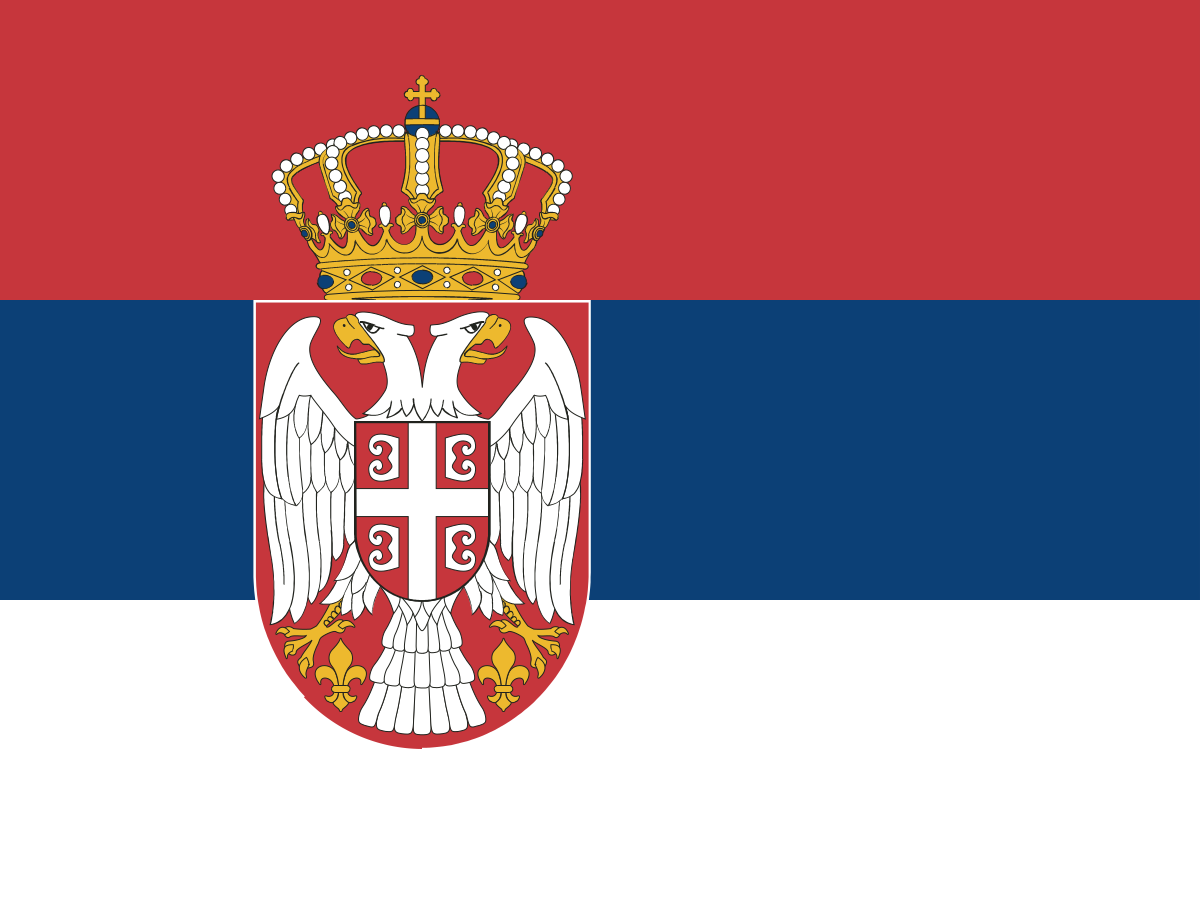
The Serbia flag
The Serbian flag has three horizontal bands: red, blue and white. The national coat of arms appears towards the hoist, overlapping the three colours.
The coat of arms includes the Serbian double-headed eagle and the shield of the medieval Nemanjić dynasty. The shield contains a white cross with four firesteels, while the royal crown appears above.
Red, blue and white
Red, blue and white are the traditional colours of the Serbian tricolour and are also associated with the wider Slavic tricolour tradition that developed during the 19th century. The colours have remained closely tied to Serbian national identity.
The Serbian coat of arms
The coat of arms is dominated by the white double-headed eagle, a historic symbol of the Serbian state and Byzantine tradition. On its chest is a shield bearing a white cross and four firesteels, with a royal crown above.
The four firesteels
The four stylised shapes around the cross are traditionally called firesteels. They are often popularly read as four Cyrillic Cs, but their heraldic history is more complex. Together with the cross, they are among Serbia's best-known symbols.
The double-headed eagle
The double-headed eagle has deep medieval roots in Serbian heraldry and reflects connections with Byzantine imperial symbolism. It became an enduring emblem of Serbian sovereignty.
The royal crown
The crown on the coat of arms reflects Serbia's historical monarchy. Although Serbia is now a republic, the crown remains part of its official heraldry and connects the modern state with its royal past.
A short history
Serbian history stretches from medieval principalities and kingdoms through Ottoman rule, the restoration of Serbian statehood, the Kingdom of Yugoslavia, socialist Yugoslavia and the modern republic.
The modern Republic of Serbia emerged as an independent state in 2006 following the dissolution of the State Union of Serbia and Montenegro.
History timeline
7th century — Slavic settlementSouth Slavic groups settled across the Balkans, laying foundations for later Serbian political communities.
9th century — ChristianisationChristianity spread among the Slavic peoples of the region and Byzantine cultural influence became important.
12th century — Nemanjić dynastyStefan Nemanja established the foundations of the powerful medieval Serbian state.
1219 — Serbian Orthodox ChurchSaint Sava secured the autocephaly of the Serbian Church and became one of the most important figures in Serbian religious and cultural history.
1346 — Serbian EmpireStefan Dušan was crowned emperor and Serbia reached the height of its medieval territorial power.
1389 — Battle of KosovoThe Battle of Kosovo became a foundational event in Serbian historical memory and later national culture.
1459 — Ottoman conquestThe medieval Serbian Despotate was conquered and much of Serbia came under Ottoman rule.
1804 — First Serbian UprisingThe uprising against Ottoman rule began a long process leading towards restored Serbian autonomy.
1815 — Second Serbian UprisingA second uprising led to increasing Serbian autonomy under Miloš Obrenović.
1878 — Independence recognisedThe Congress of Berlin formally recognised Serbia as an independent state.
1882 — Kingdom of SerbiaSerbia became a kingdom under Milan I.
1918 — New South Slavic kingdomAfter the First World War, Serbia became part of the Kingdom of Serbs, Croats and Slovenes, later known as Yugoslavia.
1945 — Socialist YugoslaviaAfter the Second World War, Serbia became one of the constituent republics of socialist Yugoslavia.
1990s — Yugoslav warsThe breakup of Yugoslavia brought conflict and major political and economic upheaval across the region.
1999 — NATO bombingNATO conducted an air campaign against the Federal Republic of Yugoslavia during the Kosovo conflict.
2003 — State UnionThe Federal Republic of Yugoslavia was replaced by the State Union of Serbia and Montenegro.
2006 — Independent SerbiaFollowing Montenegro's independence referendum, Serbia became an independent sovereign state.
2008 — Kosovo declares independenceKosovo declared independence from Serbia. Serbia does not recognise Kosovo's independence and its status remains internationally disputed.
TodaySerbia is a parliamentary republic and an EU candidate country with strong economic and cultural links across Europe and the Balkans.
Belgrade
Belgrade is Serbia's capital and largest city. It stands where the Sava meets the Danube and has been strategically important for centuries. Belgrade Fortress and Kalemegdan Park overlook the rivers.
Novi Sad
Novi Sad is Serbia's second-largest city and the capital of Vojvodina. Petrovaradin Fortress overlooks the Danube and the city hosts the EXIT music festival.
Niš
Niš is one of Serbia's oldest cities and an important Balkan crossroads. It was the birthplace of the Roman emperor Constantine the Great.
The Danube and Sava
The Danube and Sava meet at Belgrade. The rivers are important for transport, trade, tourism, fishing and ecosystems.
Mountains and national parks
Serbia has varied landscapes including mountains, forests, river valleys and fertile plains. National parks include Tara, Đerdap, Kopaonik and Fruška Gora.
Climate
Serbia has a mostly continental climate, with warm summers and cold winters. Mountain areas are cooler and receive more snow.
Wildlife
Serbia's forests and rivers support wolves, brown bears, lynx, deer, wild boar, otters and many bird species. Protected areas are important for conserving Balkan habitats.
Đerdap National Park
Đerdap National Park follows the Danube near the Iron Gates gorge. It combines dramatic river scenery, forests, archaeological sites and important wildlife habitats.
Tara National Park
Tara National Park is known for forests, mountain landscapes and the rare Serbian spruce, a species with a restricted natural range in the Balkans.
The Serbian economy
Serbia has a diversified economy based on manufacturing, services, agriculture, information technology, energy and trade. Its position makes it an important transport link between central Europe and the Balkans.
Agriculture
The fertile Vojvodina plain is Serbia's main agricultural region. Important products include wheat, maize, sunflower, sugar beet, fruit and vegetables.
Technology and IT
Serbia has a growing technology and software sector, particularly in Belgrade and Novi Sad. IT services and technology exports have become increasingly important.
Culture
Serbian culture has been shaped by Orthodox Christianity, Slavic traditions, Ottoman and Central European influences. Music, literature, food, festivals and family traditions remain important.
Serbian Orthodox Christianity
The Serbian Orthodox Church has played a major role in Serbian history and identity. Medieval monasteries such as Studenica and Žiča preserve important religious and artistic heritage.
Serbian language
Serbian is the official language. Both Cyrillic and Latin scripts are widely used, with Serbian Cyrillic constitutionally recognised as the official script.
Vuk Karadžić and the alphabet
Vuk Karadžić led major 19th-century reforms of Serbian written language and Cyrillic. His principle of closely matching spelling to pronunciation helped shape modern Serbian literacy.
Food
Serbian cuisine reflects Balkan, Ottoman, Central European and Mediterranean influences. Popular dishes include ćevapi, pljeskavica, sarma, ajvar, kajmak and gibanica.
Ajvar
Ajvar is a roasted red pepper relish popular throughout the Balkans. It is commonly served with bread, grilled meat and cheese.
Rakija
Rakija is a traditional fruit brandy made from plums, grapes, apricots or other fruit. In Serbia it is closely associated with hospitality and celebrations.
Sport
Serbia has a strong sporting tradition. Basketball, football, tennis, volleyball and water polo are particularly popular, with Serbian athletes achieving major international success.
Nikola Tesla
Nikola Tesla was born in 1856 in Smiljan, then part of the Austrian Empire, to a Serbian family. He became one of history's most influential electrical engineers and inventors.
UNESCO heritage
Serbia has UNESCO World Heritage sites including Studenica Monastery, Gamzigrad-Romuliana, Stari Ras and Sopoćani, as well as the medieval tombstone sites known as stećci shared with neighbouring countries.
Kosovo and Serbia
Kosovo is a politically sensitive and internationally disputed issue. Kosovo declared independence in 2008; Serbia does not recognise it as an independent state. Recognition varies internationally.
European Union
Serbia is an EU candidate country and has been negotiating accession. Its relationship with the EU is a major part of its foreign policy, alongside relationships with Russia, China and neighbouring Balkan states.
Why is Serbia's flag interesting?
Serbia's flag combines a classic red-blue-white Slavic tricolour with a detailed medieval-inspired coat of arms. The double-headed eagle, cross, firesteels and crown connect the modern republic to centuries of Serbian state and religious history.
Explore Serbia on FlagAtlas
Keep exploring flags and educational resources.
Sources & further reading
The supplied FlagAtlas Serbia page has been retained as the base, including its existing flag image, emoji copier, colouring link and navigation, with additional educational content about the flag, history, geography, culture and economy.
Government of Serbia · Encyclopaedia Britannica · UNESCO World Heritage