About Seychelles
Seychelles is an island country in the western Indian Ocean, northeast of Madagascar and east of mainland Africa. It is made up of around 115 islands, with the largest population and most activity concentrated around Mahé, Praslin and La Digue.
The country is famous for granite islands, coral reefs, tropical forests, beaches and unusually rich endemic wildlife.
CapitalVictoria
RegionIndian Ocean / Africa
PopulationAbout 100,000
CurrencySeychellois rupee
Official languagesEnglish, French, Seychellois Creole
Independence1976
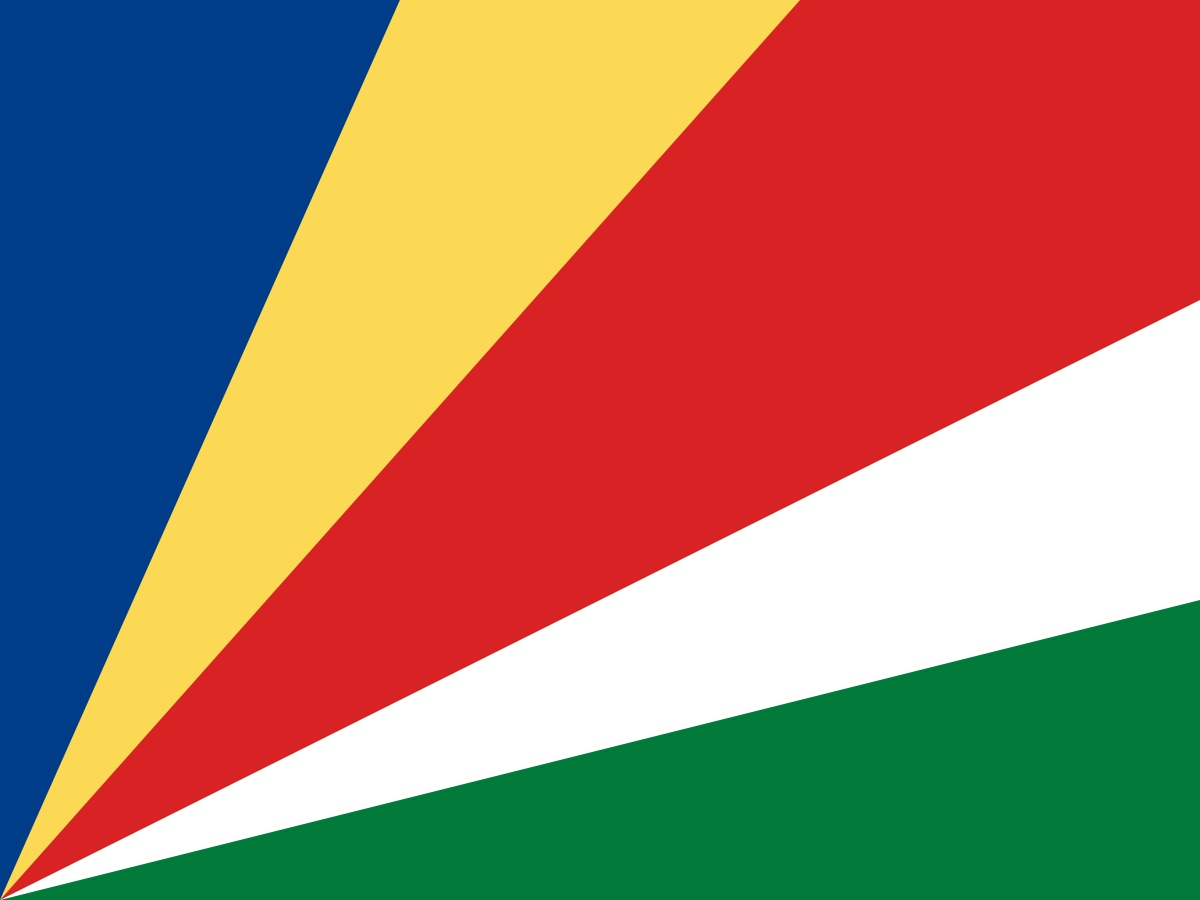
The Seychelles flag
The current Seychelles flag was adopted on 18 June 1996. Five coloured bands radiate diagonally from the lower hoist corner, creating one of the world's most distinctive national flags.
The colours are blue, yellow, red, white and green. The design is dynamic rather than based on horizontal or vertical stripes, symbolising movement and the country's future.
Blue
The blue section represents the sky and the sea surrounding Seychelles. For an island nation, the ocean is central to geography, culture, transport, fishing and tourism.
Yellow
The yellow section represents the sun. Seychelles lies close to the equator, and sunlight is an important part of the country's tropical environment and international image.
Red
The red section represents the people and their determination to work together for the future of Seychelles.
White
The white section represents social justice and harmony. It is one of the colours that gives the flag its balanced, radiating appearance.
Green
The green section represents the land and natural environment of Seychelles, including its forests and vegetation.
The five rays
The five rays are a defining feature of the Seychelles flag. They spread out from the lower hoist corner and are commonly explained through the five colours and their symbolism. The flag's design was created by artist Ludwig Shakos and was adopted in 1996.
Why the flag looks unusual
Unlike most national flags, Seychelles does not use simple horizontal or vertical bands. Its rays create a sense of movement, energy and forward progress, making it immediately recognisable among world flags.
A short history
Seychelles was uninhabited when European explorers reached the islands. France claimed the islands in the 18th century, and Britain took control during the Napoleonic Wars. Seychelles later developed as a British colony before gaining independence in 1976.
The country became a republic within the Commonwealth and has since developed a political and economic system strongly influenced by its small-island geography.
History timeline
Pre-European period — uninhabited islandsUnlike many Indian Ocean islands, Seychelles had no permanent indigenous population before European settlement, although sailors and traders knew of the islands.
1500s — Portuguese sailorsPortuguese navigators recorded the islands during voyages across the Indian Ocean.
1742 — French explorationFrench expeditions investigated the islands and began the process that led to permanent French settlement.
1753 — French claimFrance formally claimed the islands and named them Seychelles after Jean Moreau de Séchelles, a French finance minister.
1770 — Permanent settlementFrench settlers established a permanent community on Mahé, bringing plantation agriculture to the islands.
1814 — British controlFollowing the Napoleonic Wars, Britain gained control of Seychelles under the Treaty of Paris.
1903 — Crown colonySeychelles became a separate British Crown Colony rather than being administered as part of Mauritius.
1964 — Political parties emergeThe Seychelles People's United Party and Seychelles Democratic Party became important forces in the movement towards self-government.
1976 — IndependenceSeychelles became independent from Britain on 29 June 1976 and joined the Commonwealth.
1977 — Government changesA coup brought France-Albert René to power, beginning a long period of one-party rule.
1993 — Multi-party constitutionSeychelles returned to multi-party politics and adopted a new constitution following political reforms.
1996 — Current flag adoptedThe modern five-colour radiating flag replaced the previous national design.
2004 — Indian Ocean tsunamiThe tsunami generated by the Indian Ocean earthquake reached Seychelles, affecting coastal areas and infrastructure.
2004 — President James MichelJames Michel succeeded France-Albert René as president.
2016 — Political changeDanny Faure became president after James Michel resigned.
2020 — Opposition victoryWavel Ramkalawan won the presidential election, ending the Seychelles People's Party's long period in government.
TodaySeychelles remains a small island republic whose economy depends heavily on tourism, fisheries and services, while conservation plays a major role in national policy.
Mahé
Mahé is the largest island and the political and economic centre of Seychelles. Most of the population lives here, and Victoria is located on its north-eastern coast.
Victoria
Victoria is the capital of Seychelles and one of the world's smallest national capitals. It is the main administrative, commercial and transport centre of the country.
Praslin
Praslin is the second-largest island. It is famous for Vallée de Mai, a UNESCO World Heritage Site and home of the extraordinary coco de mer palm.
La Digue
La Digue is known for its beaches, granite boulders, bicycles and relatively relaxed pace of life. Anse Source d'Argent is one of its most photographed locations.
The Seychelles islands
The islands are broadly divided into granite Inner Islands and more distant coral islands. The granite islands are relatively mountainous, while many outer islands are low-lying coral formations.
Climate
Seychelles has a tropical maritime climate with warm temperatures throughout the year. Rainfall varies by season and location, while the trade winds influence weather and sea conditions.
Granite mountains
The larger inner islands contain dramatic granite mountains and forested slopes. Mahé's Morne Seychellois is the highest point in Seychelles, rising to about 905 metres.
Vallée de Mai
Vallée de Mai on Praslin is a UNESCO World Heritage Site. Its palm forest is famous for the coco de mer, whose enormous seeds are among the largest in the plant kingdom.
Coco de mer
The coco de mer palm is endemic to Seychelles and has one of the largest seeds of any plant. It grows naturally on Praslin and nearby Curieuse and has become one of the country's most famous natural symbols.
Aldabra Atoll
Aldabra Atoll is one of the world's largest raised coral atolls and a UNESCO World Heritage Site. Its isolation has helped preserve extraordinary ecosystems and a huge population of giant tortoises.
Giant tortoises
Seychelles is famous for its Aldabra giant tortoise. The species can live for well over a century and is one of the most important symbols of the islands' unique wildlife.
Birdlife
Seychelles has many endemic birds, including the Seychelles black parrot, Seychelles magpie-robin and Seychelles warbler. Conservation programmes have helped several species recover from very low historical populations.
Marine life
The waters around Seychelles support coral reefs, sea turtles, rays, sharks and many tropical fish. Marine conservation is particularly important because the ocean is central to both biodiversity and the economy.
Economy
Seychelles has one of Africa's highest levels of income per person. The economy depends heavily on tourism, fisheries and services, with environmental conservation closely linked to long-term economic planning.
Tourism
Tourism is one of the country's most important industries. Visitors are attracted by beaches, diving, sailing, hiking, wildlife and island landscapes.
Fishing
Fishing, especially tuna fishing, is an important part of the Seychelles economy. The country's position in the western Indian Ocean gives it access to rich offshore fishing grounds.
Blue economy
Seychelles has promoted the idea of a blue economy, using marine resources for economic development while trying to protect ocean ecosystems. Marine spatial planning and conservation are important parts of this approach.
Culture
Seychellois culture is strongly influenced by African, French, British, Indian and other Indian Ocean traditions. This mixture is reflected in food, music, language and festivals.
Seychellois Creole
Seychellois Creole, also called Kreol Seselwa, is widely spoken and is one of the country's three official languages alongside English and French.
Music and dance
Traditional moutya is a major cultural expression, historically associated with African and Malagasy influences. It became recognised by UNESCO as Intangible Cultural Heritage in 2021.
Food
Seychellois food combines seafood, coconut, spices, rice and tropical fruit with influences from African, French, Indian and other cuisines. Fish and octopus are particularly important.
Religion
Christianity, particularly Roman Catholicism, has historically been the largest religious tradition in Seychelles. Other Christian denominations, Hinduism, Islam and other beliefs are also represented.
Environmental protection
Seychelles has a strong international reputation for marine and terrestrial conservation. Protected areas cover substantial parts of the country's land and ocean, reflecting the importance of its biodiversity.
Seychelles and climate change
As a low-lying island nation, Seychelles is vulnerable to sea-level rise, coral bleaching, coastal erosion and changing ocean conditions. Climate adaptation and marine conservation are therefore important national issues.
Why is Seychelles' flag interesting?
The Seychelles flag is unusual because its five coloured rays fan out from the lower hoist corner rather than forming conventional stripes. Its blue, yellow, red, white and green colours combine the sea, sun, people, harmony and land into a compact national design.
Explore Seychelles on FlagAtlas
Keep exploring flags and educational resources.
Sources & further reading
The supplied FlagAtlas Seychelles page has been retained as the base, including its existing flag image, emoji copier, colouring link and navigation, with additional educational content about the flag, history, geography, wildlife, culture and economy.
Government of Seychelles · Encyclopaedia Britannica · UNESCO World Heritage