About Slovakia
Slovakia is a landlocked country in Central Europe, bordered by Czechia, Austria, Hungary, Ukraine and Poland. Its landscape ranges from the Danube lowlands to the dramatic High Tatras.
Slovakia became an independent state on 1 January 1993 following the peaceful dissolution of Czechoslovakia. It is a member of the European Union, NATO and the euro area.
CapitalBratislava
RegionCentral Europe
PopulationAbout 5.4 million
CurrencyEuro (€)
Official languageSlovak
Independence1993
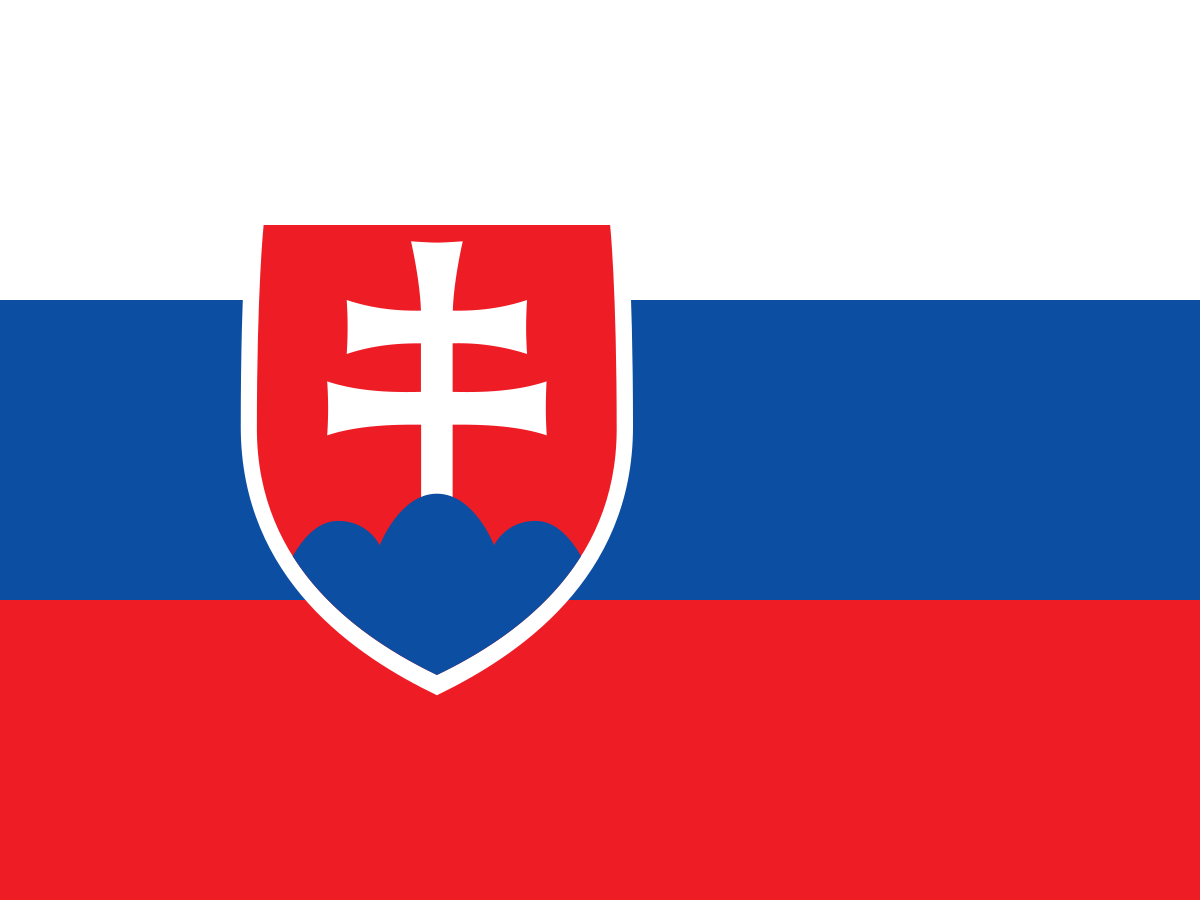
The Slovakia flag
The Slovak flag consists of three equal horizontal bands: white, blue and red. The Slovak coat of arms is placed towards the hoist.
The modern state flag was officially introduced on 1 January 1993, although the white, blue and red colours have roots in Slovak national symbolism dating back to the 19th century. citeturn0search0turn0search4
White, blue and red
The white, blue and red combination is associated with the Pan-Slavic colours, a tradition shared by several Slavic peoples. Slovakia's government notes that the current flag's colours have historical roots going back to 1848. citeturn0search0
The coat of arms
The coat of arms is a red early-Gothic shield bearing a silver double cross on a blue three-peaked mountain. It is the most distinctive feature separating the Slovak flag from other white-blue-red flags. citeturn0search1turn0search4
The double cross
The double cross is associated with Christianity and with the tradition of Saints Cyril and Methodius, who brought Christianity to Great Moravia in the 9th century. Slovakia's government identifies this as an important part of the coat of arms' symbolism. citeturn0search1
The three hills
The blue three hills are traditionally identified with the Tatras, Fatra and Mátra mountain ranges. The Mátra range is now in Hungary, but all three have historical connections with Slovak symbolism. citeturn0search1
Why Slovakia needs the coat of arms
At first glance, Slovakia's white-blue-red colours can look similar to the flags of Russia and Slovenia. The coat of arms makes the Slovak flag immediately distinguishable and is deliberately positioned towards the hoist. The official legal specification gives the flag a 2:3 aspect ratio. citeturn0search0turn0search4
A short history
The territory of modern Slovakia has been shaped by Celtic, Roman, Slavic, Great Moravian and Hungarian history. For centuries, Slovak lands were part of the Kingdom of Hungary and later the Habsburg and Austro-Hungarian realms.
In 1918 Slovakia became part of Czechoslovakia. After the Second World War and the communist period, Czechoslovakia became a federal state before peacefully separating into Czechia and Slovakia in 1993.
History timeline
9th century — Great MoraviaThe territory became an important part of Great Moravia. Saints Cyril and Methodius arrived in 863 and played a major role in Christianisation and Slavic literacy.
10th–11th centuries — Hungarian KingdomSlovak territories became part of the Kingdom of Hungary and remained connected to it for centuries.
1526 — Habsburg ruleFollowing the Battle of Mohács, much of the Kingdom of Hungary came under Habsburg rule, linking Slovak lands closely with the Habsburg monarchy.
1780s–1840s — Slovak national revivalIntellectuals increasingly promoted Slovak language, literature and national identity.
1848 — National coloursWhite, blue and red became established as Slovak national colours during the revolutionary period.
1863 — Matica slovenskáThe Slovak cultural institution Matica slovenská was founded to support Slovak language, education and cultural life.
1918 — CzechoslovakiaAfter the First World War, Slovakia joined the newly created Czechoslovak state.
1939–1945 — Slovak Republic and warA separate Slovak state existed during the Second World War under a regime allied with Nazi Germany.
1945 — Return to CzechoslovakiaAfter the Second World War, Slovakia was again part of Czechoslovakia.
1948 — Communist ruleCzechoslovakia became a communist state, beginning four decades of one-party rule.
1968 — Prague Spring and federationReform efforts known as the Prague Spring were suppressed by Warsaw Pact forces. Czechoslovakia subsequently became a federation of the Czech and Slovak republics.
1989 — Velvet RevolutionMass protests brought an end to communist rule in Czechoslovakia.
1993 — IndependenceThe peaceful dissolution of Czechoslovakia created the independent Slovak Republic on 1 January 1993.
2004 — European Union and NATOSlovakia joined both the European Union and NATO.
2009 — Euro adoptedSlovakia adopted the euro, becoming the second former Czechoslovak country to use the currency.
TodaySlovakia is a parliamentary democratic republic with a diversified European economy and a strong manufacturing base.
Bratislava
Bratislava is Slovakia's capital and largest city. It sits on the Danube close to the borders with Austria and Hungary, making it one of Europe's most geographically connected capitals.
Bratislava Castle
Bratislava Castle overlooks the Danube and the historic centre. The hill has been strategically important for centuries and the castle is one of Slovakia's best-known landmarks.
The Danube
The Danube flows through Bratislava and forms an important transport and economic corridor. Slovakia is one of the countries through which Europe's second-longest river passes.
The High Tatras
The High Tatras are Slovakia's most famous mountain range. They contain alpine peaks, mountain lakes, forests and popular hiking and winter-sports destinations.
Gerlachovský štít
Gerlachovský štít is the highest mountain in Slovakia and the entire Carpathian mountain system, rising to 2,655 metres.
National parks
Slovakia has several protected mountain and forest areas, including Tatra National Park, Slovak Paradise, Low Tatras and Mala Fatra. These landscapes support diverse wildlife and extensive hiking networks.
Wildlife
Slovakia's forests and mountains support brown bears, wolves, lynx, chamois, red deer and golden eagles. The country's large protected areas are important refuges for Central European wildlife.
Caves
Slovakia is famous for its extensive karst caves. Several are protected as part of the UNESCO World Heritage site covering the Caves of Aggtelek Karst and Slovak Karst.
Climate
Slovakia has a temperate continental climate, with warm summers and cold winters. Mountain areas are cooler and receive considerably more snow than the lowlands.
Economy
Slovakia has a developed, export-oriented economy. Important sectors include automotive manufacturing, electronics, engineering, chemicals, IT and services.
Automotive industry
Slovakia has become a major European centre for car manufacturing. Large plants operated by international manufacturers have made the automotive sector one of the country's most important industrial employers and exporters.
Industry and engineering
Engineering and advanced manufacturing are central to Slovakia's industrial base. The country has strong links with European supply chains, particularly in machinery, electronics and transport equipment.
Tourism
Tourism is driven by mountains, castles, historic towns, caves, spas and winter sports. The High Tatras and Bratislava are particularly popular destinations.
Castles
Slovakia has an unusually high concentration of castles, fortresses and manor houses. Spiš Castle, one of the country's most famous ruins, is part of a UNESCO World Heritage site.
Culture
Slovak culture combines Central European traditions with a strong rural and mountain heritage. Folk costumes, music, dance, crafts and festivals remain important parts of national identity.
Slovak language
Slovak is a West Slavic language closely related to Czech, Polish and other Slavic languages. It uses the Latin alphabet with additional diacritics.
Food
Traditional Slovak food includes bryndzové halušky, potato dumplings served with sheep's cheese and bacon, as well as soups, cabbage dishes, sausages and hearty mountain cuisine.
Bryndza
Bryndza is a traditional Slovak sheep's cheese and one of the country's best-known foods. It is strongly associated with Slovak cuisine and is central to bryndzové halušky.
Folk traditions
Slovakia has a rich tradition of folk music, dance, embroidery, wood carving and regional festivals. Many traditions differ significantly between mountain and lowland regions.
Religion
Christianity has historically been highly influential in Slovakia, with Roman Catholicism the largest tradition. Protestant and Greek Catholic communities are also significant, alongside people with no religious affiliation.
Education and science
Slovakia has universities and research institutions in cities including Bratislava, Košice, Žilina and Banská Bystrica. Its technical universities contribute to engineering and industrial research.
European Union
Slovakia joined the European Union in 2004 and has been part of the Schengen Area since 2007. It adopted the euro in 2009. citeturn0search0
National anthem
Slovakia's national anthem is Nad Tatrou sa blýska ('Lightning Over the Tatras'). Its words were written by Janko Matúška in the 19th century and the song became an important symbol of Slovak national identity.
Why is Slovakia's flag interesting?
The Slovak flag looks deceptively simple because of its white, blue and red bands, but the double cross and three hills give it a distinctive national identity. The coat of arms also connects modern Slovakia with Christianity, Great Moravia and the country's mountain heritage. citeturn0search1turn0search2
Explore Slovakia on FlagAtlas
Keep exploring flags and educational resources.
Sources & further reading
The supplied FlagAtlas Slovakia page has been retained as the base, including its existing flag image, emoji copier, colouring link and navigation. The flag and coat-of-arms details above have also been checked against official Slovak government and legal sources. citeturn0search0turn0search1turn0search4
Government of Slovakia · Slov-Lex · UNESCO World Heritage